


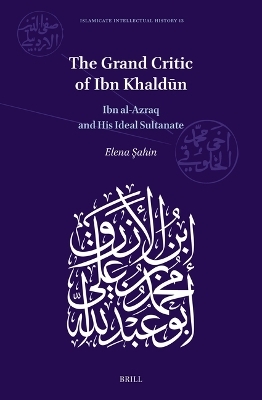
The Grand Critic of Ibn Khaldūn
Brill (Verlag)
9789004525030 (ISBN)
Ibn al-Azraq (d. 896/1491) was a renowned Andalusian jurist (faqīh) and statesman who lived during the final period of the Nasrid emirate of Granada. His most famous work, Badāʾiʿ al-Silk fī Ṭabāʾiʿ al-Mulk (Unprecedented Lines about the Nature of Political Rule), is a political treatise that builds upon Ibn Khaldūn’s (d. 808/1406) social theory (Ꜥilm al-Ꜥumrān). In The grand critic of Ibn Khaldūn Elena Şahin critically analyses the major aspects of Ibn al-Azraq’s political thought.
In this contribution on the field of the history of Islamic political thought, Elena Şahin demonstrates that while Ibn al-Azraq integrates the thrust of Ibn Khaldūn’s approach, Ibn al-Azraq’s work should be regarded as part of a larger conversation amongst various scholars, engaging, for example with the Andalusian jurist al-Shāṭibī’s (d. 790/1388) theory of Maqāṣid al-Sharīʿa. Widening the analysis of Ibn al-Azraq’s work illuminates that Ibn al-Azraq’s political theory was in opposition to that of Ibn Khaldūn, and thus gives us a better understanding of the dynamic debates within Andalusian political thought.
Elena Şahin, Dr. phil. (2022), is an independent scholar of Islamic political thought receiving her doctorate from the Martin-Luther-University of Halle-Wittenberg, Germany. She held positions in the department of Arabic and Islamic Studies at the Martin-Luther-University of Halle-Wittenberg, was a research fellow at the Orient Institut Beirut and was granted a doctoral fellowship by the Gerda Henkel Stiftung.
Acknowledgments
Introduction
1 Current State of Research
2 The Two Modern Editions and Extant Manuscripts of Badāʾiʿ al-Silk
3 Is Badāʾiʿ al-Silk a Piece of Advice Literature?
4 The Labyrinth of Ibn Khaldūn Research
5 The Cambridge School’s Precepts: A Major Source of Methodological Inspiration
6 Studying Non-Western Political Thought
7 Technical Clarifications
1 BS and the Muqaddima Reception Therein
1 Ibn al-Azraq in the Context of His Time
2 Ibn al-Azraq’s Badāʾiʿ al-Silk—A Theory of State and Statecraft Based on Islamic Normativity (sharʿ)
3 From the Muqaddima to Badāʾiʿ al-Silk fī Ṭabāʾiʿ al-Mulk
2 Cornerstones of Ibn al-Azraq’s Political Theory
1 State Formation and State Disintegration in Ibn al-Azraq’s Political Thought
2 Ibn al-Azraq’s Different Categories of Political Rule
3 Arkān al-mulk (the Pillars of Institutional Rule): The Governmental, Religious, and Military Class as the Guardians of Continuity
3 The Relation between Islamic Normativeness (sharʿ) and Political Rule in Ibn al-Azraq’s Political Thought
1 Ibn al-Azraq’s All-Encompassing Notion of sharʿ with regard to Political Rule and Statecraft
2 Construing an All-Encompassing Notion of sharʿ with regard to Political Rule in Relation to Ibn Khaldūn’s Social Theory
3 Conclusions: Ibn al-Azraq’s BS—Bringing Together al-Shāṭibī’s Theory of maqāṣid al-Sharīʿa and Ibn Khaldūn’s ʿilm al-ʿumrān in a Theory of State and Statecraft
4 Summary and Outlook
Bibliography
Index
| Erscheinungsdatum | 04.01.2025 |
|---|---|
| Reihe/Serie | Islamicate Intellectual History ; 13 |
| Verlagsort | Leiden |
| Sprache | englisch |
| Maße | 155 x 235 mm |
| Gewicht | 458 g |
| Themenwelt | Geisteswissenschaften ► Geschichte ► Regional- / Ländergeschichte |
| Geisteswissenschaften ► Philosophie | |
| Recht / Steuern ► Allgemeines / Lexika | |
| Recht / Steuern ► EU / Internationales Recht | |
| ISBN-13 | 9789004525030 / 9789004525030 |
| Zustand | Neuware |
| Informationen gemäß Produktsicherheitsverordnung (GPSR) | |
| Haben Sie eine Frage zum Produkt? |
aus dem Bereich


