


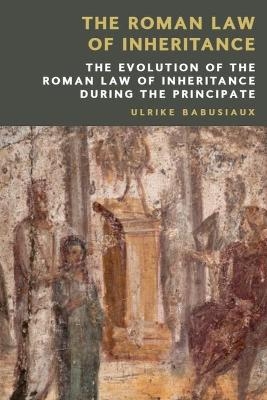
The Roman Law of Inheritance
The Evolution of the Roman Law of Inheritance during the Principate
Seiten
2024
Edinburgh University Press (Verlag)
978-1-3995-3165-8 (ISBN)
Edinburgh University Press (Verlag)
978-1-3995-3165-8 (ISBN)
Traces the evolution of the Roman legal system through a study of the law of inheritance.
Fritz Schulz once famously described the Roman law of inheritance as "labyrinthine" and is deemed to be the most complex part of the Roman legal system. As Rome evolved from a city-state to an imperial power, the rules of inheritance often changed because of the economic importance of acquisition at death. These changes are reflected in the Corpus iuris civilis, despite the best efforts of the compilers of the Corpus to eliminate variations in the text in order to standardise the existing material for the purposes of their compilation.
The Roman Law of Inheritance gives the reader an insight into the content, structure and evolution of Roman inheritance law and provides an understanding of a fundamental part of Roman legal thought. In addition, it tackles the most difficult features of Roman law of inheritance, including the fideicommissa and the interpretation of wills which are explained against the background of historical stratification.
Fritz Schulz once famously described the Roman law of inheritance as "labyrinthine" and is deemed to be the most complex part of the Roman legal system. As Rome evolved from a city-state to an imperial power, the rules of inheritance often changed because of the economic importance of acquisition at death. These changes are reflected in the Corpus iuris civilis, despite the best efforts of the compilers of the Corpus to eliminate variations in the text in order to standardise the existing material for the purposes of their compilation.
The Roman Law of Inheritance gives the reader an insight into the content, structure and evolution of Roman inheritance law and provides an understanding of a fundamental part of Roman legal thought. In addition, it tackles the most difficult features of Roman law of inheritance, including the fideicommissa and the interpretation of wills which are explained against the background of historical stratification.
Ulrike Babusiaux is a Professor at the Faculty of Law at the University of Zurich. Ulrike Babusiaux is a Professor at the Faculty of Law at the University of Zurich.
Preface
Chapter 1 – Introduction
Chapter 2 - The General Historical and Legal framework
Chapter 3 - The Rules of Intestacy
Chapter 4 - The Position of the Heir
Chapter 5 - The Protection of the Position of Heir
Chapter 6 - The Testamentary Order of Succession
Chapter 7 - Protecting Inheritance Expectations and the Rules of Disinheritance
Chapter 8 - The Law of Legacies
Chapter 9 - The Interpretation of Wills
Chapter 10 - Final Conclusions
| Erscheinungsdatum | 06.08.2024 |
|---|---|
| Übersetzer | Neo Christodoulides, Ulrike Babusiaux |
| Zusatzinfo | 42 black and white tables |
| Verlagsort | Edinburgh |
| Sprache | englisch |
| Maße | 156 x 234 mm |
| Themenwelt | Geisteswissenschaften ► Geschichte ► Regional- / Ländergeschichte |
| Geschichte ► Teilgebiete der Geschichte ► Militärgeschichte | |
| Recht / Steuern ► Allgemeines / Lexika | |
| Recht / Steuern ► EU / Internationales Recht | |
| Recht / Steuern ► Privatrecht / Bürgerliches Recht ► Besonderes Schuldrecht | |
| Recht / Steuern ► Rechtsgeschichte | |
| ISBN-10 | 1-3995-3165-4 / 1399531654 |
| ISBN-13 | 978-1-3995-3165-8 / 9781399531658 |
| Zustand | Neuware |
| Informationen gemäß Produktsicherheitsverordnung (GPSR) | |
| Haben Sie eine Frage zum Produkt? |
Mehr entdecken
aus dem Bereich


aus dem Bereich
von der Wiederbewaffnung bis zur Zeitenwende
Buch | Softcover (2025)
C.H.Beck (Verlag)
CHF 16,80
Deutschlands großer Volksaufstand
Buch | Softcover (2024)
Propyläen Verlag
CHF 30,80


