


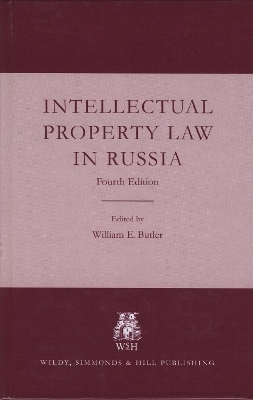
Intellectual Property Law in Russia
Seiten
2005
|
4th Revised edition
Wildy, Simmonds and Hill Publishing (Verlag)
978-1-898029-71-7 (ISBN)
Wildy, Simmonds and Hill Publishing (Verlag)
978-1-898029-71-7 (ISBN)
- Titel nicht im Sortiment
- Artikel merken
Now in its fourth edition, Intellectual Property Law in Russia covers the developing intellectual property laws in the Russian Federation. Russia has begun to adjust its policies towards the protection of intellectual and industrial property. It has begun to adopt its own legislation to replace that of the former Soviet Union. Offices for the filing of applications to protect author’s rights of various kinds have been established. The legislation adopted is expressly directed towards integrating Russia more closely with the market-oriented systems of the West.
Russian and Soviet legal doctrine, just as in many other countries, has been divided as to whether ‘intellectual property’ can truly be said to exist. The term in the Russian language is not ‘property’ at all, but ‘ownership’. To speak of ‘intellectual property’ would be legal nonsense in the strict sense of the words.
In the nineteenth century Russian legislation expressly relegated the rights of authors, inventors, possessors of factory drawings and models to the law of ownership. Soviet legal doctrine avoided the term ’intellectual property’ or ‘ownership’ altogether, it being criticised for, not only it’s inaccuracy but for being bourgeois and exploitative.
The open formulation of the Civil Code makes it possible to extend protection to the results of intellectual activity by enacting new relevant laws without changing the Civil Code itself. Since 1993 Russian legislation has extended by way of individual legislation protection to utility models, computer programs, place names of origin of goods, data bases, neighbouring rights, and commercial secrets but left without protection two foundation stones of Soviet protection policies - discoveries and nationalization proposals.
Russian and Soviet legal doctrine, just as in many other countries, has been divided as to whether ‘intellectual property’ can truly be said to exist. The term in the Russian language is not ‘property’ at all, but ‘ownership’. To speak of ‘intellectual property’ would be legal nonsense in the strict sense of the words.
In the nineteenth century Russian legislation expressly relegated the rights of authors, inventors, possessors of factory drawings and models to the law of ownership. Soviet legal doctrine avoided the term ’intellectual property’ or ‘ownership’ altogether, it being criticised for, not only it’s inaccuracy but for being bourgeois and exploitative.
The open formulation of the Civil Code makes it possible to extend protection to the results of intellectual activity by enacting new relevant laws without changing the Civil Code itself. Since 1993 Russian legislation has extended by way of individual legislation protection to utility models, computer programs, place names of origin of goods, data bases, neighbouring rights, and commercial secrets but left without protection two foundation stones of Soviet protection policies - discoveries and nationalization proposals.
William E. Butler is a pre-eminent authority on the legal systems of Russia, other members of the Commonwealth of Independent States (CIS), and Mongolia. He is also extensively involved in the fields of public and private international law.
Legislative Texts;
General Provisions;
Civil Code of the Russian Federation (1994) [Excerpts';
Criminal Code of the Russian Federation (1996) [Excerpts];
Authors Rights;
Law on Authors and Neighbouring Rights (9 July 1993, as amended 19 July 1995 and 20 July 2004);
| Erscheint lt. Verlag | 31.3.2005 |
|---|---|
| Verlagsort | London |
| Sprache | englisch |
| Maße | 138 x 216 mm |
| Gewicht | 515 g |
| Themenwelt | Recht / Steuern ► EU / Internationales Recht |
| Recht / Steuern ► Wirtschaftsrecht ► Urheberrecht | |
| ISBN-10 | 1-898029-71-7 / 1898029717 |
| ISBN-13 | 978-1-898029-71-7 / 9781898029717 |
| Zustand | Neuware |
| Informationen gemäß Produktsicherheitsverordnung (GPSR) | |
| Haben Sie eine Frage zum Produkt? |
Mehr entdecken
aus dem Bereich

aus dem Bereich
gewerblicher Rechtsschutz, Urheberrecht, Wettbewerbsrecht
Buch | Softcover (2025)
UTB (Verlag)
CHF 82,55


