


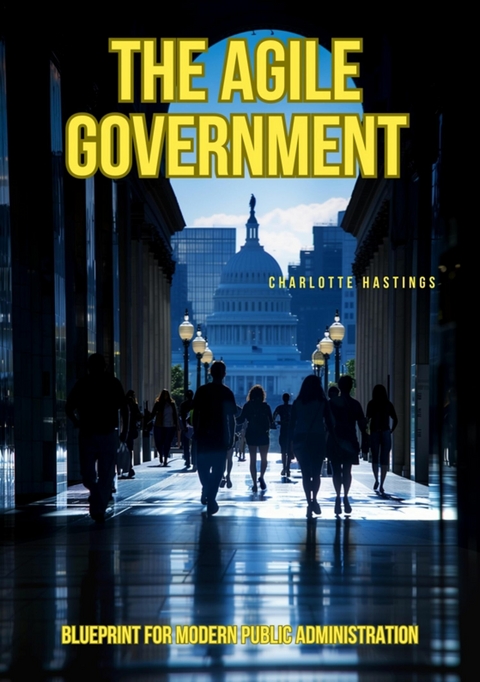
The Agile Government (eBook)
124 Seiten
tredition (Verlag)
978-3-384-15514-6 (ISBN)

I. Introduction to Agile in Public Administration
Understanding Agile Methodologies and Their Relevance to Public Administration
As we navigate through redefining administration and governance models, one approach stands out in a profound way: Agile. Agile has revolutionized the way we perceive project management and software development, but its influence reaches much beyond this scope. This section will invite you on a journey to understanding Agile’s terminologies, its fundamental philosophy, principles, and its potent influence on the software development industry. Get ready to delve into the Agile Manifesto’s birth and evolution, along with detailed case studies of governments’ Agile adoption worldwide. In addition, we will explore paradigm shifts initiated by Agile and the implication of Agile frameworks on policy maintenance, innovation, and revision. We also aim to dwell upon the contrast and comparison between traditional and Agile Project management methods, focusing on their distinct features. This navigation will further lead us to the analysis of the impact of Agile adoption on government projects. Emphasis will also be drawn on understanding the challenges and potential benefits associated with transforming public administration using Agile methodologies. This journey through Agile will not stop at understanding concepts but will also share practical and impactful examples from governments that have used Agile methods for improved service efficiency and increased transparency. Designed to contextualize Agile within the public sector frame, it aims to disrupt and reshape traditional ways of thinking with Agile-oriented perspectives. Buckle up as we debunk misconceptions surrounding Agile, providing insights into essential drivers for adoption, and crucial steps in selecting the right Agile Framework. Welcome to a journey of discovery, discussion, and transformation.
Definition and principles of Agile
Agile, dating back to the 2001 Agile Manifesto, is a flexible project management approach that values adaptability, collaboration, and quick response to change. It emerged as a reaction to traditional “waterfall” methods, which were criticized for being rigid and linear, hindering businesses’ speed and adaptability in a fast-paced environment.
At its core, Agile revolves around four key values:
1. Individual interactions over processes and tools: fostering communication and collaboration rather than dependence on structured protocols.
2. Working software over comprehensive documentation: focusing on delivering functional software or systems rather than excessive documentation.
3. Customer collaboration over contract negotiation: involving customers in iterative and continuous development to meet their evolving needs.
4. Responding to change over following a plan: remaining flexible to adapt to changes rather than sticking rigidly to a plan.
Agile further breaks down into 12 principles, offering a road map for effective development practice. Ranging from the priority of customer satisfaction through early and continuous delivery of valuable software, to adjusting work pace for sustainability and simplicity, these principles encourage self-organization and cross-functional teams. They promote regular reflection for efficiency enhancements and accommodate changing requirements, even late in development.
In practice, these Agile values and principles allow teams to stay nimble, remain customer-focused, adapt to change, and deliver quality results efficiently and rapidly, which are of fundamental importance in the fast-evolving digital age.
Origin of Agile methodologies
The Agile Manifesto, conceived in 2001 by seventeen forward-thinking software developers, marked a pivotal shift in project management philosophy. It pivoted from customary rigid, plan-driven approaches to a more flexible, customer-oriented methodology. The manifesto, guided by values such as individuals and interactions, working software, customer collaboration, and responding to change, laid the foundation for agile methodologies as we know them today.
The birth of agile was largely a response to the limitations observed in traditional waterfall methodologies, which were deemed inefficient and inflexible. Inefficiencies arose from a lack of adaptability to change, over-emphasis on documentation, and delayed testing - issues agile aimed to rectify. Agile revolutionized the software development industry by enhancing responsiveness to customer needs, boosting product quality, and reducing time to market.
Key Agile frameworks include Scrum, Kanban, and Lean. Scrum is characterized by its distinctly structured nature, employing sprints for time-boxed project completion, while Kanban emphasizes continuous workflow and Lean focuses on optimizing efficiency by eliminating waste.
Interestingly, Agile methodologies are not limited to software development but also find applicability in public administration. They offer flexibility, adaptability, and a citizen-centric approach, perfectly aligning with the drive for efficient, transparent, and citizen-engaged governance. Applying Agile methods to public administration thus reflects a notable convergence of governance and software development philosophies.
Core elements of Agile
At the heart of Agile methodologies lie certain core values, professed in the Agile Manifesto. The Manifesto emphasizes ‘Individuals and interactions over processes and tools’, ‘Working software over comprehensive documentation’, ‘Customer collaboration over contract negotiation’ and ‘Responding to change over following a plan’. This doesn’t negate the value of the items on the right hand, but cherishes the items on the left more.
Reinforcing these values are the twelve principles of Agile, focusing on customer satisfaction, embracing change, frequent delivery, close collaboration, trust, face-to-face communication, working solutions, sustainable development, technical excellence, simplicity, self-organizing teams, and regular adaptation to enhance agility.
Several Agile methods and frameworks predicated on these principles exist, including Scrum, Kanban, Lean, and XP, each with a different focus yet sharing the common Agile essence - customer value, collaboration, and flexibility.
Clear roles and responsibilities mark these frameworks: in Scrum, a Product Owner manages the product backlog and communicates the vision; the Scrum Master facilitates and removes blocks, while the Development Team designs and creates the product. These roles exhibit checks and balances, ensuring success.
Agile emphasizes iterative development, enabling innovations and modifications based on customer feedback, leading to robust, fit-for-purpose out comes. It requires teams to frequently reflect and adjust, fostering continuous growth and competitive advantage.
Relevance of Agile in the public sector
Governments worldwide are turning towards agile methodologies to enhance project outcomes and improve citizen services. Adoption of agile practices in government projects signifies a shift from linear, rigid processes to more flexible, iterative, and customer-centered approaches. By adopting agile, government agencies can quicken the delivery of taxpayer value and respond faster to changing circumstances and needs.
The impact of agile on citizen engagement is profound. Agile encourages transparency, enables quicker feedback loops, and involves the end-users (citizens) in decision-making. This engagement fosters trust, improves user satisfaction, and ensures that public services align better with citizen needs.
The benefits of agile in public administration encompass increased project control, improved risk management, enhanced productivity, and reduced wastage of resources. Furthermore, agile methodologies prioritize value delivery, promoting a results-focused culture that drives public good.
Nevertheless, adopting agile in the public sector does come with its unique set of challenges. Issues such as regulatory constraints, entrenched hierarchies, resistance to change, and lack of agile expertise often hinder agile transformations. Despite these hurdles, agile methodologies have demonstrated tremendous potential as powerful tools for public sector transformation.
Intriguingly, several case studies illuminate the successful implementation of agile in government initiatives. From the United States’ USDS and 18F employing agile to overhaul federal digital services, to the United Kingdom’s GDS using agile principles to redesign public services, examples abound that demonstrate the transformative power of agile in public administration.
Paradigm shift in public administration through Agile
A paradigm shift in public administration is a fundamental change in the approach or underlying assumptions that govern how government organizations operate, deliver services, and engage with citizens. This seismic shift usually occurs in response to significant technological, social, or economic changes.
Agile, originally a framework for software development, has initiated significant paradigm shifts in public administration by promoting iterative, collaborative, and user-centric approaches. The Agile way emphasizes quick responses to change and fosters continuous improvement, making it a powerful catalyst for change in bureaucracies traditionally characterized by rigid hierarchies and siloed operations.
Case studies of Agile-driven paradigm shifts can be...
| Erscheint lt. Verlag | 23.2.2024 |
|---|---|
| Verlagsort | Ahrensburg |
| Sprache | englisch |
| Themenwelt | Recht / Steuern ► Öffentliches Recht ► Verwaltungsverfahrensrecht |
| Sozialwissenschaften ► Politik / Verwaltung ► Politische Theorie | |
| Sozialwissenschaften ► Politik / Verwaltung ► Staat / Verwaltung | |
| Wirtschaft ► Betriebswirtschaft / Management | |
| Schlagworte | Government • Governmental organizations • Nation • NGO • Parties • Population • Public • public administration • Public Affairs • State |
| ISBN-10 | 3-384-15514-9 / 3384155149 |
| ISBN-13 | 978-3-384-15514-6 / 9783384155146 |
| Informationen gemäß Produktsicherheitsverordnung (GPSR) | |
| Haben Sie eine Frage zum Produkt? |
 EPUB (Wasserzeichen)
DRM: Digitales Wasserzeichen
Dieses eBook enthält ein digitales Wasserzeichen und ist damit für Sie personalisiert. Bei einer missbräuchlichen Weitergabe des eBooks an Dritte ist eine Rückverfolgung an die Quelle möglich.
Dateiformat: EPUB (Electronic Publication)
EPUB ist ein offener Standard für eBooks und eignet sich besonders zur Darstellung von Belletristik und Sachbüchern. Der Fließtext wird dynamisch an die Display- und Schriftgröße angepasst. Auch für mobile Lesegeräte ist EPUB daher gut geeignet.
Systemvoraussetzungen:
PC/Mac: Mit einem PC oder Mac können Sie dieses eBook lesen. Sie benötigen dafür die kostenlose Software Adobe Digital Editions.
eReader: Dieses eBook kann mit (fast) allen eBook-Readern gelesen werden. Mit dem amazon-Kindle ist es aber nicht kompatibel.
Smartphone/Tablet: Egal ob Apple oder Android, dieses eBook können Sie lesen. Sie benötigen dafür eine kostenlose App.
Geräteliste und zusätzliche Hinweise
Buying eBooks from abroad
For tax law reasons we can sell eBooks just within Germany and Switzerland. Regrettably we cannot fulfill eBook-orders from other countries.
aus dem Bereich


