


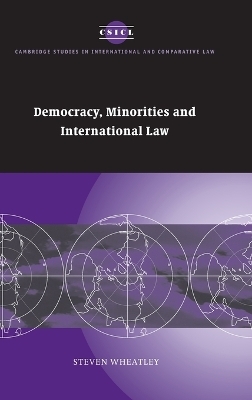
Democracy, Minorities and International Law
Seiten
2005
Cambridge University Press (Verlag)
978-0-521-84898-5 (ISBN)
Cambridge University Press (Verlag)
978-0-521-84898-5 (ISBN)
The emergence of democracy as a legal obligation of States has important implications for the international community. Wheatley examines the contribution that international law may make to the resolution of cultural conflicts in democratic States.
This work explores the contribution that international law may make to the resolution of culture conflicts - political disputes between the members of different ethno-cultural groups - in democratic States. International law recognises that persons belonging to minorities have the right to enjoy their own culture and peoples have the right to self-determination without detailing how these principles are to be put into effect. The emergence of democracy as a legal obligation of States permits the international community to concern itself with both the procedure and substance of 'democratic' decisions concerning ethno-cultural groups. Democracy is not to be understood simply as majority rule. Cultural conflicts in democratic States must be resolved in a way that is either acceptable or defensible and defeasible to all citizens, including persons belonging to ethno-cultural minorities. Democracy, Minorities and International Law examines the implications of this recognition.
This work explores the contribution that international law may make to the resolution of culture conflicts - political disputes between the members of different ethno-cultural groups - in democratic States. International law recognises that persons belonging to minorities have the right to enjoy their own culture and peoples have the right to self-determination without detailing how these principles are to be put into effect. The emergence of democracy as a legal obligation of States permits the international community to concern itself with both the procedure and substance of 'democratic' decisions concerning ethno-cultural groups. Democracy is not to be understood simply as majority rule. Cultural conflicts in democratic States must be resolved in a way that is either acceptable or defensible and defeasible to all citizens, including persons belonging to ethno-cultural minorities. Democracy, Minorities and International Law examines the implications of this recognition.
Steven Wheatley is Senior Lecturer in Human Rights Law and International Law at the University of Leeds.
Acknowledgements; List of abbreviations; Table of cases, opinions, treaties and other documents; Introduction; 1. The rights of minorities; 2. The self-determination of peoples; 3. Democracy; Conclusion.
| Erscheint lt. Verlag | 22.12.2005 |
|---|---|
| Reihe/Serie | Cambridge Studies in International and Comparative Law |
| Verlagsort | Cambridge |
| Sprache | englisch |
| Maße | 160 x 235 mm |
| Gewicht | 508 g |
| Themenwelt | Recht / Steuern ► EU / Internationales Recht |
| Recht / Steuern ► Öffentliches Recht ► Völkerrecht | |
| ISBN-10 | 0-521-84898-9 / 0521848989 |
| ISBN-13 | 978-0-521-84898-5 / 9780521848985 |
| Zustand | Neuware |
| Informationen gemäß Produktsicherheitsverordnung (GPSR) | |
| Haben Sie eine Frage zum Produkt? |
Mehr entdecken
aus dem Bereich
aus dem Bereich
Die Rechtsprechung des Gerichtshofs der Europäischen Union, deutscher …
Buch | Softcover (2025)
Nomos (Verlag)
CHF 53,50


