


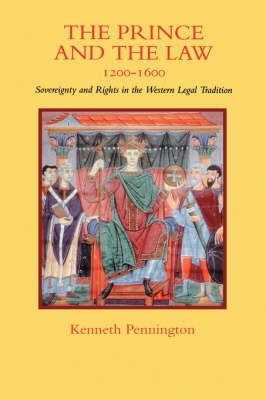
The Prince and the Law, 1200-1600
Sovereignty and Rights in the Western Legal Tradition
Seiten
1993
University of California Press (Verlag)
978-0-520-07995-3 (ISBN)
University of California Press (Verlag)
978-0-520-07995-3 (ISBN)
The power of the prince versus the rights of his subjects is one of the basic struggles in the history of law and government. This study of the history of monarchy, conceptions of law and due process addresses that struggle and uncovers new vistas in the study of Western legal tradition.
The power of the prince versus the rights of his subjects is one of the basic struggles in the history of law and government. In this masterful history of monarchy, conceptions of law, and due process, Kenneth Pennington addresses that struggle and opens an entirely new vista in the study of Western legal tradition. Pennington investigates legal interpretations of the monarch's power from the twelfth to the seventeenth century. Then, tracing the evolution of defendants' rights, he demonstrates that the origins of due process are not rooted in English common law as is generally assumed. It was not a sturdy Anglo-Saxon, but, most probably, a French jurist of the late thirteenth century who wrote, "A man is innocent until proven guilty." This is the first book to examine in detail the origins of our concept of due process. It also reveals a fascinating paradox: while a theory of individual rights was evolving, so, too, was the concept of the prince's "absolute power." Pennington illuminates this paradox with a clarity that will greatly interest students of political theory as well as legal historians.
The power of the prince versus the rights of his subjects is one of the basic struggles in the history of law and government. In this masterful history of monarchy, conceptions of law, and due process, Kenneth Pennington addresses that struggle and opens an entirely new vista in the study of Western legal tradition. Pennington investigates legal interpretations of the monarch's power from the twelfth to the seventeenth century. Then, tracing the evolution of defendants' rights, he demonstrates that the origins of due process are not rooted in English common law as is generally assumed. It was not a sturdy Anglo-Saxon, but, most probably, a French jurist of the late thirteenth century who wrote, "A man is innocent until proven guilty." This is the first book to examine in detail the origins of our concept of due process. It also reveals a fascinating paradox: while a theory of individual rights was evolving, so, too, was the concept of the prince's "absolute power." Pennington illuminates this paradox with a clarity that will greatly interest students of political theory as well as legal historians.
Kenneth Pennington is Professor of History and Law at Syracuse University. Among his previous books is Popes and Bishops: The Papal Monarchy in the Twelfth and Thirteenth Centuries (1984).
| Erscheint lt. Verlag | 10.6.1993 |
|---|---|
| Verlagsort | Berkerley |
| Sprache | englisch |
| Gewicht | 680 g |
| Themenwelt | Recht / Steuern ► Allgemeines / Lexika |
| Recht / Steuern ► EU / Internationales Recht | |
| Sozialwissenschaften ► Politik / Verwaltung ► Europäische / Internationale Politik | |
| Sozialwissenschaften ► Politik / Verwaltung ► Staat / Verwaltung | |
| ISBN-10 | 0-520-07995-7 / 0520079957 |
| ISBN-13 | 978-0-520-07995-3 / 9780520079953 |
| Zustand | Neuware |
| Informationen gemäß Produktsicherheitsverordnung (GPSR) | |
| Haben Sie eine Frage zum Produkt? |
Mehr entdecken
aus dem Bereich



aus dem Bereich
Amerikas Strategie der Vorherrschaft und der Kampf um Eurasien
Buch | Softcover (2024)
NOMEN Verlag
CHF 27,95
kurze Geschichte einer langen Beziehung
Buch | Hardcover (2025)
Suhrkamp (Verlag)
CHF 36,40
erfolgreiche Interessenvertretung durch Prozesskompetenz im komplexen …
Buch | Hardcover (2023)
Wiley-VCH (Verlag)
CHF 58,75


