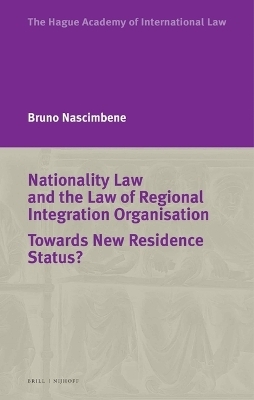
Nationality Law and the Law of Regional Integration Organisation
Martinus Nijhoff (Verlag)
9789004536364 (ISBN)
Bruno Nascimbene is a former Professor of International Law at the University of Genoa and of European Union Law at the University of Milan, where he is also Professor Emeritus. He is also a practising lawyer in international and European Law.
Chapter I. The concept of nationality: Ongoing developments19
1. The alien and non-membership: The citizen and nationality19
2. The concepts of alien and citizen: A brief historical background .21
3. The limits of the opposition between the two notions – The variety of intermediate categories of aliens: Residence and, in general, social ties with the national community28
4. The concept of nationality and international human rights law: An evolving phenomenon 34
5. The international personality of the individual: Developments in international law and the limits to the recognition of personality .36
Chapter II. Nationality and residence in the regional organisations: The European Union40
Section A. The definition of European citizenship40
1. Nationality and the regional integration organisations – The European Union: From European citizenship to “residential citizen- ship”40
2. Origin and formation of European Union citizenship rules41
3. Citizenship after the Treaty of Lisbon: a) Legal framework; b) Changes with regard to citizenship; c) Important rules45
4. The beneficiaries of citizenship rights: Natural persons48
5. Acquisition and loss of citizenship – The competences of the Union and the Member States: European citizenship as comple- mentary or additional to national citizenship50
6. The case law of the Court of Justice on acquisition and loss of citizenship: The requirement of “additional” conditions as well as possession of the nationality of a Member State52
7. Revocation of nationality and possible subsequent statelessness. .56
8. The loss of EU citizenship as a consequence of Brexit60
9. The right to one’s name: Power of the State and limits68
10. Conclusions: a) The limits set by EU law; b) The prospects of harmonisation73
Section B. Citizen status and “residential citizenship”75
1. EU citizen status: The importance of residence and the extension of rights to third-country nationals75
2. a) Rights and duties: The changes introduced by the Lisbon Treaty; b) The protection afforded by the Charter of Fundamental Rights 77
3. a) “Residential citizenship”; “civil citizenship”; b) Equal treatment, integration; c) Immigration and protection of fundamental rights. The different standard of treatment84
4. Rules governing the rights of third-country nationals: The different categories of beneficiaries 89
5. Citizenship and residence rights: What the case law says96
6. “Civil citizenship”: Concept and content – the importance of resi- dence98
7. The standard of treatment of European citizens and third-country nationals: The case law of the Court of Justice: a) workers’ rights (welfare benefits); b) rights provided for in association agreements; c) right of residence; d) rights of spouses; e) rights of long-term residents103
Chapter III. Nationality law and regional integration112
Section A. The Council of Europe112
1. Initiatives taken in the framework of the Council of Europe: Limits of applicability ratione personae – conventions concerning nationals of the Contracting States112
2. Conventions that concern aliens: The Convention on Nationality – limits to the sovereignty of the State116
3. The right to a nationality; the importance of residence: The outlook of the European Court of Human Rights118
4. Acknowledgment of political rights and the importance of resi- dence: a) The Covenant on Civil and Political Rights; b) Other instruments 123
5. Conclusion to Section A126
Section B. Regional organisations in South America127
1. Forms of integration and the idea of a South American ciudadanía: Attention to social aspects; the protection of fundamental rights and the prohibition of discrimination on grounds of nationality 127
2. The Andean Community of Nations: a) The Latin-American common market and freedom of movement; b) The “Andean passport”; c) The Andean Labour Migration Instrument and equal treatment; d) Protection of family members and social rights; e) The Andean Migration Statute; f) Diplomatic and consular pro- tection; g) Human rights protection131
3. Mercosur: a) Objectives; b) Freedom of movement; c) Social aspects and the protection of migrant workers; d) The right of resi- dence, the Brasilia agreements and the definition of a legal status for Mercosur nationals; e) Electoral law; f) Towards a Mercosur nationality status; g) Social rights and the right to vocational training; h) The limits of the initiatives taken and the subsequent results138
4. The UNASUR crisis: Confirmation of the difficulty of moving towards an evolved form of integration between Latin American countries; a) Objectives of the Constitutive Treaty and recognition of fundamental rights; b) Institution of South American citizenship as a gradual integration objective 144
5. Conclusion to Section B147
Section C. Regional organisations of Africa147
1. The right to a nationality and free movement of persons in the African regional context: Some general remarks147
2. A look at two of the African sub-regional integration processes that have paid most attention to the free movement of persons . .151
(a) ECOWAS: Freedom of movement, residence and establish- ment – difficulties encountered151
(b) SADC: Economic aims and freedom of movement of Member States’ nationals154
3. Conclusion to Section C156
Chapter IV. The notion of nationality and private international law: some brief remarks157
1. The rise and fall of nationality as a connecting factor157
2. The residence criterion159
3. Current outlook161
Chapter V. Conclusions163
1. Limits to State sovereignty163
2. Developments in nationality rights163
3. The (possible) future of nationality rights165
Bibliography166
| Erscheinungsdatum | 24.10.2022 |
|---|---|
| Reihe/Serie | The Hague Academy Special Editions |
| Sprache | englisch |
| Maße | 155 x 235 mm |
| Gewicht | 323 g |
| Themenwelt | Recht / Steuern ► EU / Internationales Recht |
| Recht / Steuern ► Öffentliches Recht ► Besonderes Verwaltungsrecht | |
| ISBN-13 | 9789004536364 / 9789004536364 |
| Zustand | Neuware |
| Informationen gemäß Produktsicherheitsverordnung (GPSR) | |
| Haben Sie eine Frage zum Produkt? |
aus dem Bereich