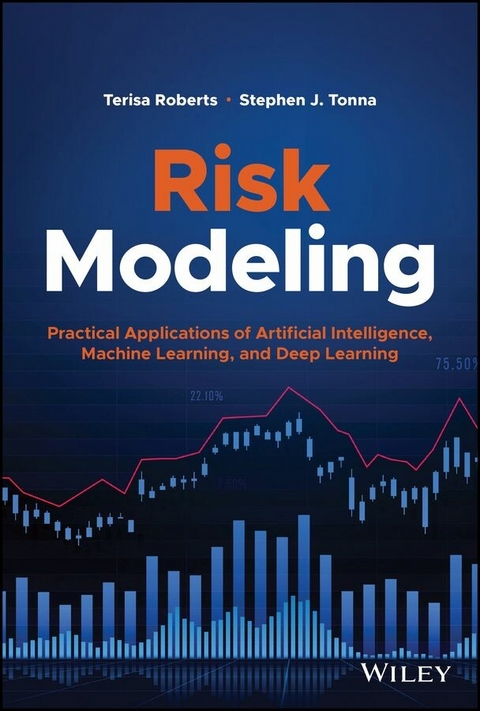
Risk Modeling (eBook)
John Wiley & Sons (Verlag)
978-1-119-82494-7 (ISBN)
A wide-ranging overview of the use of machine learning and AI techniques in financial risk management, including practical advice for implementation
Risk Modeling: Practical Applications of Artificial Intelligence, Machine Learning, and Deep Learning introduces readers to the use of innovative AI technologies for forecasting and evaluating financial risks. Providing up-to-date coverage of the practical application of current modelling techniques in risk management, this real-world guide also explores new opportunities and challenges associated with implementing machine learning and artificial intelligence (AI) into the risk management process.
Authors Terisa Roberts and Stephen Tonna provide readers with a clear understanding about the strengths and weaknesses of machine learning and AI while explaining how they can be applied to both everyday risk management problems and to evaluate the financial impact of extreme events such as global pandemics and changes in climate. Throughout the text, the authors clarify misconceptions about the use of machine learning and AI techniques using clear explanations while offering step-by-step advice for implementing the technologies into an organization’s risk management model governance framework. This authoritative volume:
- Highlights the use of machine learning and AI in identifying procedures for avoiding or minimizing financial risk
- Discusses practical tools for assessing bias and interpretability of resultant models developed with machine learning algorithms and techniques
- Covers the basic principles and nuances of feature engineering and common machine learning algorithms
- Illustrates how risk modeling is incorporating machine learning and AI techniques to rapidly consume complex data and address current gaps in the end-to-end modelling lifecycle
- Explains how proprietary software and open-source languages can be combined to deliver the best of both worlds: for risk models and risk practitioners
Risk Modeling: Practical Applications of Artificial Intelligence, Machine Learning, and Deep Learning is an invaluable guide for CEOs, CROs, CFOs, risk managers, business managers, and other professionals working in risk management.
TERISA ROBERTS, PHD, is Global Solution Lead for Risk Modeling and Decisioning at SAS. She has nearly twenty years of experience in quantitative risk management and advanced analytics. She regularly advises banks and regulators around the world on industry best practices in AI, automation, and digitalization related to risk modeling and decisioning.
STEPHEN J. TONNA, PHD, is a Senior Banking Solutions Advisor at SAS. He is a member of the SAS Risk Finance Advisory team for SAS Risk Research and Quantitative Solutions (RQS) in Asia Pacific. He received his doctorate in genetics, mathematics, and statistics from the University of Melbourne and research fellowship from the Brigham and Women's Hospital and Harvard Medical School.
A wide-ranging overview of the use of machine learning and AI techniques in financial risk management, including practical advice for implementation Risk Modeling: Practical Applications of Artificial Intelligence, Machine Learning, and Deep Learning introduces readers to the use of innovative AI technologies for forecasting and evaluating financial risks. Providing up-to-date coverage of the practical application of current modelling techniques in risk management, this real-world guide also explores new opportunities and challenges associated with implementing machine learning and artificial intelligence (AI) into the risk management process. Authors Terisa Roberts and Stephen Tonna provide readers with a clear understanding about the strengths and weaknesses of machine learning and AI while explaining how they can be applied to both everyday risk management problems and to evaluate the financial impact of extreme events such as global pandemics and changes in climate. Throughout the text, the authors clarify misconceptions about the use of machine learning and AI techniques using clear explanations while offering step-by-step advice for implementing the technologies into an organization's risk management model governance framework. This authoritative volume: Highlights the use of machine learning and AI in identifying procedures for avoiding or minimizing financial risk Discusses practical tools for assessing bias and interpretability of resultant models developed with machine learning algorithms and techniques Covers the basic principles and nuances of feature engineering and common machine learning algorithms Illustrates how risk modeling is incorporating machine learning and AI techniques to rapidly consume complex data and address current gaps in the end-to-end modelling lifecycle Explains how proprietary software and open-source languages can be combined to deliver the best of both worlds: for risk models and risk practitioners Risk Modeling: Practical Applications of Artificial Intelligence, Machine Learning, and Deep Learning is an invaluable guide for CEOs, CROs, CFOs, risk managers, business managers, and other professionals working in risk management.
TERISA ROBERTS, PHD, is Global Solution Lead for Risk Modeling and Decisioning at SAS. She has nearly twenty years of experience in quantitative risk management and advanced analytics. She regularly advises banks and regulators around the world on industry best practices in AI, automation, and digitalization related to risk modeling and decisioning. STEPHEN J. TONNA, PHD, is a Senior Banking Solutions Advisor at SAS. He is a member of the SAS Risk Finance Advisory team for SAS Risk Research and Quantitative Solutions (RQS) in Asia Pacific. He received his doctorate in genetics, mathematics, and statistics from the University of Melbourne and research fellowship from the Brigham and Women's Hospital and Harvard Medical School.
Acknowledgments xi
Preface xiii
Chapter 1 Introduction 1
Risk Modeling: Definition and Brief History 4
Use of AI and Machine Learning in Risk Modeling 7
The New Risk Management Function 7
Overcoming Barriers to Technology and AI Adoption with a Little Help from Nature 10
This Book: What It Is and Is Not 11
Endnotes 12
Chapter 2 Data Management and Preparation 15
Importance of Data Governance to the Risk Function 18
Fundamentals of Data Management 20
Other Data Considerations for AI, Machine Learning, and Deep Learning 22
Concluding Remarks 29
Endnotes 30
Chapter 3 Artificial Intelligence, Machine Learning, and Deep Learning Models for Risk Management 31
Risk Modeling Using Machine Learning 35
Definitions of AI, Machine, and Deep Learning 40
Concluding Remarks 52
Endnotes 52
Chapter 4 Explaining Artificial Intelligence, Machine Learning, and Deep Learning Models 55
Difference Between Explaining and Interpreting Models 57
Why Explain AI Models 59
Common Approaches to Address Explainability of Data Used for Model Development 61
Common Approaches to Address Explainability of Models and Model Output 62
Limitations in Popular Methods 68
Concluding Remarks 69
Endnotes 69
Chapter 5 Bias, Fairness, and Vulnerability in Decision-Making 71
Assessing Bias in AI Systems 73
What Is Bias? 76
What Is Fairness? 77
Types of Bias in Decision-Making 78
Concluding Remarks 89
Endnotes 89
Chapter 6 Machine Learning Model Deployment, Implementation, and Making Decisions 91
Typical Model Deployment Challenges 93
Deployment Scenarios 98
Case Study: Enterprise Decisioning at a Global Bank 101
Practical Considerations 102
Model Orchestration 103
Concluding Remarks 104
Endnote 104
Chapter 7 Extending the Governance Framework for Machine Learning Validation and Ongoing Monitoring 105
Establishing the Right Internal Governance Framework 108
Developing Machine Learning Models with Governance in Mind 109
Monitoring AI and Machine Learning 112
Compliance Considerations 122
Further Takeaway 125
Concluding Remarks 126
Endnotes 127
Chapter 8 Optimizing Parameters for Machine Learning Models and Decisions in Production 129
Optimization for Machine Learning 131
Machine Learning Function Optimization Using Solvers 133
Tuning of Parameters 136
Other Optimization Algorithms for Risk Models 141
Machine Learning Models as Optimization Tools 143
Concluding Remarks 147
Endnotes 148
Chapter 9 The Interconnection between Climate and Financial Instability 149
Magnitude of Climate Instability: Understanding the "Why" of Climate Change Risk Management 152
Interconnected: Climate and Financial Stability 157
Assessing the impacts of climate change using AI and machine learning 158
Using scenario analysis to understand potential economic impact 160
Practical Examples 170
Concluding Remarks 172
Endnotes 172
About the Authors 175
Index 177
CHAPTER 1
Introduction
“By far, the greatest danger of Artificial Intelligence is that people conclude too early that they understand it.”
—Eliezer Yudkowsky
No doubt, we, as a society, are entering into new advances in technology at ground-breaking speed. The rapid growth in digital data and advances in computing power open endless possibilities for transformation in every sphere of life. At the same time, these developments are also driving unparalleled change in human behavior, consumer demand, and expectations. It is believed that we are now entering the next wave of revolution: the fifth industrial revolution or the age of artificial intelligence (AI). In this age, it is said that machines are truly capable of varying degrees of self-determination, reason, and “thought,” working with humans in unison. As a technology, AI is pervasive in every industry, including financial services. It is also starting to mature as a useful tool in risk management function.
However, AI is a broad term and defined by various industry bodies in different ways. The Oxford Dictionary defines it as “the theory and development of computer systems able to perform tasks normally requiring human intelligence, such as visual perception, speech recognition, decision-making, and translation between languages.”1 The European Union defines it as “systems that display intelligent behaviour by analysing their environment and taking actions—with some degree of autonomy—to achieve specific goals.”2 The Office of the Comptroller of the Currency (OCC) in the United States defines it as “the application of computational tools to address tasks traditionally requiring human analysis.”3
As a scientific discipline, AI includes several subdisciplines, such as machine learning (of which deep learning and reinforcement learning are examples), machine reasoning (which includes knowledge representation, deduction, and induction), and robotics (which includes sensors and the integration of other techniques into cyber-physical systems). Despite the enormous transformational benefits that true “AI” systems and platforms can bring to humanity, what is it about “AI” that sends shivers down our spines? Arguably, the shivers are caused by the fact that, for the first time in human history, we are engaging with the intelligence component of technology and the fear of the unknown. And another reason is Hollywood!
It is quite amazing that one of the most memorable moments in cinema is from Stanley Kubrick's 1968 production of Arthur C. Clarke's 2001: A Space Odyssey.4 In an iconic scene, the heuristically programmed algorithmic computer (HAL), responsible for controlling the systems of the Discovery One spacecraft, replies to astronaut David Bowman's request, “Open the pod bay doors, HAL,” with “I'm sorry, Dave. I'm afraid I can't do that.” Perhaps this scene is so memorable, because it is unbelievable to think that an advanced, sentient machine like HAL can think, feel, and mimic human behavior and decide on its own.
There are scenes from other movies and science fiction novels that depict AI as ultimately rising and taking control of society. In many ways, AI-enabled systems are already safely integrated into our personal lives. Take, for example, virtual assistants like Google Assistant, Apple's Siri, and Amazon's Alexa that use the more traditionally derived and AI-puritan List Processing (LISP) for voice recognition. Such “AI” has been widely adopted5 and will continue its advancements as more applications integrate AI methodologies. This is true for the traditional AI applications like machine learning and deep learning to computer vision and cognitive computing as employed by next-generation televisions, cars, and home appliances.6 In addition, technologies or machines utilizing AI or developed using machine or deep learning algorithms (concepts we will cover in Chapter 3) have contributed to the advancement of robotic process automation (RPA), which refers to the automation of repeatable processes by computer-coded software programs that were traditionally done by humans. One of the reasons why RPA is starting to replace other, more traditional operational efficiency improvement strategies is because it runs at a fraction of the cost of human capital.7 In addition to the cost-savings, RPA has reduced processing time and error rates. Examples of RPA deployments in banks include virtual assistants that handle repetitive tasks such as document-processing and verification, account opening and funds transfers, and correction of formatting and data errors that arise in customer requests.
By continuing to augment, and at times automate, manual jobs or daily tasks, AI-enabled applications continue to transform our personal and professional lives. AI is making what was once science-fiction into science-fact. This will continue to be the case when considering the consolidated impact of four major factors:8
- Moore's law. Computing power is said to double every two years and will continue to do so for the foreseeable future.9
- Data. The creation of data and replication have doubled each year. It is estimated that 1.7 megabytes of new information are created every second for every human being on the planet, meaning that from 2010 to 2020, there was a 5,000% growth in data—from 1.2 trillion gigabytes in 2010 to 59 trillion gigabytes in 2020. The exponential growth in data is largely driven by digitalization, and is expected to continue.10 It is the fuel for AI-based algorithms, especially those that require large and rich amounts of data for training and development, like deep learning.11
- Funding. AI funding has doubled every two years, largely driven by the availability of required computational power.12
- Test of time. There is 50 years of established AI and quantitative research that is underpinning better algorithms.
Taking these four factors into account and the current state of play, AI is not merely hype. Although we are going through a hype cycle where expectations may not be realistic, there is great potential that will likely be realized in the coming years.13 To remain relevant in the wake of the age of AI, it is critical for organizations to prepare for a large-scale adoption, integration, and use of AI-enabled systems in industries such as financial services. A word of caution, though—for AI and machine learning to realize short- and long-term business value in a responsible way, the foundational technological building blocks of data, people, and processes will need to be reconsidered. These building blocks will be discussed in more detail throughout this book.
RISK MODELING: DEFINITION AND BRIEF HISTORY
In recent years, the number of risk models employed by financial institutions increased dramatically, by 10–25% annually.14 Let's define what a risk model is. A risk model involves the application of quantitative methods, analytics, and algorithms to quantify financial and nonfinancial risks. It is important to note that risk management applies to other industries besides financial institutions; however, the applications used in this book mainly relate to the financial services industry and particularly to the quantification of financial risks.
Henceforth, in this book, the term model refers to a financial risk model unless otherwise stated. Interestingly, most of the modern-day risk and probability theory evolved from innovation in science, economics, and technology in the last 200 to 300 years.15 However, our ability to utilize mathematics to estimate probabilities and use it as a means to quantify risk in our modern world stems from developmental advances across multiple centuries. The English term hazard, referring to “chance of loss or harm, risk,” likely originates from the Arabic term az-zahr, which means “the dice.” Ground-breaking mathematicians like Fibonacci (the golden ratio), followed by Blaise Pascal (the father of modern theory in decision-making), laid the foundations for modern-day probability theory.
Moreover, Fibonacci learned the Hindu-Arabic numerical system from traders while visiting his father at a port in Algeria in the thirteenth century. Innovations in mathematics, trading, and finance seem inextricably linked—but that is perhaps a topic for another book. The use of risk models can likely be traced back to the precursor of what we now consider actuarial science in insurance. In the eighteenth century, these pre-modern-day analysts poured over data to estimate life expectancy on which to price insurance premiums.
Fast forward to modern times; based on the work of others like David Hume and Nicholas Bernoulli, Harry Markowitz developed portfolio theory in 1952. Today, we can define a model as a quantitative method, system, or approach that applies statistical, economic, financial, or mathematical theories, techniques, and assumptions to process input data into quantitative estimates.16
The use of risk models is now ubiquitous in financial services. One reason is the swaths of new regulations before and after the Global Financial Crisis. In the last decade, regulation after new regulation has expanded the volume of risk models that organizations need to manage. In...
| Erscheint lt. Verlag | 20.9.2022 |
|---|---|
| Reihe/Serie | SAS Institute Inc |
| SAS Institute Inc | Wiley and SAS Business Series |
| Sprache | englisch |
| Themenwelt | Recht / Steuern ► Wirtschaftsrecht |
| Wirtschaft ► Betriebswirtschaft / Management | |
| Schlagworte | Accounting • AI applications risk management • AI risk modelling techniques • artificial intelligence risk management • Corporate Finance • deep learning risk management • machine learning credit risk • machine learning risk management • machine learning risk management algorithms • Rechnungswesen |
| ISBN-10 | 1-119-82494-X / 111982494X |
| ISBN-13 | 978-1-119-82494-7 / 9781119824947 |
| Informationen gemäß Produktsicherheitsverordnung (GPSR) | |
| Haben Sie eine Frage zum Produkt? |
 EPUB (Adobe DRM)
Kopierschutz: Adobe-DRM
Adobe-DRM ist ein Kopierschutz, der das eBook vor Mißbrauch schützen soll. Dabei wird das eBook bereits beim Download auf Ihre persönliche Adobe-ID autorisiert. Lesen können Sie das eBook dann nur auf den Geräten, welche ebenfalls auf Ihre Adobe-ID registriert sind.
Details zum Adobe-DRM
Dateiformat: EPUB (Electronic Publication)
EPUB ist ein offener Standard für eBooks und eignet sich besonders zur Darstellung von Belletristik und Sachbüchern. Der Fließtext wird dynamisch an die Display- und Schriftgröße angepasst. Auch für mobile Lesegeräte ist EPUB daher gut geeignet.
Systemvoraussetzungen:
PC/Mac: Mit einem PC oder Mac können Sie dieses eBook lesen. Sie benötigen eine
eReader: Dieses eBook kann mit (fast) allen eBook-Readern gelesen werden. Mit dem amazon-Kindle ist es aber nicht kompatibel.
Smartphone/Tablet: Egal ob Apple oder Android, dieses eBook können Sie lesen. Sie benötigen eine
Geräteliste und zusätzliche Hinweise
Buying eBooks from abroad
For tax law reasons we can sell eBooks just within Germany and Switzerland. Regrettably we cannot fulfill eBook-orders from other countries.
aus dem Bereich