


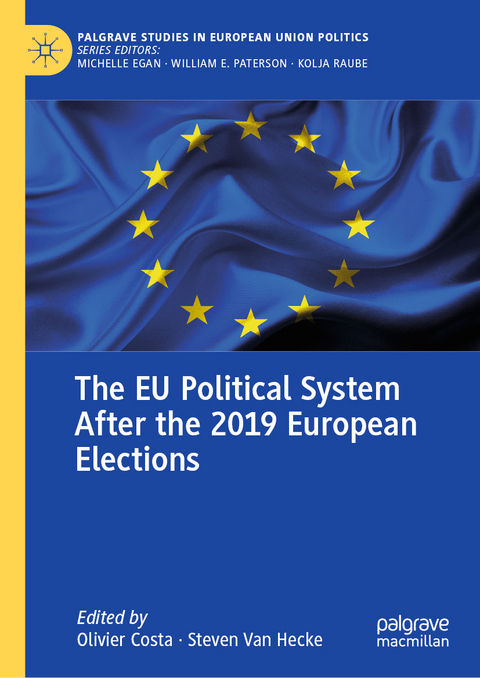
The EU Political System After the 2019 European Elections
Springer International Publishing (Verlag)
978-3-031-12337-5 (ISBN)
Olivier Costa is Director of European Political and Governance Studies at the College of Europe, Belgium, and Research Professor in Political Science and EU studies at the Centre National de la Recherche Scientifique, CEVIPOF-Sciences Po, France. He is also Executive Editor of the Journal of European Integration. Steven Van Hecke is Assistant Professor in Comparative and EU Politics at the Public Governance Institute of the KU Leuven, Belgium, and Senior Research Fellow at the Leibniz-Institut fur Europaische Geschichte in Mainz, Germany.
1. Introduction.- 2. EU Citizen Participation "in the Union's Democratic Life": A Policy and Legal Analysis.- 3. Higher turnout at the expense of representativeness? The 2019 European elections against the backdrop of a socio-economically biased voter turnout.- 4. Unpacking legislative turnover in the 2019 European Parliament elections.- 5. The Life and Death of Spitzenkandidaten: What Role is Left for European Political Parties?.- 6. The political regime of the EU through the prism of the confirmation of the von der Leyen Commission by the European Parliament.- 7. Dealing with fragmentation: The new political equilibrium and coalition dynamics in the European Parliament during the 9th legislature.- 8. They are no different, they are much the same? Post-2019 inter-institutional dynamics in the European Union.- 9. The Von Der Leyen Commission: An Early Assessment.- 10. A "geopolitical Commission": reaching a pointof inflexion?.- 11. Balancing the unbalanced? An ongoing rivalry between European Parliament and European Council.- 12. The European Parliament's practice in scrutinizing the Commission's delegated acts before and after the 2019 EP elections.- 13. The empowerment of the General Secretariat of the Council: a growing challenge for rotating presidencies?.- 14. The European Parliament under COVID-19: Institutional adaptation in times of pandemics.- 15. The Evolution of Central Banking in Europe.- 16. The EU budget and Recovery Plan: a chance for EU ambition?.- 17. "A Green European Wave?" Green Electoral Success and the European Green Deal.- 18. How Covid-19 Hit Brussels and Beyond: The EU's Crisis Management Tested by a Pandemic.- 19. The evolution of enhanced cooperation in the EU: from EnCo to PeSCo (2009-2019).- 20. The End of Enlargement? The EU's Struggle with the Western Balkans and Eastern Partnership countries.- 21. From the Gulf of Aden to the Mediterranean sea: The institutionalisation of EU-NATO maritime relations.- 22. The EU's embrace of geopolitics: Insights from the EU-China Relationship.
| Erscheinungsdatum | 24.11.2022 |
|---|---|
| Reihe/Serie | Palgrave Studies in European Union Politics |
| Zusatzinfo | XXVI, 519 p. 37 illus., 29 illus. in color. |
| Verlagsort | Cham |
| Sprache | englisch |
| Maße | 148 x 210 mm |
| Gewicht | 837 g |
| Themenwelt | Recht / Steuern ► Öffentliches Recht |
| Sozialwissenschaften ► Politik / Verwaltung ► Politische Systeme | |
| Sozialwissenschaften ► Politik / Verwaltung ► Staat / Verwaltung | |
| Schlagworte | EU law • EU Parliament Elections • EU policy-making • European Commission • European Parliament • European Union Politics |
| ISBN-10 | 3-031-12337-9 / 3031123379 |
| ISBN-13 | 978-3-031-12337-5 / 9783031123375 |
| Zustand | Neuware |
| Informationen gemäß Produktsicherheitsverordnung (GPSR) | |
| Haben Sie eine Frage zum Produkt? |
aus dem Bereich


