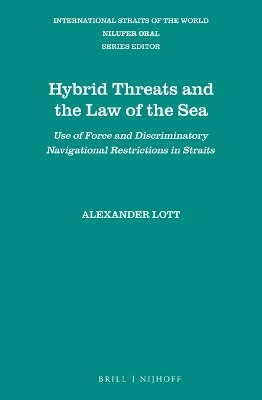
Hybrid Threats and the Law of the Sea
Martinus Nijhoff (Verlag)
978-90-04-50935-1 (ISBN)
Read also Alexander Lott's blog on the recent Award of the Annex VII Arbitral Tribunal in the dispute concerning the Kerch Strait incident.
Hybrid Threats and the Law of the Sea debates the practice of states that have resorted to discriminatory navigational restrictions or aggression against foreign ships and aircraft in densely navigated straits. The book explores both widely acknowledged and lesser-known maritime incidents that meet the characteristics of hybrid warfare or hybrid conflict. This research approaches hybrid threats from the perspective of the interrelationship between navigational restrictions, law enforcement, armed attack, and the legal regime of straits. It provides guidance for determining whether the rules of armed conflict or law enforcement are applicable to various naval incidents.
Alexander Lott, Ph.D. (2017), is Marie Curie fellow at the Norwegian Centre for the Law of the Sea, University of Tromsø and affiliated to the University of Tartu. He has published monographs and many articles on maritime law and security.
Preface
Acknowledgements
List of Illustrations
Abbreviations and Euphemisms
part 1
The Meaning of Straits and Hybrid Threats
1 The Implications of Hybrid Threats to the Maritime Domain
2 The Legal Concept and Classification of Straits
2.1 The Legal Concept of a Strait
2.2 The Legal Classification of Straits
2.3 The Law of Naval Warfare in Straits and Its Relation to the Law of the Sea
3 The Concept of Hybrid Threats
3.1 The Meaning of Hybrid Conflicts
3.2 Differences between the Rules on the Use of Force in Maritime Law Enforcement Operations and Armed Conflicts
3.3 The Meaning of Hybrid Warfare
part 2
Use of Force in Maritime Hybrid Warfare
4 Permit-Based Passage v. Transit Passage in an Occupied Area The 2018 Kerch Strait Incident and the 2022 Ukraine-Russia Naval Warfare
4.1 The Kerch Strait Incident and Its Implications for the Passage Regime in the Sea of Azov
4.2 Freedom of Navigation of Ukrainian and Russian Ships in the Kerch Strait
4.3 A Critical Analysis of Ukraine’s Arguments about the Applicability of Transit Passage to Ships and Aircraft in/over the Sea of Azov and the Kerch Strait
4.4 The Significance of 2003 Bilateral Treaties for the Passage Regime of the Kerch Strait
4.5 The Sea of Azov as a Potential Historic Bay and Its Implications for the Regime of Passage in the Kerch Strait under Article 35(a) of losc
4.6 The Importance of the Obligation of Non-recognition for the Passage Regime of the Kerch Strait
4.7 Parallel Legal Regimes vs Sui Generis Regime of the Kerch Strait
4.8 The Kerch Strait as a Belligerent Strait
5 Use of Force against Sovereign Immune Vessels Law Enforcement v. Humanitarian Law Paradigm
5.1 In dubio pro jus in bello?
5.2 Threshold of an Armed Attack in a Hybrid Naval Conflict
5.3 Distinction between Law Enforcement and Humanitarian Law Paradigms
6 Iran-Israel ‘Shadow War’ in Waters around the Arabian Peninsula and Incidents near the Bab el-Mandeb
6.1 Legal Regime of the Bab el-Mandeb
6.2 Geopolitical Characteristics of the Bab el-Mandeb
6.3 Terrorism and Piracy in and near the Bab el-Mandeb
6.4 Armed Conflict in Yemen
6.5 Background of the Iran-Israel Conflict
6.6 Problems with Attributing State Responsibility
6.7 Non-state Actors and Article 51 of the UN Charter
7 Russia’s Military Operations in the Territories of the Viro Strait’s Coastal States
7.1 Geographical and Geopolitical Characteristics of the Viro Strait
7.2 The Legal Regime of the Viro Strait
7.3 Foreign Military Activities in the Viro Strait: Incursions of Foreign Submarines and Military Aircraft
part 3
Discriminatory Navigational Restrictions in Hybrid Conflicts
8 Discriminatory Prohibition of the Right of Transit Passage of a Commercial Ship The Arrest of Stena Impero by Iran
8.1 Geographical and Geopolitical Characteristics of the Strait of Hormuz
8.2 Legal Regime of the Strait of Hormuz
8.3 The 2019 Stena Impero Incident and the Traffic Separation Scheme in the Strait of Hormuz
8.4 Parallel Passage Regimes in the Strait of Hormuz?
8.5 Significance of Iranian Internal Waters for the Passage Regime in the Strait of Hormuz
9 Tensions in and over the Taiwan Strait in 2021
9.1 Legal and Geographical Characteristics of the Taiwan Strait
9.2 Navigation in the Taiwan Strait in the Light of Recent Developments in China’s Legislation
9.3 Geopolitical Tensions in the Taiwan Strait and Intrusions of Taiwan’s Air Defence Identification Zone
10 Discriminatory Navigational Restrictions in the Kerch Strait in Respect of Foreign Commercial Ships
10.1 The Significance of the Kerch Strait for Commerce
10.2 Restrictions on Foreign Commercial Ships’ Navigation through the Kerch Strait
11 Discriminatory Prohibition of the Right of Innocent Passage of a Commercial Ship The Vironia Incident in the Gulf of Finland
11.1 Right of Innocent Passage in the Eastern Gulf of Finland from 1920s to 2000
11.2 The Russian Federation’s Maritime Zones in the Gulf of Finland
11.3 The Vironia Incident in the Gulf of Finland and Its Aftermath
11.4 Potential Legal Basis of the Russian Federation’s Permit-Based Passage Regime in the Gulf of Finland
part 4
Major Maritime Industrial Projects, Piracy, and Unidentified Soldiers
12 The Nord Stream Project and Estonian-Russian Incidents in the Viro Strait
12.1 Link between Industrial Projects and Maritime Security
12.2 The Significance of the Viro Strait’s eez Corridor for the Nord Stream Project
12.3 Marine Scientific Research in the Context of Seabed Studies on the Pipeline Route
12.4 The Incident between the Estonian Coast Guard and Russian Research Vessels in the Viro Strait’s eez Corridor
12.5 Permit-Based Marine Scientific Research in an eez: Estonia’s Decision to Deny Seabed Surveys
13 Countering the Threat of ‘Little Green Men’ in the Åland Strait
13.1 Geopolitical Characteristics of the Åland Strait and Preparations to Counter Unidentified Soldiers on the Åland Islands
13.2 Legal Regime of the Åland Strait
14 Threats of Piracy in the Straits of Malacca, Sunda, Lombok
14.1 Legal and Geopolitical Characteristics
14.2 Threats of Piracy in Indonesia and the Straits of Malacca and Singapore
part 5
Concluding Observations on the Implications of Hybrid Threats for Maritime Security Law
15 A Need for a New Legal Framework on Hybrid Naval Warfare?
16 Discriminatory Navigational Restrictions in the Context of Hybrid Conflicts
17 Low-Intensity Use of Force (Hybrid Warfare) through the Prism of Law Enforcement and an Armed Attack
18 Guidelines for Distinguishing between the Rules of Armed Conflict and Law Enforcement in Grey Zone Naval Incidents
18.1 Use of Force by State Vessels against Attacks Launched from Commercial Ships
18.2 Use of Force against a Commercial Ship in a Law Enforcement Operation
18.3 State vs State Scenario
Bibliography
Chronological Table of International Instruments
Table of National Legislation
Chronological Table of Cases
Chronological List of Maps
Index
| Erscheinungsdatum | 01.09.2022 |
|---|---|
| Reihe/Serie | International Straits of the World ; 19 |
| Sprache | englisch |
| Maße | 155 x 235 mm |
| Gewicht | 660 g |
| Themenwelt | Recht / Steuern ► EU / Internationales Recht |
| Recht / Steuern ► Öffentliches Recht ► Völkerrecht | |
| ISBN-10 | 90-04-50935-6 / 9004509356 |
| ISBN-13 | 978-90-04-50935-1 / 9789004509351 |
| Zustand | Neuware |
| Informationen gemäß Produktsicherheitsverordnung (GPSR) | |
| Haben Sie eine Frage zum Produkt? |
aus dem Bereich