


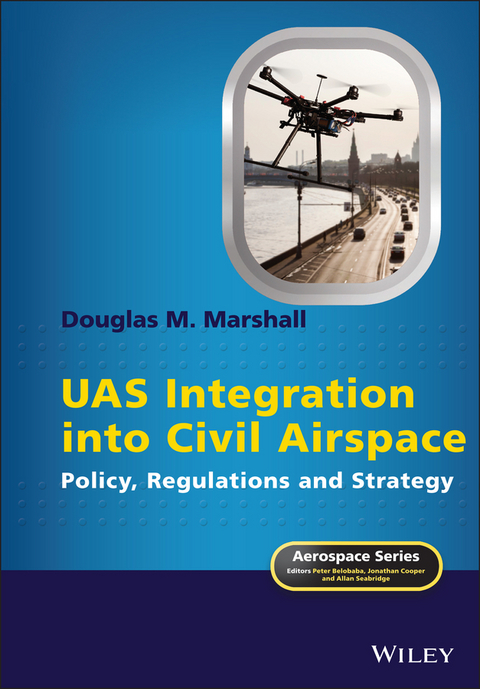
UAS Integration into Civil Airspace (eBook)
John Wiley & Sons (Verlag)
978-1-118-53658-2 (ISBN)
Explores current Unmanned Air Systems policies with a view to developing a common airspace access and integration strategy
UAS Integration into Civil Airspace: Policy, Regulations and Strategy examines the current state of Unmanned Aerial Systems (UAS) airspace access and integration around the world, focusing on the efforts that have produced a regulatory response to the demand for access. This analysis discusses the proposed architectures for a common strategic and analytical thread that may serve as templates for the entire community, as well as for regulators and policymakers who must balance the needs and demands of UAS users with the general public's right to safe skies and privacy. An understanding of the market forces and business cases that are fuelling the development of the technology is also covered with a focus on the economics of the industry.
The book presents a strategy for airspace access and integration that will facilitate humanitarian, environmental, social and security uses of unmanned aircraft systems on a global scale.
Key features:
UAS Integration into Civil Airspace: Policy, Regulations and Strategy is essential reading for all professionals involved in UAS industry, as well as students in mechanical engineering and law.
Douglas M. Marshall
TrueNorth Consulting LLC., USA
UAS Integration into Civil Airspace Explores current Unmanned Air Systems policies with a view to developing a common airspace access and integration strategy UAS Integration into Civil Airspace: Policy, Regulations and Strategy examines the current state of Unmanned Aerial Systems (UAS) airspace access and integration around the world, focusing on the efforts that have produced a regulatory response to the demand for access. This analysis discusses the proposed architectures for a common strategic and analytical thread that may serve as templates for the entire community, as well as for regulators and policymakers who must balance the needs and demands of UAS users with the general public s right to safe skies and privacy. An understanding of the market forces and business cases that are fuelling the development of the technology is also covered with a focus on the economics of the industry. The book presents a strategy for airspace access and integration that will facilitate humanitarian, environmental, social and security uses of unmanned aircraft systems on a global scale. Key features: Discusses existing and evolving policies and regulations from nations around the world for operating Unmanned Aerial Systems (UAS) in civil airspace Examines the current status of technological developments such as UTM and U-space and explores the technological potential in the years to come Presents a comprehensive airspace integration strategy that balances the many conflicting interests in the UAS world, with due regard for safety, utility and affordability UAS Integration into Civil Airspace: Policy, Regulations and Strategy is essential reading for all professionals involved in UAS industry, as well as students in mechanical engineering and law.
Douglas M. Marshall, J.D., is the owner of TrueNorth Consulting LLC, a UAS support and service organization founded in 2007. He has served as an Adjunct Professor of Law, DePaul University College of Law, where he developed and delivered the first drone law course in an American law school. Previously, he was a division manager, UAS Regulations & Standards Development at the Physical Science Laboratory, New Mexico State University, and Professor of Aviation at the University of North Dakota. He is the co-editor of two books related to aviation, and is the author of numerous published articles on aviation law, regulations, and remotely piloted aircraft.
Preface xi
Aerospace Series Preface xvii
Acknowledgements xix
List of Acronyms and Abbreviations xxi
1 Background 1
Introduction 1
Setting the Stage for Integration of Remotely Piloted Aircraft into Non-segregated Airspace 2
The Law of the Sea and the Law of the Air 2
A Brief History of Aviation Regulations 3
International Civil Aviation Regulations 4
The Chicago Convention and the International Civil Aviation Organization 6
Conclusion 9
References 9
2 UAS Airspace Integration in the European Union 11
Regulations, Opinions, Decisions 11
Implementing Organizations 39
Eurocontrol 60
Conclusion 66
References 66
3 ICAO 69
ICAO Model UAS Regulations 69
Advisory Circulars 70
DRAFT Canada AC 922-001, RPAS Safety Assurance 71
UTM Guidance 71
ICAO RPAS Concept of Operations 75
ICAO U-AID Guidance 80
The ICAO UAS Toolkit 81
RPAS Manual (Doc.) 10019 1st Edition 82
Conclusion 86
References 86
4 UAS Airspace Integration in the United States 87
The FAA Modernization and Reform Act of 2012 (Hereafter FMRA), Public Law 112-95, Title III - Safety, Subtitle B - Unmanned Aircraft Systems 88
The FAA Extension, Safety, and Security Act of 2016 Title II, Subtitle B-UAS Safety (Pub. L. 114-190) 91
The FAA Reauthorization Act of 2018 (Pub. L. 115-254) 92
The Response from the FAA and NASA 96
Status of UTM Today 104
UTM Vision 104
Participation 109
Performance Authorizations 109
Airspace Authorization 110
Recent Developments in UAM/AAM 110
Conclusion 111
References 111
5 Global Airspace Integration Activities 113
Australia 113
Brazil 115
Canada 116
China 117
France 119
Germany 120
Ireland 121
Italy 122
Japan 123
Mexico 124
Netherlands 124
New Zealand 125
Norway 125
Singapore 126
South Africa 127
Sweden 128
United Kingdom 129
Conclusion 130
References 131
6 The Role of Standards 133
Conclusion 141
References 142
7 The Technology 143
Conclusion 150
References 152
8 Cybersecurity and Cyber Resilience 153
Describing the Threat 155
ICAO 157
IATF 157
Global Resilient Aviation Network Concept of Operations - Trust Framework 162
ICAO Council and Assembly Documents 166
Declaration on Cybersecurity in Civil Aviation (Dubai, 2017) 166
Conclusion 172
References 173
Index 175
The book is an excellent historical resource for anyone who wants to know how the current regulations and policies came to pass. And possibly also why we don't have other rules enabling the industry. I believe that anyone in the commercial drone business and those in or contemplating Advanced Air Mobility and Urban Air Mobility (AAM/UAM) would benefit from reading this book. After reading, you will have an educated understanding of the future you are embarking on. --Patrick Egan, sUAS News
The book is easy to read, refreshingly so for such a complex subject and is accessible to all readers, even without a detailed technical knowledge. It is a useful reference for everyone in the industry, including regulators who will inevitably determine the pace of adoption of UAS in civil airspace. Most of the world's aviation authorities, service providers and regulators have engaged in intense efforts since the early 2000s to establish methods and safety protocols to integrate UAS into complex and increasingly busy controlled and uncontrolled airspace. This book provides an excellent oversight of international progress, along with ICAO's oversight and direction of co-ordinating rules and, in my view is the 'go-to' book for UAS operations and by far the best introduction on the subject available to date. --Richard Deakin, FRAeS, AEROSPACE
Preface
In early 2009 Fred Smith, founder, chairman and CEO of the venerable cargo airline, FedEx, declared in an interview that he would like to switch the FedEx fleet to unmanned aircraft as soon as possible, but would have to wait for the FAA to sort out the rules for national airspace integration. In his view, unmanned cargo freighters offer many advantages for his company, predicting that they would be safer, cheaper, and would boast a greater capacity. The result would be a reduction of airfreight prices from ten times the cost of surface-carried freight to a factor of two, with all the speed advantages of air over ground or ocean transportation. Smith pointed out that the modern version of the Boeing 777 is already capable of being operated unmanned, in that the aircraft can take off, fly, navigate, and land without human intervention (and could even be equipped with an autonomous ground guidance system so the aircraft can be “driven” around an airport environment without running into or over someone or something). The same is true of most of the newest passenger aircraft types. The cost savings would derive from the fact that even a single-pilot aircraft requires a completely different design, with radically different economics and logistics. Smith might characterize the economic opportunity as “unused capacity,” or what can be removed from the airplane that would allow an increased load. Systems such as oxygen, pressurization system, lavatories, extra seats, gallies, all intended for the comfort of the crew, can be eliminated and replaced with revenue-generating non-breathing cargo. The concept is not a pipe dream. Northrop Grumman’s Global Hawk reconnaissance aircraft, which is the size of a small business jet, has been flying entirely autonomous missions for several years, meaning that the aircraft is capable of taxing to the runway, taking off, executing its flight plan, and landing at its intended destination without any human intervention.
Aside from the obvious concerns from those who do not trust technology to safely permit a large commercial aircraft to operate without a pilot on board, even over the oceans rather than populated terrain, Smith hit on one of the key elements that inhibits such operations from being approved by government regulators. The “holy grail” in the small UAS technology space is now national airspace (NAS) integration. Will society ever get to the point where autonomous systems will be allowed to operate in the same airspace as manned or piloted aircraft, or even be sufficiently comfortable with the safety mitigations to travel in an aircraft without a pilot on board? While the concept is no longer in the realm of futuristic representations of how things will be in 2050, as depicted in motion pictures and television productions, scaled-down versions of that vision are in the making now. Electrically powered aircraft are in the airworthiness approval stage with the FAA. Urban air mobility concepts under development by companies such as Airbus, Joby Aviation, Kitty Hawk, Lilium, Terrafugia, and Uber Air are well on their way to securing civil aviation authority approvals to market eVTOL (electric vertical takeoff and landing) prototypes that can operate at low altitudes in urban environments. “Self-flying” air taxis are already taking passengers on test flights in Chinese cities. Researchers, developers, regulators, and others are working very hard to create remotely piloted systems that can share airspace at lower airspace levels, in an environment that is unlikely to confront a remotely piloted B777 loaded to the rafters with computer chips and smart phones, and flying at 400 feet above ground at 250 kts. What is now possible is a remotely or autonomously piloted aircraft carrying emergency medical supplies to a person in need, dispatched from the nearest public safety facility and operating in your neighborhood at an altitude of less than 250 feet above ground level (AGL), possibly saving a life. Or delivering that FedEx package that may have been carried to a distribution center by a conventional aircraft, but replacing the ground vehicle currently needed to complete the last leg of the journey. While technologically possible now, these scenarios may only take place outside of strictly controlled test environments under the watchful eyes of regulatory agencies such as the US Federal Aviation Administration or its functional equivalents elsewhere, national civil aviation authorities.
There are many moving parts in the realm of unmanned aircraft systems. Capturing all of them and doing them justice would require several volumes. The one essential component of the UAS “big picture” is airspace management; thus the focus of this book. Even that subcategory calls for a recursive analysis, as any technology is made up of many components that themselves are technologies, which have subparts that are also technologies, and so on, in a repeating, or recurring fashion. The airspace management function is typically the exclusive province of civil aviation authorities focused on safety and the fundamental goal of keeping aircraft separated from one another so as to not create a hazard of a mid-air collision. This function has been largely successful for over 60 years, depending upon the country in question. Generally, the denser the airspace traffic, the greater the likelihood of a mishap. Midair collisions, though relatively rare when compared to the number of aircraft in flight at any one time in congested airspace, such as parts of the US and Europe, still happen, often with tragic results. In the list of the top 10 leading causes of fatal general aviation accidents in the US from 2001 to 2017, the last year this statistic is available, midair collisions ranked number eight. The number of near-midair collisions reported each year is approximately 200, and actual collisions average between 15 and 20. General aviation hours flown (those most important to our analysis because they are more likely to be found at low operating levels), totaled 25.9 million in the calendar year 2019.
The theme of this book focuses on just one of those many moving parts, the integration of unmanned aircraft into controlled and uncontrolled airspace. The ongoing regulatory and policy efforts around the world to achieve full airspace integration will be examined, which requires a functional breakdown of the key elements of the technology that must meet regulatory requirements before the systems will be permitted to go into full operation. Predictions of the future in this technology sector are fraught with uncertainty, but an attempt will be made to outline a probable path forward as revealed by government regulators and myriad interested parties. Among the other moving parts are ongoing regulatory developments for Operations Over People, operations Beyond Visual Line of Sight of the pilot in command, Remote Identification of aircraft, and Night Operations. While these components are critical features of the overall challenge of airspace integration, they will not be discussed in detail in this volume, except to the extent that it is necessary to clarify their role in the integration picture.
The rapid evolution of the technology underlying unmanned aircraft, unmanned aircraft systems, remotely piloted aircraft systems, and, more commonly, drones, among other terms of art, presents a formidable challenge to anyone attempting to encapsulate the entire domain in one book. The broad notion of unmanned or remotely piloted aircraft has been with us for over a century. Society has witnessed extraordinary developments in the field of unmanned aviation over the last 30 years or so. The categories or topics that now define or bound the current state of the art of this technology are too numerous to list here, but will be discussed in the body of this book.
The media and popular press adopted the catchall label “drone,” while experts and regulators generally prefer UAV, UAS, RPA, or RPAS instead of “drone,” because the term “drone” once had a very specific meaning. The early descriptions of these types of aircraft settled on “drone,” although the historical root of the term remains controversial (likened to a honeybee drone, or perhaps derived from a 1930s British target drone called a “Queen Bee”? No one really knows). In the earliest phases of development of unmanned aircraft, “drone” referred to target aircraft or remotely piloted offensive weapons deployed by both sides in both World Wars. Today’s unmanned aircraft are far more sophisticated, and in most cases more capable of non-military missions than the “true” drones of nine decades ago. This book will use drone, UAS, sUAS, UAV, UAS, and RPAS more or less interchangeably, as a matter of style and continuity, unless the specific term used calls for an explanation of why it is used in the context of the discussion.
Military organizations, primarily in the United States, led the way in developing drone technology from flying targets for aircraft weaponry and surface-based artillery to aerial sensor systems modified for intelligence, surveillance, and reconnaissance (ISR) missions. That capability soon led to development of platforms capable of carrying and deploying highly effective offensive munitions (such as the General Atomics’ Predator and Reaper series used in the first Gulf War and thereafter in subsequent Middle East conflicts).
Alongside the military’s tactical and strategic adoption of unmanned aerial systems, and the emerging market for civilian or scientific versions of those systems, the consumer sector emerged, which quickly realized the potential for unmanned systems...
| Erscheint lt. Verlag | 25.3.2022 |
|---|---|
| Reihe/Serie | Aerospace Series |
| Aerospace Series (PEP) | Aerospace Series (PEP) |
| Mitarbeit |
Herausgeber (Serie): Peter Belobaba, Jonathan Cooper, Allan Seabridge |
| Sprache | englisch |
| Themenwelt | Recht / Steuern ► EU / Internationales Recht |
| Recht / Steuern ► Privatrecht / Bürgerliches Recht ► Transportrecht | |
| Technik ► Fahrzeugbau / Schiffbau | |
| Technik ► Luft- / Raumfahrttechnik | |
| Technik ► Maschinenbau | |
| Schlagworte | Aeronautic & Aerospace Engineering • Business & Management • Civil Law • Law • Luftfahrt • Luft- u. Raumfahrttechnik • Maschinenbau • mechanical engineering • Öffentliche Verwaltung • Öffentliche Verwaltung u. Management • Public Administration & Management • Rechtswissenschaft • uas policy • uas reference • uas regulations • uas strategy • uas textbook • unmanned aerial system economics • Unmanned Aerial Systems • unmanned aerial systems policy • unmanned air systems • unmanned air systems economics • unmanned air systems policy • Wirtschaft u. Management • Zivilrecht |
| ISBN-10 | 1-118-53658-4 / 1118536584 |
| ISBN-13 | 978-1-118-53658-2 / 9781118536582 |
| Informationen gemäß Produktsicherheitsverordnung (GPSR) | |
| Haben Sie eine Frage zum Produkt? |
 EPUB (Adobe DRM)
Kopierschutz: Adobe-DRM
Adobe-DRM ist ein Kopierschutz, der das eBook vor Mißbrauch schützen soll. Dabei wird das eBook bereits beim Download auf Ihre persönliche Adobe-ID autorisiert. Lesen können Sie das eBook dann nur auf den Geräten, welche ebenfalls auf Ihre Adobe-ID registriert sind.
Details zum Adobe-DRM
Dateiformat: EPUB (Electronic Publication)
EPUB ist ein offener Standard für eBooks und eignet sich besonders zur Darstellung von Belletristik und Sachbüchern. Der Fließtext wird dynamisch an die Display- und Schriftgröße angepasst. Auch für mobile Lesegeräte ist EPUB daher gut geeignet.
Systemvoraussetzungen:
PC/Mac: Mit einem PC oder Mac können Sie dieses eBook lesen. Sie benötigen eine
eReader: Dieses eBook kann mit (fast) allen eBook-Readern gelesen werden. Mit dem amazon-Kindle ist es aber nicht kompatibel.
Smartphone/Tablet: Egal ob Apple oder Android, dieses eBook können Sie lesen. Sie benötigen eine
Geräteliste und zusätzliche Hinweise
Buying eBooks from abroad
For tax law reasons we can sell eBooks just within Germany and Switzerland. Regrettably we cannot fulfill eBook-orders from other countries.


