


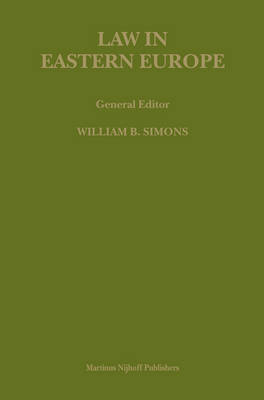
Moscow's Road to Nuremberg
The Soviet Background to the Trial
Seiten
1995
Kluwer Law International (Verlag)
9789041101822 (ISBN)
Kluwer Law International (Verlag)
9789041101822 (ISBN)
This study explores the Soviet regime's contribution to the prehistory of the Nuremberg trial, for example, the repertory of official acts and pronouncements as well as scholarly treatment of issues which ultimately shaped the legal complexion of the Nuremberg test.
Recent events in former Yugoslavia and Rwanda have revived diplomatic interest in measures contemplating concerted action directed at the suppression and punishment of war crimes. Indeed, steps have already been initiated to set up war crimes tribunals to prosecute those responsible for such atrocities. Not to be outdone, Yeltsin's Foreign Minister has also issued a call for public discussion of the idea of `creating a system of international criminal justice with regard to crimes against peace and humanity, other international violations of the law.' The precedents of the Second World War in this venue thus seem relevant once again. Since the Soviet Union played a leading role in paving the way for the Nuremberg trial and respective proceedings before national tribunals, and Russia - as self-proclaimed heir and successor to the USSR - continues to exercise a great deal of influence in these matters today, a look at Moscow's doctrinal and practical scorecard may prove useful for future reference.
The present study explores the Soviet regime's contribution to the prehistory of the Nuremberg trial, i.e., the repertory of official acts and pronouncements as well as scholarly treatment of issues which ultimately shaped the legal complexion of the Nuremberg test. Our focus in this case is on the mode of development of the style and substance of the bill of indictment until the day of the court's opening session from the standpoint of Moscow's stake in the operation. The views recorded during the trial in primary or secondary sources or those expressed later are taken into account only if they shed light on the preparatory stages of the drama. The subsequent evolution of Moscow's thoughts on the subject deserves a separate full-scale analysis.
Recent events in former Yugoslavia and Rwanda have revived diplomatic interest in measures contemplating concerted action directed at the suppression and punishment of war crimes. Indeed, steps have already been initiated to set up war crimes tribunals to prosecute those responsible for such atrocities. Not to be outdone, Yeltsin's Foreign Minister has also issued a call for public discussion of the idea of `creating a system of international criminal justice with regard to crimes against peace and humanity, other international violations of the law.' The precedents of the Second World War in this venue thus seem relevant once again. Since the Soviet Union played a leading role in paving the way for the Nuremberg trial and respective proceedings before national tribunals, and Russia - as self-proclaimed heir and successor to the USSR - continues to exercise a great deal of influence in these matters today, a look at Moscow's doctrinal and practical scorecard may prove useful for future reference.
The present study explores the Soviet regime's contribution to the prehistory of the Nuremberg trial, i.e., the repertory of official acts and pronouncements as well as scholarly treatment of issues which ultimately shaped the legal complexion of the Nuremberg test. Our focus in this case is on the mode of development of the style and substance of the bill of indictment until the day of the court's opening session from the standpoint of Moscow's stake in the operation. The views recorded during the trial in primary or secondary sources or those expressed later are taken into account only if they shed light on the preparatory stages of the drama. The subsequent evolution of Moscow's thoughts on the subject deserves a separate full-scale analysis.
Part 1: I. The Pre-War Record. II. War Years: The First Half, 1941-1943. III. War Years: The Second Half, 1943-1495. IV. Doctrinal Exegesis. V. The London Conference and After. Part 2: VI. A Long Digression. Bibliography of Soviet (Russian) Works. Index.
| Erscheint lt. Verlag | 1.12.1995 |
|---|---|
| Reihe/Serie | Law in Eastern Europe ; 47 |
| Verlagsort | Zuidpoolsingel |
| Sprache | englisch |
| Maße | 155 x 235 mm |
| Gewicht | 393 g |
| Einbandart | gebunden |
| Themenwelt | Recht / Steuern ► EU / Internationales Recht |
| Recht / Steuern ► Öffentliches Recht ► Völkerrecht | |
| ISBN-13 | 9789041101822 / 9789041101822 |
| Zustand | Neuware |
| Informationen gemäß Produktsicherheitsverordnung (GPSR) | |
| Haben Sie eine Frage zum Produkt? |
Mehr entdecken
aus dem Bereich
aus dem Bereich
Die Rechtsprechung des Gerichtshofs der Europäischen Union, deutscher …
Buch | Softcover (2025)
Nomos (Verlag)
CHF 53,50


