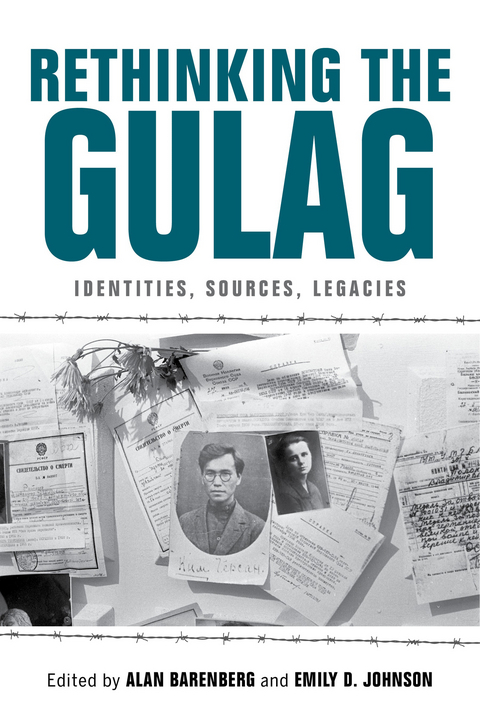
Rethinking the Gulag (eBook)
320 Seiten
Indiana University Press (Verlag)
978-0-253-05959-8 (ISBN)
— Alan Barenberg is a well-respected scholar with an excellent monograph under his belt and a good presence on social media. Emily D. Johnson is also a well-respected scholar and has experience editing volumes. — The history and legacy of the Gulag is of continuing importance and interest in Soviet, Russian, and Eastern European studies. — Gulag studies represents a unique opportunity for a collection such as this. While many edited volumes might claim to put contributors in conversation, this volume was conceived primarily as a conversation and therefore the contributors have responded to the work of fellow collaborators within their own chapters. This sense of conversation is underscored by brief summary thoughts on each section provided by distinguished scholars in the field. In this way, it also bridges generational divides between "new wave" scholars using exciting approaches available through digital scholarship and established scholars who helped to define the primary theoretical questions of the field. — The volume will be of interest to scholars in anthropology, criminology, literature, and history. While the work does not include comparisons between Russian and Soviet penal institutions and those in other areas, individuals who study such institutions will find the volume useful. Some sections of the book may also be used in course packs for advanced university classes on Soviet history, literature, or criminology.
Moving away from grand metaphorical or theoretical models, Rethinking the Gulag instead unearths the complexities and nuances of experience that define the new wave of Gulag studies.
Alan Barenberg is the Buena Vista Foundation Associate Professor of History at Texas Tech University. He is author of Gulag Town, Company Town: Forced Labor and Its Legacy in Vorkuta. Emily D. Johnson is the Brian and Sandra O'Brien Presidential Professor of Russian at the University of Oklahoma. She is author of How St. Petersburg Learned to Study Itself: The Russian Idea of Kraevedenie and editor and translator of Gulag Letters by Arsenii Formakov.
1. Introduction: Gulag Studies since the Archival Revolution, by Alan Barenberg and Emily D. Johnson
Part I: Identities
2. Religious Identity, Practice, and Hierarchy at the Solovetskii Camp of Forced Labor of Special Significance, by Jeffrey S. Hardy
3. Censoring the Mail in Stalin's Multi-ethnic Penal System: The Use of Languages Other Than Russian in Soviet Inmate Correspondence, by Emily D. Johnson
4. "Who are you in life?": The Gulag Reputation System and its Legacies Today, by Gavin Slade
5. The Real Gulag: Commentary on the "Identities" Section, by Lynne Viola
Part II: Sources
6. "They won't survive for long": Soviet Officials on Medical Release Procedures, by Mikhail Nakonechnyi
7. Applying Digital Methods to Forced Labor History: German POWs During and After the Second World War, by Susan Grunewald
8. Framing Gulag Memoirs: A Distant Reading, by Sarah J. Young
9. Researching the Gulag in the Era of "Big Data": Commentary on the "Sources" Section, by Judith Pallot
Part III: Legacies
10. The Role of Nature in Gulag Poetry: Shalamov and Zabolotsky, by Josephine von Zitzewitz
11. "I would very much like to read your story about Kolyma": Georgii Demidov, Varlam Shalamov, and the Development of Gulag Prose, 1965-67, by Alan Barenberg
12. The Necropolis of the Gulag as a Historical-Cultural Object: An Overview and Explication of the Problem, by Irina Anatolievna Flige (translated by Josephine von Zitzewitz)
13. Sites and Sounds of the Camps: Commentary on the "Legacies" Section, by Alexander Etkind
14. Afterword, by Alan Barenberg and Emily D. Johnson
Index
| Erscheint lt. Verlag | 1.3.2022 |
|---|---|
| Co-Autor | Alexander Etkind, Irina Anatolievna Flige, Susan Grunewald, Jeffrey S. Hardy, Mikhail Nakonechnyi, Judith Pallot, Gavin Slade, Lynne Viola, Josephine Von Zitzewitz, Sarah J. Young |
| Zusatzinfo | 12 b&w illus., 9 b&w tables |
| Verlagsort | Bloomington |
| Sprache | englisch |
| Maße | 150 x 150 mm |
| Themenwelt | Geschichte ► Teilgebiete der Geschichte ► Kulturgeschichte |
| Recht / Steuern ► EU / Internationales Recht | |
| Recht / Steuern ► Strafrecht ► Kriminologie | |
| Recht / Steuern ► Strafrecht ► Strafverfahrensrecht | |
| Schlagworte | Crime • Criminology • Justice • labor camp • Penal system • Prison • Russia • soviet • Stalin |
| ISBN-10 | 0-253-05959-3 / 0253059593 |
| ISBN-13 | 978-0-253-05959-8 / 9780253059598 |
| Informationen gemäß Produktsicherheitsverordnung (GPSR) | |
| Haben Sie eine Frage zum Produkt? |
 EPUB (Adobe DRM)
Kopierschutz: Adobe-DRM
Adobe-DRM ist ein Kopierschutz, der das eBook vor Mißbrauch schützen soll. Dabei wird das eBook bereits beim Download auf Ihre persönliche Adobe-ID autorisiert. Lesen können Sie das eBook dann nur auf den Geräten, welche ebenfalls auf Ihre Adobe-ID registriert sind.
Details zum Adobe-DRM
Dateiformat: EPUB (Electronic Publication)
EPUB ist ein offener Standard für eBooks und eignet sich besonders zur Darstellung von Belletristik und Sachbüchern. Der Fließtext wird dynamisch an die Display- und Schriftgröße angepasst. Auch für mobile Lesegeräte ist EPUB daher gut geeignet.
Systemvoraussetzungen:
PC/Mac: Mit einem PC oder Mac können Sie dieses eBook lesen. Sie benötigen eine
eReader: Dieses eBook kann mit (fast) allen eBook-Readern gelesen werden. Mit dem amazon-Kindle ist es aber nicht kompatibel.
Smartphone/Tablet: Egal ob Apple oder Android, dieses eBook können Sie lesen. Sie benötigen eine
Geräteliste und zusätzliche Hinweise
Buying eBooks from abroad
For tax law reasons we can sell eBooks just within Germany and Switzerland. Regrettably we cannot fulfill eBook-orders from other countries.
aus dem Bereich