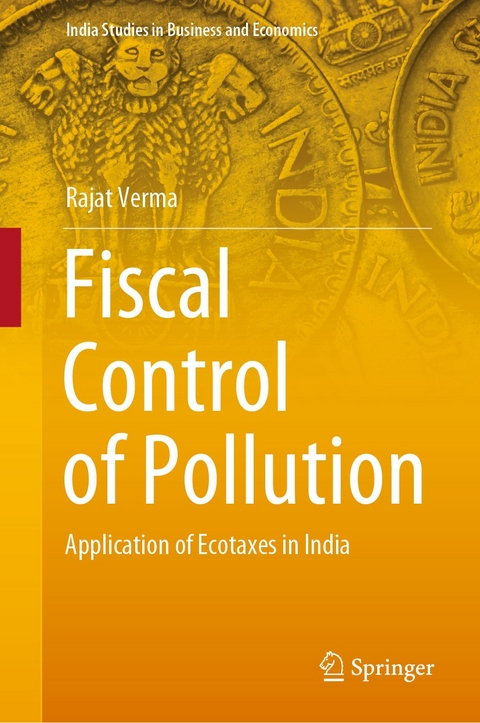
Fiscal Control of Pollution (eBook)
XXVI, 314 Seiten
Springer Singapore (Verlag)
978-981-16-3037-8 (ISBN)
The book provides material for the researchers and graduate students on the methodological structure of eco-taxes. The proposed methodological intervention could be utilised by the researchers who wish to analyse the macroeconomic impact of any tax through the framework of Social Accounting Matrix (SAM). Additionally, the process as well as the implications and nuances provided in the book will assist the policy makers to design innovative policies for dealing with environmental issues. The volume also has something for the practitioners by helping them comprehend various effects of these instruments on different stake holders of the economy and thus will be useful as a policy prescription. The three policy scenarios analysed in this study could be considered by the policymakers while attempting to design these instruments in the Indian context and thus ending the extensive reliance on the age old and grossly ineffective Command and Control (CAC) Policies.
Rajat Verma is presently the Chairperson of the School of Economics at NMIMS-Bengaluru Campus. Prior to joining NMIMS he taught in Bengaluru Dr. B. R. Ambedkar School of economics (BASE). He has also taught several courses in the discipline of Economics in various colleges of the University of Delhi from 2011-2013. He pursued his Ph. D. in Economics with a specialization in Environmental Economics from the Institute of Social and Economic Change, Bangalore. Dr. Verma has published innovative research papers on the topic of environmental taxes and has also published in the field of international trade. He specializes in Social Accounting Matrix based analysis and has research interests in areas of environmental economics, public finance and international trade.
This volume analyses the process and structure of ecotaxes in India to bring forth its rationale, application and incidence on emerging environmental problems on the backdrop of the environmental issues confronted by the Indian economy. Being at infant stage in India, the concept of ecotaxes is plagued with large empirical difficulties. This book provides a holistic understanding of the complexities in the design and implementation of these fiscal instruments at the country level. After elaborating on the theory, history of its applications, the book provides an innovative methodological exercise. It examines the adequacy and relevance of ecotaxation in the Indian context, along with ensuring that the distortions due to the proposed levy are minimised. The incidence of these taxes on the households, the double dividend hypothesis and the effect on competitiveness of the producer are a few of the core themes elaborated upon in this book. This is demonstrated through a linear general equilibrium framework of Environmentally extended Social Accounting Matrix (E-SAM).The book provides material for the researchers and graduate students on the methodological structure of eco-taxes. The proposed methodological intervention could be utilised by the researchers who wish to analyse the macroeconomic impact of any tax through the framework of Social Accounting Matrix (SAM). Additionally, the process as well as the implications and nuances provided in the book will assist the policy makers to design innovative policies for dealing with environmental issues. The volume also has something for the practitioners by helping them comprehend various effects of these instruments on different stake holders of the economy and thus will be useful as a policy prescription. The three policy scenarios analysed in this study could be considered by the policymakers while attempting to design these instruments in the Indian context and thus ending the extensive reliance on the age oldand grossly ineffective Command and Control (CAC) Policies.
| Erscheint lt. Verlag | 8.7.2021 |
|---|---|
| Reihe/Serie | India Studies in Business and Economics | India Studies in Business and Economics |
| Zusatzinfo | XXVI, 314 p. 29 illus., 25 illus. in color. |
| Sprache | englisch |
| Themenwelt | Recht / Steuern ► Allgemeines / Lexika |
| Recht / Steuern ► EU / Internationales Recht | |
| Recht / Steuern ► Privatrecht / Bürgerliches Recht | |
| Sozialwissenschaften ► Politik / Verwaltung ► Staat / Verwaltung | |
| Wirtschaft ► Volkswirtschaftslehre | |
| Schlagworte | Double Dividend Hypothesis • Ecotaxes • Environmental Fiscal Instruments • Environmental taxes • Green Taxes • Incidence of Taxes • Social Accounting Matrix (SAM) |
| ISBN-10 | 981-16-3037-2 / 9811630372 |
| ISBN-13 | 978-981-16-3037-8 / 9789811630378 |
| Informationen gemäß Produktsicherheitsverordnung (GPSR) | |
| Haben Sie eine Frage zum Produkt? |
 PDF (Wasserzeichen)
DRM: Digitales Wasserzeichen
Dieses eBook enthält ein digitales Wasserzeichen und ist damit für Sie personalisiert. Bei einer missbräuchlichen Weitergabe des eBooks an Dritte ist eine Rückverfolgung an die Quelle möglich.
Dateiformat: PDF (Portable Document Format)
Mit einem festen Seitenlayout eignet sich die PDF besonders für Fachbücher mit Spalten, Tabellen und Abbildungen. Eine PDF kann auf fast allen Geräten angezeigt werden, ist aber für kleine Displays (Smartphone, eReader) nur eingeschränkt geeignet.
Systemvoraussetzungen:
PC/Mac: Mit einem PC oder Mac können Sie dieses eBook lesen. Sie benötigen dafür einen PDF-Viewer - z.B. den Adobe Reader oder Adobe Digital Editions.
eReader: Dieses eBook kann mit (fast) allen eBook-Readern gelesen werden. Mit dem amazon-Kindle ist es aber nicht kompatibel.
Smartphone/Tablet: Egal ob Apple oder Android, dieses eBook können Sie lesen. Sie benötigen dafür einen PDF-Viewer - z.B. die kostenlose Adobe Digital Editions-App.
Buying eBooks from abroad
For tax law reasons we can sell eBooks just within Germany and Switzerland. Regrettably we cannot fulfill eBook-orders from other countries.
aus dem Bereich