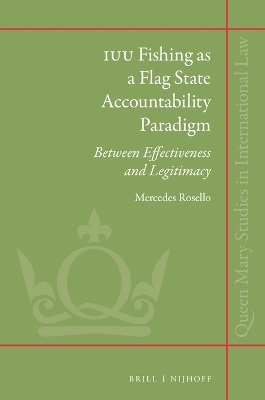
IUU Fishing as a Flag State Accountability Paradigm
Martinus Nijhoff (Verlag)
978-90-04-46282-3 (ISBN)
Illegal, unreported and unregulated (IUU) fishing is a widely used designation for a broad range of fishing practices with a common theme: whether illegal or not, they cause damage to marine fish stocks and the human communities that depend on them. Yet, when subjected to thorough analysis, this pragmatic governance tool is revealed in a light that calls for caution against uncritical application. Unwrapping its uneasy relationship with international law, this study is ultimately a qualified defence of the IUU fishing paradigm, but also a practical proposal for its reform. This original book makes a genuine contribution to the international fisheries law and policy literature.
Mercedes Rosello, Ph.D. (2019), University of Hull, is a Senior Lecturer at Leeds Beckett University. She has published numerous peer-reviewed journal articles, book chapters, and blog posts on international and European Union fisheries law and policy topics.
Acknowledgements
Acronyms
International Legislation and Voluntary Instruments
International Cases
International Arbitration
Advisory Opinions
European Union Cases
Domestic Cases
Resolutions of International Organisations
RFMOS
Introduction
PART 1
IUU Fishing as Interpretive Lens
1 Origins and Meaning of IUU Fishing
1.1 How Imperfect Regulatory Frameworks Enable IUU Fishing
1.1.1 Drivers of IUU Fishing Activity
1.1.2 Enablers of IUU Fishing Activity
1.2 Emergence and Function of IUU Fishing as a Governance Tool
1.2.1 The Origins of the IUU Fishing Concept
1.2.2 Integration of the IUU Concept in the International Legal Framework
1.2.2.1 Legal Interpretive Filter: Illegal Fishing
1.2.2.2 Hybrid Interpretive Filter: Unregulated Fishing
1.3 Conclusion
2 Rationale for an IUU Fishing Interpretive Lens
Introduction
2.1 International Law And The IUU Fishing Interpretive Lens
2.1.1 Jurisdiction
2.2 The due Diligence Nature of Flag State Obligations
2.3 Conservation And Management
2.3.1 The LOSC
2.3.2 The UNFSA
2.3.3 Effectiveness Limitations
2.4 Flag State Control Over Fishing Vessels’ High Seas Activities
2.4.1 The LOSC
2.4.2 The Compliance Agreement
2.4.3 The UNFSA
2.4.4 Effectiveness Limitations
2.5 The Duty to Cooperate
2.5.1 The LOSC
2.5.2 The Compliance Agreement
2.5.3 The UNFSA
2.5.4 Effectiveness Limitations
2.6 IUU Fishing Issues not Covered in the Fisheries Treaties
2.7 General Conduct Standards
2.8 Contribution to Effectiveness of the IUU Fishing Interpretive Lens
2.8.1 Effectiveness Illustration: RFMO Compliance Practice
2.8.2 Governance Effect of the IUU Fishing Interpretive Lens
2.9 Conclusion
PART 2
IUU Fishing As Compliance Mechanism
3 Compliance and State Responsibility
Chapter Introduction
3.1 State responsibility as Compliance Mechanism
3.2 State Responsibility and International Rules and Actors
3.2.1 Exclusion of Rules and Actors
3.2.2 Responsibility and Due Diligence Obligations
3.3 Reciprocal Structure of State Responsibility and Its Implications
3.4 Responsibility and erga omnes Obligations
3.5 Responsibility and erga omnes partes Obligations
3.6 Responsibility and Injury to Rights
3.7 Other Factors Limiting the Effectiveness of State Responsibility
3.8 Conclusion
4 IUU Fishing as Compliance Mechanism
Introduction
4.1 States and Compliance with International Obligations
4.2 The Compliance and Enforcement Dimensions of the IUU Fishing Paradigm
4.2.1 Extraterritorial Port State Controls
4.2.2 Extraterritorial Market Suspensions
4.2.3 Conclusion
4.3 Critiques to IUU Fishing as a Compliance Mechanism
4.3.1 Effectiveness Critique
4.3.2 Legality Critique
4.3.3 Legitimacy Critique
4.3.4 Illustration: The Cambodia Case
4.3.5 Implications of the Legitimacy Critique
4.4 Correcting the Legitimacy Flaws of the iuu Fishing Compliance Paradigm
4.5 Conclusion
PART 3
IUU Fishing as Flag State Accountability Paradigm
5 IUU Fishing and State Accountability
Introduction
5.1 A Conceptual Analysis of Accountability
5.1.1 Meta-Analysis of Accountability Definitions
5.2 Beyond the Core Concept: Social Dimension of Accountability
5.2.1 Rational Drivers to Participation
5.2.2 Autonomy and Transparency in Conduct Disclosure
5.3 Tabular Analysis
5.4 Re-Conceptualisation of the iuu Fishing Compliance System as Accountability Mechanism
5.4.1 Core Accountability Re-Construction in the IUU Fishing Context: Tabular Representation
5.4.2 Broader Accountability Re-Construction
5.4.3 Application of Critiques to Rational Models and Sanctions
5.5 Limitations of the Conceptual Accountability Model
5.6 Conclusion
6 IUU Fishing as Flag State Accountability Paradigm
Introduction
6.1 The IUU Fishing Accountability Paradigm and Effectiveness
6.2 The IUU Fishing Accountability Paradigm and Normativity
6.3 The IUU Fishing Paradigm and Regime Complexes
6.4 Shared Rules and Norms in Regime Complexes
6.4.1 Norms and Practice in Regime Complexes
6.4.2 Accountability as an ‘interactional’ Site of Rule Socialisation
6.4.2.1 A Methodology for the Norm-Rule-Conduct Evaluation Space
6.4.2.2 Interpretive Reciprocity and Analogy
6.4.3 IUU Fishing as Flag State Accountability Paradigm
6.4.3.2 Addressing the Legality Critique
6.4.3.3 Addressing the Legitimacy Critique
6.5 Conclusion
Conclusion
Bibliography
Index
| Erscheinungsdatum | 08.06.2021 |
|---|---|
| Reihe/Serie | Queen Mary Studies in International Law ; 45 |
| Sprache | englisch |
| Maße | 155 x 235 mm |
| Gewicht | 544 g |
| Themenwelt | Recht / Steuern ► EU / Internationales Recht |
| Recht / Steuern ► Öffentliches Recht ► Völkerrecht | |
| ISBN-10 | 90-04-46282-1 / 9004462821 |
| ISBN-13 | 978-90-04-46282-3 / 9789004462823 |
| Zustand | Neuware |
| Informationen gemäß Produktsicherheitsverordnung (GPSR) | |
| Haben Sie eine Frage zum Produkt? |
aus dem Bereich