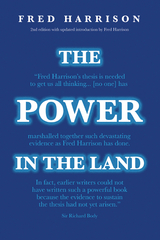
Power In The Land (eBook)
398 Seiten
Distributed By PublishDrive (Verlag)
978-0-85683-543-8 (ISBN)
Fred Harrison is Executive Director for the Land Research Trust. He studied economics at Oxford, first at Ruskin College and then at University College, where he read Philosophy, Politics and Economics. His MSc is from the University of London. He cut short a career as an investigative journalist in Fleet Street and embarked on a 10-year sojourn in Russia, following the collapse of communism, acting as an advisor to a number of Russian academic and political bodies, including the Duma (parliament), in order to help the Russian people avoid the economics favoured by rent-seekers.
The major industrial nations enter the 1990s in the midst of land booms offering riches for a few but unemployment for many. Banks in TEXAS were bankrupted by massive speculation in real estate. Even embassies had to abandon their offices because they could not afford the rents in TOKYO. In BRITAIN, the spoils from housing - the direct result of the way the land market operates - enriched owner-occupiers but crippled the flow of workers into regions where entrepreneurs wanted to invest and lead the economy back to full-employment. Fred Harrison's thesis is that land speculation is the major cause of depressions. He shows how the land market functions as a junction box which regulates the power flowing between Labour and Capital. And how land speculation periodically throws the switches on the productive power of men and machines, causing economic stagnation. This theory was acknowledged by philosophers such as Adam Smith and Karl Marx, and social reformers ranging from Winston Churchill to Leo Tolstoy, but it has been forgotten by today's economists and policy-makers. The hypothesis is tested against the historical facts and the recent booms and slumps, and is found to offer a powerful explanation for postwar trends in unemployment and the distribution of income. The Power in the Land challenges the pessimistic belief, nurtured by the depressions of the last two decades, that unemployment is now a permanent feature of late 20th century society. The author elaborates policies, based on a radical reform of the tax system, which would banish involuntary unemployment and generate continuous economic growth.
2
Laissez Faire: Adam Smith’s Version
Adam Smith believed that he was recommending the economics of the free market when he wrote The Wealth of Nations. He thought that his theoretical system had, as its dynamic principle, the competitive spirit; that, within the framework of natural justice, economic growth would be enjoyed by the three ‘original great orders’ which comprised civilized society — the land-lords, capitalists and labourers. He was wrong.
Smith was not wrong in thinking that theoretically the economics of capitalist competition could function efficiently to the advantage of all. His cr tor arose from the deduction that his specific system provided such an outcome, that it would secure the dual aim of freeing people to pursue private aims while guaranteeing the natural harmony of the total system. For his was not a description of how to construct a free market: he insulated the landlords from the competitive spirit. Until this is appreciated the science of political economy will be severely limited in its influence on public policy.
For two centuries Smith’s book has been the ‘bible’ for the buccaneering entrepreneurs who built factories and mass-produced cheap goods, and for the rational thinkers — the technologists, scientists and engineers and organisational managers — who trampled theological mysticism under foot in favour of science. But when Smith penned The Wealth of Nations he betrayed the spirit of the free market. At the abstract level, his testament promoted a philosophy that relentlessly exposed the special privileges and the monopoly power that politicians and manufacturers tried to invoke to their profitable advantage, but the book also set the seal of approval on an institutional framework that crippled capitalism at its conception. And so Adam Smith’s victims were not just the toiling masses who were subjected to the tortuous economic pressures that reduced so many of them to misery. A death blow was also administered to the very idea of the free market.
Lutissez faire is now discredited because, by popular agreement, it has failed to work to everyone’s satisfaction. It was out of resignation to this ‘failure’ that the philosophy of the New Deal developed: the belief that a mixed economy would do what the free market was incapable of accomplishing. But the interpretation of the history of industrial society ever since publication of The Wealth of Nations has geen grossly defective, which is why the critics have been able to conclude that unrestrained competition is inherently evil. Collective action, collective ownership of capital and centralised bureaucratic planning are now — in degrees varying only according to vested interests — acclaimed as the remedial alternatives.
The analyses have been wrong because the historians and social scientists have taken all the tenets of Adam Smith as necessarily intrinsic to the capitalist market. They have pursued their enquiries into a malfunctioning system without questioning the necessity for those property rights which have underpinned that system; without questioning whether, had a modified configuration of property rights existed, the free market might have achieved its goals without the evil consequences which have beset industrial society. Across the political spectrum, from Marxist left to conservative right, the arguments and counter-arguments have progressed without adequate reflection on whether a reform of the principles of property ownership and the rationale which motivates the owners of these rights might be sufficient to improve the operations of the free market without recourse to those bureaucratic modifications that deny the ‘perfect liberty’ that Smith wished to attain.
The debate about capitalism as a mode of production, therefore, has been in the terms validated by Adam Smith. But contrary to what he thought he was doing — and his readers interpreted him as doing1—Smith developed an economic framework which entailed a fatal element of monopoly power. He wrote about an ‘invisible hand’ guiding the system to the benefit of everyone, but he recommended the preservation of a structure of property rights which by its very nature struck at the heart of individual liberty and economic prosperity.
Critics, then, are opponents of Adam Smith — not of laissez faire. For the freely competitive market system with a capitalistic ethos has yet to be put to trial. Responsibility for the slums of Bolton in the 19th century, and the hunger of the Jarrow marchers in the 20th century, must be laid at the feet of Adam Smith and the politicians and practitioners who happily accepted his values; these tragedies, as we shall see, are not a necessary part of laissez faire capitalism. The search for a system which combines personal freedom and social stability with economic prosperity for everyone is a realisable dream, and its pursuit must start with an analysis of the defects in the philosophical justification advanced to legitimise the history of western industrial society: The Wealth of Nations.
Dr Smith was a careful Scottish scholar. He had taught at the University of Edinburgh, travelled to France where he studied the Physiocratic system of economics, and was an accomplished logician and natural scientist. His great book was not specifically prepared for the Industrial Revolution which was fermenting all around him. He wanted to define the principles of a free and just economic system of relevance to any civilized society. Indeed, surprisingly, he was not well acquainted with the great strides in mechanical inventions which characterised the two decades during which he wrote the book which he published in 1776.2
The clues to Smith’s fatal errors were contained in his first book, The Theory of Moral Sentiments (1759),3 which was a discourse on ethics. In this, he distorted the way in which income was divided between the landlords and the landless. In doing so, however, he linked ‘the invisible hand’ with the process, and the free market was generally held to be guilty of what subsequently happened.
Smith knew the facts. The natural fertility of the earth, nurtured by human labour, increased the output that fed a greater multitude. But, he insisted:
It is to no purpose that the proud and unfeeling landlord views his extensive fields, and without a thought for the wants of his brethren, in imagination consumes himself the whole harvest that grows upon them. The homely and vulgar proverb, that the eye is larger than the belly, never was more fully verified than with regard to him.4
Smith insisted that, given the limited capacities of the landlord’s belly, he was obliged to ‘distribute’ his surplus food. The rich ‘consume little more than the poor; and in spite of their natural selfishness and rapacity... they divide with the poor the produce of all their improvements’. Underpinning the whole structure of Adam Smith’s economics was this naive claim that landlords shared the surplus output among every person in society; more than that, however, the distribution was effectively an equal one. Of landlords, he said:
They are led by an invisible hand to make nearly the same distribution of the necessaries of life which would have been made had the earth been divided into equal portions among all its inhabitants; and thus, without intending it, without knowing it, advance the interest of the society, and afford means to the multiplication of the species.5
So land redistribution was not on the agenda of reforms that might be necessary to improve the new mode of production. For ‘the invisible hand’ ensured that people enjoyed ‘nearly the same distribution’ as if the earth had been divided into equal portions among all.
Smith insulated the landlords from criticism by claiming that they were not responsible for the existing distribution of property rights, and that in any event nobody was really excluded from a share of wealth:
When providence divided the earth among a few lordly masters, it neither forgot nor abandoned those who seemed to have been left out in the partition. These last, too, enjoy their share of all that it produces. In what constitutes the real happiness of human life, they are in no respect inferior to those who would seem so much above them. In ease of body and peace of mind, all the different ranks of life are nearly upon a level, and the beggar, who suns himself by the side of the highway, possesses that security which kings are fighting for.6
All was well, then; the ‘fitness’ of the system was bestowed with a certain ‘propriety and beauty’7 that was the free market.
Smith appears to confuse the differences between the division of the products of the earth, with the value of that output as it is exchanged across the stalls in the market towns. Landlords may not hoard all the food that is grown on their land; but nor do they distribute its value on a nearly equal basis, as Smith would have us believe — as any landless beggar sunning himself on the side of the highway could have told the young Professor of Moral Philosophy from Glasgow.
Adam Smith was not a fool, and his attention to detail was meticulous. So we can account for the apparent shallowness of his economic reasoning only in terms of his having to fit reality to his theory. He must, at the outset, have decided that property rights to land should not be...
| Erscheint lt. Verlag | 26.4.2021 |
|---|---|
| Sprache | englisch |
| Themenwelt | Recht / Steuern ► EU / Internationales Recht |
| Recht / Steuern ► Steuern / Steuerrecht | |
| Wirtschaft ► Betriebswirtschaft / Management ► Unternehmensführung / Management | |
| ISBN-10 | 0-85683-543-9 / 0856835439 |
| ISBN-13 | 978-0-85683-543-8 / 9780856835438 |
| Informationen gemäß Produktsicherheitsverordnung (GPSR) | |
| Haben Sie eine Frage zum Produkt? |
 EPUB (Ohne DRM)
Digital Rights Management: ohne DRM
Dieses eBook enthält kein DRM oder Kopierschutz. Eine Weitergabe an Dritte ist jedoch rechtlich nicht zulässig, weil Sie beim Kauf nur die Rechte an der persönlichen Nutzung erwerben.
Dateiformat: EPUB (Electronic Publication)
EPUB ist ein offener Standard für eBooks und eignet sich besonders zur Darstellung von Belletristik und Sachbüchern. Der Fließtext wird dynamisch an die Display- und Schriftgröße angepasst. Auch für mobile Lesegeräte ist EPUB daher gut geeignet.
Systemvoraussetzungen:
PC/Mac: Mit einem PC oder Mac können Sie dieses eBook lesen. Sie benötigen dafür die kostenlose Software Adobe Digital Editions.
eReader: Dieses eBook kann mit (fast) allen eBook-Readern gelesen werden. Mit dem amazon-Kindle ist es aber nicht kompatibel.
Smartphone/Tablet: Egal ob Apple oder Android, dieses eBook können Sie lesen. Sie benötigen dafür eine kostenlose App.
Geräteliste und zusätzliche Hinweise
Buying eBooks from abroad
For tax law reasons we can sell eBooks just within Germany and Switzerland. Regrettably we cannot fulfill eBook-orders from other countries.
aus dem Bereich