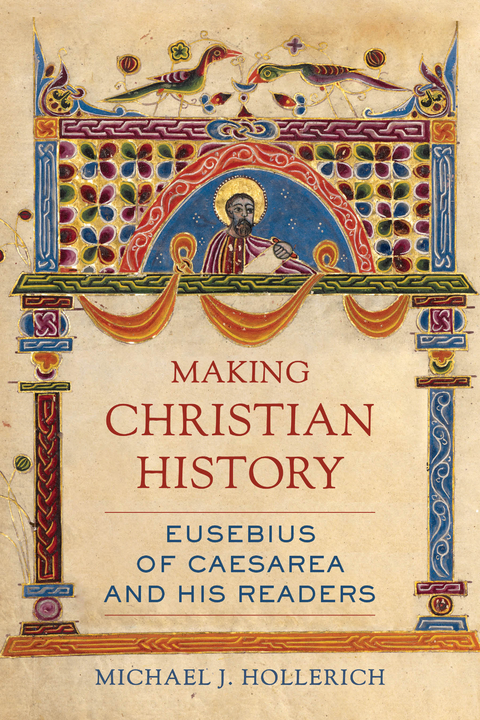
Making Christian History (eBook)
332 Seiten
University of California Press (Verlag)
9780520968134 (ISBN)
Eusebius’s text left its mark on Christian historical writing from late antiquity to the early modern period—across linguistic, cultural, political, and religious boundaries—until its encounter with modern historicism and postmodernism. Making Christian History demonstrates Eusebius’s vast influence throughout history, not simply in shaping Christian culture but also when falling under scrutiny as that culture has been reevaluated, reformed, and resisted over the past 1,700 years.
Abbreviations
Acknowledgments
1. Eusebius and His Ecclesiastical History
Eusebius as Transitional Figure
Eusebius's Historical Diptych: The Chronicle and the Ecclesiastical History
What Is "Ecclesiastical History," and Why Did Eusebius Write One?
An Untrodden Path? Eusebius’s Predecessors
2. The Reception of the Ecclesiastical History in a Christian Empire
The Manuscript Tradition as Reception History
Translations and Continuations in Antiquity
Eusebius's First Continuators: Rufinus of Aquileia and Gelasius of Caesarea
Eusebius's Ancient Greek Continuators: An Ecclesiastical History Canon
3. The Reception of the Ecclesiastical History in the Non-Greek East
Syriac Christianity: Historiography, Doctrinal Conflict, and Regime Change
Armenia: Adapting Eusebius on the Borderland of Rome and Persia
Eusebius in the Coptic Tradition: From Ecumenical to Ethnic Ecclesiastical History
4. The Reception of the Ecclesiastical History in the Latin West
The Ancient Latin Tradition after Rufinus
"National" Ecclesiastical History in the Middle Ages
Bede and Ecclesiastical History in Anglo-Saxon England: Eusebius's Heir and Critic
Eusebius and Frankish Identity: The Cult of the Book
A Norman Ecclesiastical History: Orderic Vitalis
Ecclesiastical History in a Corpus Christianum
5. Eusebius in Byzantium
John Malalas and His Chronicle
The Paschal Chronicle
George Synkellos and Theophanes: At the Summit of Byzantine Chronography
Nicephorus Callistus Xanthopulus and the Return of Ecclesiastical History
6. Eusebius Rediscovered in Early Modernity: Renaissance, Reformation, and the Republic of Letters
The Ecclesiastical History and Renaissance Humanism: Humanist Historiography and Sacred History
Eusebius in a Confessional Age: From Humanist Retrieval to the Weaponizing of Ecclesiastical History
Eusebius in the Republic of Letters
7. Reading Eusebius in Modernity and Postmodernity: The Ecclesiastical History in Modern Scholarship
In Search of Patrons: The Ecclesiastical History and Its Modern History of Publication
Critical Reception I: Secular
Critical Reception II: Religious and Theological
Ecclesiastical History and Its Future
Bibliography
Index
| Erscheint lt. Verlag | 22.6.2021 |
|---|---|
| Reihe/Serie | Christianity in Late Antiquity | Christianity in Late Antiquity |
| Sprache | englisch |
| Themenwelt | Geschichte ► Allgemeine Geschichte ► Altertum / Antike |
| Geisteswissenschaften ► Geschichte ► Regional- / Ländergeschichte | |
| Geschichte ► Teilgebiete der Geschichte ► Religionsgeschichte | |
| Religion / Theologie ► Christentum ► Kirchengeschichte | |
| Recht / Steuern ► Allgemeines / Lexika | |
| Recht / Steuern ► Öffentliches Recht ► Kirchenrecht | |
| ISBN-13 | 9780520968134 / 9780520968134 |
| Informationen gemäß Produktsicherheitsverordnung (GPSR) | |
| Haben Sie eine Frage zum Produkt? |
 EPUB (Adobe DRM)
Kopierschutz: Adobe-DRM
Adobe-DRM ist ein Kopierschutz, der das eBook vor Mißbrauch schützen soll. Dabei wird das eBook bereits beim Download auf Ihre persönliche Adobe-ID autorisiert. Lesen können Sie das eBook dann nur auf den Geräten, welche ebenfalls auf Ihre Adobe-ID registriert sind.
Details zum Adobe-DRM
Dateiformat: EPUB (Electronic Publication)
EPUB ist ein offener Standard für eBooks und eignet sich besonders zur Darstellung von Belletristik und Sachbüchern. Der Fließtext wird dynamisch an die Display- und Schriftgröße angepasst. Auch für mobile Lesegeräte ist EPUB daher gut geeignet.
Systemvoraussetzungen:
PC/Mac: Mit einem PC oder Mac können Sie dieses eBook lesen. Sie benötigen eine
eReader: Dieses eBook kann mit (fast) allen eBook-Readern gelesen werden. Mit dem amazon-Kindle ist es aber nicht kompatibel.
Smartphone/Tablet: Egal ob Apple oder Android, dieses eBook können Sie lesen. Sie benötigen eine
Geräteliste und zusätzliche Hinweise
Buying eBooks from abroad
For tax law reasons we can sell eBooks just within Germany and Switzerland. Regrettably we cannot fulfill eBook-orders from other countries.
aus dem Bereich