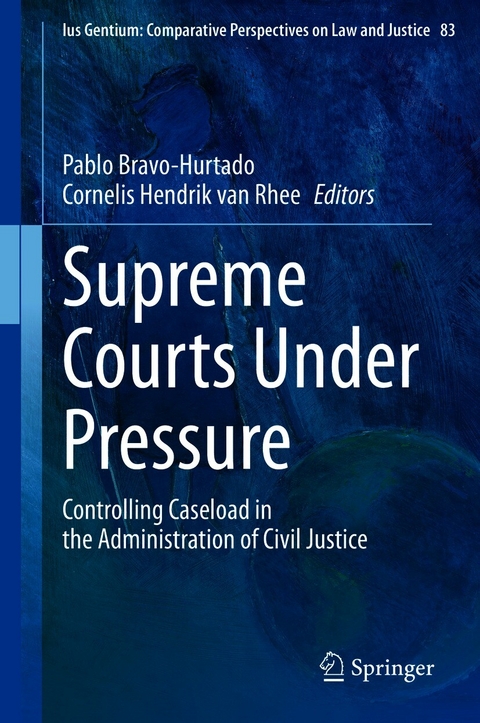
Supreme Courts Under Pressure (eBook)
VII, 233 Seiten
Springer International Publishing (Verlag)
978-3-030-63731-6 (ISBN)
This book discusses civil litigation at the supreme courts of nine jurisdictions - Argentina, Austria, Croatia, England and Wales, France, Germany, Italy, Spain and the United States - and focuses on the available instruments used to keep the caseload of these courts within acceptable limits. Such instruments are necessary in order to allow supreme courts to fulfil their main duties, that is, the administration of justice in individual cases (private function) and providing for the uniformity and development of the law within their respective jurisdictions (public function). If the number of cases at the supreme court level is too high, the result is undue delays, which are mainly problematic with regard to the private function. It may also put the quality of the court's judgments under pressure, which can affect its public and private function alike. Thus, measures aimed at avoiding excessive caseloads need to take both functions into account.
Increasing the capacity of the court to handle larger numbers of cases may result in the court being unable to adequately fulfil its public function, since large numbers of court decisions make it difficult to guarantee the uniformity of the law and its development. Therefore, a balanced approach is needed to safeguard capacity and quality. As shown by the contributions gathered here, the nature of reform in this area is not the same everywhere. There are a variety of reasons for this heterogeneity, ranging from different understandings of the caseload problem itself, local conceptions regarding the purpose of the Supreme Court, and strong entitlements concerning the right to appeal to budgetary restrictions and extremely rigid legislation. The book also shows that the implementation of similar solutions to case overload, such as access filters, may have different effects in different jurisdictions. The conclusion might well be that the problem of overburdened courts is multifactorial and context-dependent, and that easy, one-size-fits-all solutions are hard to find and perhaps even harder to implement.
Pablo Bravo-Hurtado is associate professor of civil procedure at the Catholic University of Valparaíso (PUCV) in Chile and project director of the Centre of Law Artificial Intelligence and Technology of (PUCV). Bravo-Hurtado taught civil procedure and Chilean legal history at the Catholic University of Temuco (Chile) (2010-2013) and comparative civil procedure and European legal history at Maastricht University (Netherlands) (2014-2017), before being appointed at PUCV where he teaches civil procedure and artificial intelligence and law.
C.H. (Remco) van Rhee is professor of European legal history and comparative civil procedure at Maastricht University in the Netherlands and director of the programme 'Foundations and Principles of Civil Procedure in Europe' of the Ius Commune Research School. van Rhee taught Roman law at the University of Leiden (Netherlands) (1991-1994) and property and civil procedure at the University of Utrecht (Netherlands) (1994-1998) before being appointed at Maastricht University to the chair of European Legal History and Comparative Civil Procedure.
| Erscheint lt. Verlag | 13.3.2021 |
|---|---|
| Reihe/Serie | Ius Gentium: Comparative Perspectives on Law and Justice | Ius Gentium: Comparative Perspectives on Law and Justice |
| Zusatzinfo | VII, 233 p. 5 illus. |
| Sprache | englisch |
| Themenwelt | Recht / Steuern ► EU / Internationales Recht |
| Recht / Steuern ► Privatrecht / Bürgerliches Recht | |
| Schlagworte | Access Filters • civil procedure • Permission to Appeal • Private Function Supreme Court • Public Function Supreme Court • Supreme courts |
| ISBN-10 | 3-030-63731-X / 303063731X |
| ISBN-13 | 978-3-030-63731-6 / 9783030637316 |
| Informationen gemäß Produktsicherheitsverordnung (GPSR) | |
| Haben Sie eine Frage zum Produkt? |
 PDF (Wasserzeichen)
DRM: Digitales Wasserzeichen
Dieses eBook enthält ein digitales Wasserzeichen und ist damit für Sie personalisiert. Bei einer missbräuchlichen Weitergabe des eBooks an Dritte ist eine Rückverfolgung an die Quelle möglich.
Dateiformat: PDF (Portable Document Format)
Mit einem festen Seitenlayout eignet sich die PDF besonders für Fachbücher mit Spalten, Tabellen und Abbildungen. Eine PDF kann auf fast allen Geräten angezeigt werden, ist aber für kleine Displays (Smartphone, eReader) nur eingeschränkt geeignet.
Systemvoraussetzungen:
PC/Mac: Mit einem PC oder Mac können Sie dieses eBook lesen. Sie benötigen dafür einen PDF-Viewer - z.B. den Adobe Reader oder Adobe Digital Editions.
eReader: Dieses eBook kann mit (fast) allen eBook-Readern gelesen werden. Mit dem amazon-Kindle ist es aber nicht kompatibel.
Smartphone/Tablet: Egal ob Apple oder Android, dieses eBook können Sie lesen. Sie benötigen dafür einen PDF-Viewer - z.B. die kostenlose Adobe Digital Editions-App.
Buying eBooks from abroad
For tax law reasons we can sell eBooks just within Germany and Switzerland. Regrettably we cannot fulfill eBook-orders from other countries.
aus dem Bereich