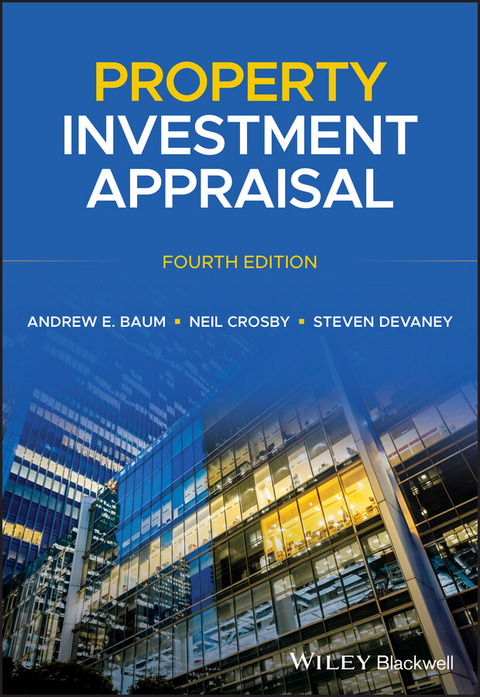
Property Investment Appraisal (eBook)
John Wiley & Sons (Verlag)
978-1-118-39953-8 (ISBN)
Discover an insightful examination of the property investment appraisal process from leaders in the industry
This book explains the process of property investment appraisal: the process of estimating both the most likely selling price (market value) and the worth of property investments to individuals or groups of investors (investment value).
Valuations are important. They are used as a surrogate for transactions in the measurement of investment performance and they influence investors and other market operators when transacting property. Valuations need to be trusted by their clients and valuers need to produce rational and objective solutions. Appraisals of worth are even more important, as they help to determine the prices that should be paid for assets, even in times of crisis, and they can indicate market under- or over-pricing.
In a style that makes the theory as well as the practice of valuation accessible to students and practitioners, the authors provide a valuable critique of conventional valuation methods and argue for the adoption of more contemporary cash-flow methods. They explain how such valuation models are constructed and give useful examples throughout. They also show how these contemporary cash-flow methods connect market valuations with rational appraisals.
The UK property investment market has been through periods of both boom and bust since the first edition of this text was produced in 1988. As a result, the book includes examples generated by vastly different market states. Complex reversions, over-rented properties and leaseholds are all fully examined by the authors.
This Fourth Edition includes new material throughout, including brand new chapters on development appraisals and bank lending valuations, heavily revised sections on discounted cash flow models with extended examples, and on the measurement and analysis of risk at an individual property asset level. The heart of the book remains the critical examination of market valuation models, which no other book addresses in such detail.
ANDREW E. BAUM is Professor of Practice at the Saïd Business School, University of Oxford, where he leads the Future of Real Estate Initiative. He is also Senior Research Fellow at Green Templeton College and Emeritus Professor at the University of Reading. He is Chairman of Newcore Capital Management and advisor to several property organisations. He has held senior positions with Nuveen, CBRE Global Investors, Grosvenor and other investors and fund managers.
NEIL CROSBY is Professor of Real Estate in the Department of Real Estate and Planning at the University of Reading. He is a Fellow of the Academy of Social Sciences, has been awarded life membership of the Investment Property Forum and a fellowship of the Society of Property Researchers, and is a member of the RICS Valuation Standards Board. He originally qualified and practised as a Chartered Valuation Surveyor in the UK before holding academic positions at Nottingham Trent and Oxford Brookes Universities.
STEVEN DEVANEY is an Associate Professor at the Henley Business School, University of Reading, where he teaches both investment appraisal and market valuation methods. He was previously a Lecturer in Real Estate at the University of Aberdeen and worked as an analyst at Investment Property Databank.
ANDREW E. BAUM is Professor of Practice at the Saïd Business School, University of Oxford, where he leads the Future of Real Estate Initiative. He is also Senior Research Fellow at Green Templeton College and Emeritus Professor at the University of Reading. He is Chairman of Newcore Capital Management and advisor to several property organisations. He has held senior positions with Nuveen, CBRE Global Investors, Grosvenor and other investors and fund managers. NEIL CROSBY is Professor of Real Estate in the Department of Real Estate and Planning at the University of Reading. He is a Fellow of the Academy of Social Sciences, has been awarded life membership of the Investment Property Forum and a fellowship of the Society of Property Researchers, and is a member of the RICS Valuation Standards Board. He originally qualified and practised as a Chartered Valuation Surveyor in the UK before holding academic positions at Nottingham Trent and Oxford Brookes Universities. STEVEN DEVANEY is an Associate Professor at the Henley Business School, University of Reading, where he teaches both investment appraisal and market valuation methods. He was previously a Lecturer in Real Estate at the University of Aberdeen and worked as an analyst at Investment Property Databank.
1
Property Investment Appraisal in its Context
1.1 What is Appraisal?
The subject of this book is the appraisal of property, or real estate, investments. In choosing the term ‘appraisal’, we have two distinct applications in mind.
The first of these is market valuation; this means to fix a price for an asset, or to predict the most likely selling price of an asset.
The second is investment appraisal. This means to estimate the worth or value of an asset.
The book is concerned with the difference between these two terms. While a market valuation will tell us what a property asset is likely to sell for, an investment appraisal will tell us what the asset is worth to us. In a scenario where we wish to acquire a property, comparison of these appraisals can help us answer the following question: should we pay the market price – or not?
There is now widespread acceptance of the international definition of Market Value set out in the valuation standards of the International Valuation Standards Council (IVSC), which is commonly known as ‘the White Book’. This definition is
the estimated amount for which an asset or liability should exchange on the valuation date between a willing buyer and a willing seller in an arm's length transaction after proper marketing and where the parties had each acted knowledgeably, prudently, and without compulsion.
(IVSC 2019)
Many nations feel the need to have their own valuation standards, not least the UK, whose standards (maintained by the Royal Institution of Chartered Surveyors [RICS]) have been through a number of editions of what is commonly referred to as ‘the Red Book’. The latest edition (RICS 2020a) adopts the aforementioned international definition of Market Value. There are also some regional standards such as the European ‘Blue Book’ published by TEGOVA, The European Group of Valuers Associations. This has in the past created some tension and rivalry between international, regional, and national bodies, particularly in Europe. Yet there is now very little disagreement, if any, on the general wording of the Market Value definition, even if there are some differences in interpretation. Hopefully, these differences will continue to diminish as the property investment market becomes more and more international.
Investment appraisal, or the estimation of worth or value, is not necessarily market-based. Between the second and third editions of this book, this concept was both developed and institutionalised, having entered UK valuation standards in the 1990s as the ‘calculation of worth’. It was subsequently defined in International Valuation Standards under the term ‘Investment Value’. Up until 2013, this was defined as:
the value of property to a particular investor or class of investors, for identified investment objectives. This subjective concept relates specific property to a specific investor, group of investors, or entity with identifiable investment objectives and/or criteria.
(IVSC 2007)
This definition blurred a major issue, specifically whether worth or value is to an individual investor or to a group of investors. This question has significant implications about how value might be assessed in practice, as the value to an individual and the value to a group may not be the same. However, in the 2013 edition, the IVSC changed the definition and came down heavily on the side of Investment Value representing worth to the individual investor rather than to a group or the market. The latest definition is:
the value of an asset to a particular owner or prospective owner for individual investment or operational objectives.
(IVSC 2019)
Individual investors are influenced by a set of criteria through which the value of an asset might be assessed. For example, their tax situation, the rate at which they can borrow, how much equity capital they have, what adjoining assets they own, and the strengths and weaknesses of their existing investment portfolio are all factors that may lead them to perceive value in a particular property.
Hence, while all investors may agree upon such important variables as the size of the asset being appraised and the cash flow implications of the lease, individual investors will often be subject to different motivations (see Chapter 2). As will be shown later in this book, the distinction between the estimated price (Market Value) and worth (Investment Value) can be important.
Further, it is possible that a group of investors will share the same characteristics and use similar criteria, the result being that they attach a similar value to a particular property asset. Ascertaining the possible buyer group is very relevant to appraisal and the appraisal process includes identifying objectively measured market variables and the prospective owner's (or group of owners') subjective estimates of other relevant factors. Hence, we believe that there are three basic concepts of value attached to appraisal: first, Market Value or exchange price; second, worth to a group or the market place; and, third, worth to the individual. Investment Value was in previous definitions used to cover both the second and third concepts, but worth to the individual is now the sole basis of Investment Value. We believe that this leaves a definitional hole. Assets can be valued differently to exchange price not just because a specific investor has particular characteristics relating to tax, debt, or other reasons; there are plenty of examples of where the market as a whole did not recognise certain characteristics concerning the asset causing them to under- or over-price properties as a consequence.
The term ‘appraisal’ covers all three processes. We use the term market valuation for the process of estimating Market Value (the prediction of the most likely selling price) and we continue to use Investment Value for both worth to the market and the individual, and will be specific about which is which in the text. We hope this will not cause confusion. It is a shame that the possibility of confusion exists, largely because the development of property terminology has been influenced by the isolation of the property world from other financial markets. There is no doubt regarding the meaning of valuation in the securities markets: it means the estimation of worth. Market valuation (or pricing) is a function that is carried out by buyers, sellers, and market makers. The price of a particular company in the stock market is publicly quoted, and large numbers of identical shares in that company can be bought and sold at that price. There is no need to employ a valuer to estimate the Market Value (or most likely selling) price of a publicly listed share – that price is available on a screen in real time.
In property, however, prices are not available, because each property is unique, the market is private, and there are no market makers. The price at which a transaction will take place will be influenced by an expert opinion – a ‘valuation’ – because there is insufficient market evidence and insufficient homogeneity of product for traders to be able to fix prices. While there may be some consensus regarding the most likely selling price or Market Value, it is to be expected that, at any one time, different views of worth will be held by different individuals and groups. These differences will fuel market turnover: those who believe that the Market Value is higher than the worth of the asset to them will sell; those who believe that the worth to them is higher than Market Value will buy.
Two other concepts of value need to be considered. First, International Financial Reporting Standards (IFRS) contain a definition of value for use in financial reporting that is termed Fair Value. The definition is
The price that would be received to sell an asset or paid to transfer a liability in an orderly transaction between market participants on the measurement date.
(IASB, 2020)
This definition is expanded upon in IFRS 13. However, it can be seen that there are strong similarities with Market Value given the focus on exchange price in the context of an assumed transaction at the date of measurement. In fact, the RICS (2020a) suggests that the definitions of Fair Value and Market Value are consistent for most practical purposes. Given this, it was confusing that International Valuation Standards contained a definition of Fair Value that differed from both Market Value and the IFRS definition. The IVS definition also focused on exchange price, but dropped some of the requirements of Market Value by allowing specific circumstances affecting the parties involved to be taken into account. This concept has since been renamed Equitable Value and we do not consider it any further.
Another concept and definition of value that is not included in International Valuation Standards is Sustainable or Long Term Value. This cannot be ignored in the wake of the Global Financial Crisis (GFC) and the part that both residential and commercial real estate played in that crisis. The term ‘sustainable’ is used in the sense that it can be sustained through time and it is the basis for Mortgage Lending Value, a concept used by some European banks as a risk-management tool for their commercial loan books. Mortgage Lending Value is part of the Basel accords, along with Market Value, and is used in the determination of...
| Erscheint lt. Verlag | 20.1.2021 |
|---|---|
| Sprache | englisch |
| Themenwelt | Recht / Steuern ► Wirtschaftsrecht |
| Wirtschaft ► Betriebswirtschaft / Management ► Rechnungswesen / Bilanzen | |
| Betriebswirtschaft / Management ► Spezielle Betriebswirtschaftslehre ► Immobilienwirtschaft | |
| Schlagworte | Accounting • bank lending valuations • Bewertung • Business & Management • complex reversions • Immobilien • Immobilien u. Grundbesitz • <p>Property appraisal • over-rented leaseholds </p> • over-rented properties • Property & Real Estate • Real estate appraisal • real estate investing • real estate investment appraisal • real estate valuations • real property appraisal • Rechnungswesen • Valuation • Wirtschaft u. Management |
| ISBN-10 | 1-118-39953-6 / 1118399536 |
| ISBN-13 | 978-1-118-39953-8 / 9781118399538 |
| Informationen gemäß Produktsicherheitsverordnung (GPSR) | |
| Haben Sie eine Frage zum Produkt? |
 EPUB (Adobe DRM)
Kopierschutz: Adobe-DRM
Adobe-DRM ist ein Kopierschutz, der das eBook vor Mißbrauch schützen soll. Dabei wird das eBook bereits beim Download auf Ihre persönliche Adobe-ID autorisiert. Lesen können Sie das eBook dann nur auf den Geräten, welche ebenfalls auf Ihre Adobe-ID registriert sind.
Details zum Adobe-DRM
Dateiformat: EPUB (Electronic Publication)
EPUB ist ein offener Standard für eBooks und eignet sich besonders zur Darstellung von Belletristik und Sachbüchern. Der Fließtext wird dynamisch an die Display- und Schriftgröße angepasst. Auch für mobile Lesegeräte ist EPUB daher gut geeignet.
Systemvoraussetzungen:
PC/Mac: Mit einem PC oder Mac können Sie dieses eBook lesen. Sie benötigen eine
eReader: Dieses eBook kann mit (fast) allen eBook-Readern gelesen werden. Mit dem amazon-Kindle ist es aber nicht kompatibel.
Smartphone/Tablet: Egal ob Apple oder Android, dieses eBook können Sie lesen. Sie benötigen eine
Geräteliste und zusätzliche Hinweise
Buying eBooks from abroad
For tax law reasons we can sell eBooks just within Germany and Switzerland. Regrettably we cannot fulfill eBook-orders from other countries.
aus dem Bereich