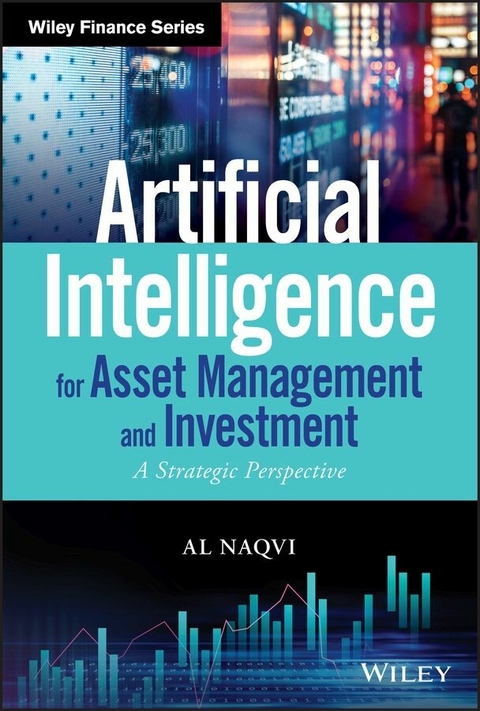
Artificial Intelligence for Asset Management and Investment (eBook)
John Wiley & Sons (Verlag)
978-1-119-60184-5 (ISBN)
Make AI technology the backbone of your organization to compete in the Fintech era
The rise of artificial intelligence is nothing short of a technological revolution. AI is poised to completely transform asset management and investment banking, yet its current application within the financial sector is limited and fragmented. Existing AI implementations tend to solve very narrow business issues, rather than serving as a powerful tech framework for next-generation finance. Artificial Intelligence for Asset Management and Investment provides a strategic viewpoint on how AI can be comprehensively integrated within investment finance, leading to evolved performance in compliance, management, customer service, and beyond.
No other book on the market takes such a wide-ranging approach to using AI in asset management. With this guide, you'll be able to build an asset management firm from the ground up-or revolutionize your existing firm-using artificial intelligence as the cornerstone and foundation. This is a must, because AI is quickly growing to be the single competitive factor for financial firms. With better AI comes better results. If you aren't integrating AI in the strategic DNA of your firm, you're at risk of being left behind.
- See how artificial intelligence can form the cornerstone of an integrated, strategic asset management framework
- Learn how to build AI into your organization to remain competitive in the world of Fintech
- Go beyond siloed AI implementations to reap even greater benefits
- Understand and overcome the governance and leadership challenges inherent in AI strategy
Until now, it has been prohibitively difficult to map the high-tech world of AI onto complex and ever-changing financial markets. Artificial Intelligence for Asset Management and Investment makes this difficulty a thing of the past, providing you with a professional and accessible framework for setting up and running artificial intelligence in your financial operations.
AL NAQVI is the CEO of the American Institute of Artificial Intelligence, where he designs and develops machine learning based finance products, teaches classes on applied AI, deep learning, and cognitive transformation, and leads the company strategy. He studies the application of deep learning to financial engineering, investment, and asset management. He is also the author of Artificial Intelligence for Audit, Forensic Accounting, and Valuation (Wiley).
Make AI technology the backbone of your organization to compete in the Fintech era The rise of artificial intelligence is nothing short of a technological revolution. AI is poised to completely transform asset management and investment banking, yet its current application within the financial sector is limited and fragmented. Existing AI implementations tend to solve very narrow business issues, rather than serving as a powerful tech framework for next-generation finance. Artificial Intelligence for Asset Management and Investment provides a strategic viewpoint on how AI can be comprehensively integrated within investment finance, leading to evolved performance in compliance, management, customer service, and beyond. No other book on the market takes such a wide-ranging approach to using AI in asset management. With this guide, you ll be able to build an asset management firm from the ground up or revolutionize your existing firm using artificial intelligence as the cornerstone and foundation. This is a must, because AI is quickly growing to be the single competitive factor for financial firms. With better AI comes better results. If you aren t integrating AI in the strategic DNA of your firm, you re at risk of being left behind. See how artificial intelligence can form the cornerstone of an integrated, strategic asset management framework Learn how to build AI into your organization to remain competitive in the world of Fintech Go beyond siloed AI implementations to reap even greater benefits Understand and overcome the governance and leadership challenges inherent in AI strategy Until now, it has been prohibitively difficult to map the high-tech world of AI onto complex and ever-changing financial markets. Artificial Intelligence for Asset Management and Investment makes this difficulty a thing of the past, providing you with a professional and accessible framework for setting up and running artificial intelligence in your financial operations.
AL NAQVI is the CEO of the American Institute of Artificial Intelligence, where he designs and develops machine learning based finance products, teaches classes on applied AI, deep learning, and cognitive transformation, and leads the company strategy. He studies the application of deep learning to financial engineering, investment, and asset management. He is also the author of Artificial Intelligence for Audit, Forensic Accounting, and Valuation (Wiley).
Preface
ARE YOU SEEKING A BOOK on artificial intelligence (AI) in finance? Good news and not so good news. Good news is that you are likely to find many books; bad news is that most of those are written by quants and for quants. Riddled with complex math equations, proofs, and theorems, these books speak a language that many people do not understand.
It is as if authors want to demonstrate how much they know about machine learning but not tell you what you need to know. The tone is often ridiculing, even insulting, as if each sentence is coded language to discourage nonmembers from entering the exclusive club of AI. In some cases, the tone is demeaning toward even other quants, with the connotation of “you don't know, we know” position. The subtle undertone is clear: if you do not understand complex math and data science, you do not deserve to enter the amazing world of AI. This esoteric, closed, and limited membership in AI is problematic at many levels.
If you have not spent decades in the investment world and you talk to some hardcore finance professionals, they will remind you that if you are an experienced data scientist, then you don't belong in the industry. You will be labeled as “too naive” or “too young” or “too inexperienced.” If you are an expert in deep learning and reinforcement learning, they will tell you that you have no use in the finance world. They will argue that deep learning and reinforcement learning are not being extensively used in finance (what they are really saying is that they are not using these models, and they have not seen those being widely used in practice). This criticism of machine learning professionals can be viewed as a mix of some reality and a bit of fear of the unknown.
Do not get me wrong. Certain authors are well-meaning and direct. They point out the gaps and show how to close them. They recognize that one must be blunt and direct to show the weaknesses. For instance, De Prado's approach is a passionate wake-up call for many quant organizations, and I am confident his work saved billions of dollars and avoided many unnecessary catastrophes (De Prado, Advances in Financial Machine Learning, Wiley 2018). I am referring to those who point out problems but never provide solutions.
It is true that finance machine learning is different. The signal-to-noise ratio is low. You are dealing with a dynamic and constantly changing system. Your every action is under scrutiny. You are dealing with significant amounts of unstructured data. You could be identifying relationships and then trying to discover the theory of attempting to explain what is transpiring. Many interesting finds are prone to overfitting. You are operating in an environment that is not only constantly changing—your interaction with it is exposing your strategy, and hence your strategy is subject to constant reinvention.
Now come to the non-quant consulting club. There are several people who are trivializing AI. This is the hype club that opens every AI conversation with a vague, astrology-styled notion of future of work, and the next words in those conversations are almost always deep learning, AlphaGo, and IBM AI winning the Jeopardy! contest. When quants hear that, they get frustrated—and rightfully so. In the words of the great master, “Everything should be made as simple as possible, but no simpler” (Albert Einstein). The hype club is composed of classical digital era consultants who are trying to figure out how to apply their ERP and CRM playbooks to get machine learning working. That approach will not work.
This book is neither a manual to implement quantamental algorithms nor a buzz-filled consulting talk of the hype club. It is a practical manual that can be used by both parties—quantitatively oriented investment managers and the leaders of support functions in asset management. It is a pragmatic approach to build a modern asset management firm. It is written with the intent to bring both quants and non-quants together to rebuild their firms around AI and do that based on the scientific method.
If asset management was all about quantitative strategies, then you would not need sales organizations. If AI was only for quantitative strategies, then you would not see AI in any other function such as marketing, sales, human resources, and others. An asset management firm is more than just its investment wing, and AI is more than just for the quant departments.
Yet, if Nabisco didn't make good cookies, then regardless of how well the support function performs, cookies would not sell. In other words, the investment function is at the heart of asset management, and that function must be realigned with the developments in the financial machine learning. The traditional statistical solutions are inefficient and ineffective to deal with the nature of problems, the datasets, the unstructured nature of data, the sparse high-dimensional data, and the rapidly changing investment environment. Top-down theory application can only go so far. A new way of doing things is needed.
To read this book, you do not need to have a PhD in math or computer science or data science. If you have one, that will help you acquire the strategic business action plan for transforming an investment management firm. If you come from business, analytics, financial, or strategy sides, this book will introduce you to the fascinating world of AI. The point is that whether your starting point is mathematics, computer science, or data science—or your entry point is business, finance, or strategy—to be successful today you need to learn how to create investment transformation. And the only way that transformation happens is when all parties—technologists, investment professionals, and businesspeople—meet in the middle. That meeting point is known as the AI transformational space.
This is the first book on the strategic perspective of artificial intelligence in investment management that gives you a comprehensive plan for AI-centric transformation. The goal of the book is to help you build a powerful firm by navigating through the complex and fascinating world of AI.
To keep machine learning trapped in the quantitative investment departments is dangerous. First, it assumes that machine learning is only applicable in trading-centric investment operations. It ignores the fact that machine learning is a pervasive technology that is being used and deployed in all areas of an asset management firm. Those areas include marketing, human resources, sales, compliance, corporate social responsibility (CSR), and many others. Second, it incorrectly assumes that people with PhDs in mathematics, computer science, or AI are the only ones interested in AI. This assumption is often based on the historical roots of machine learning, when it was viewed as the exclusive toolkit of quantitative investment in legacy firms. That exclusivity is no longer true. Third, this closed, cult-style adherence is extremely dangerous as it assumes that a firm's business model is static. It ignores the fact that fintech start-ups and tech firms are entering the legacy space and architecting their business models with AI—and that responding to such a powerful competitive threat requires a far more strategic approach to AI in finance than the one that comes with quantitative investment only. Fourth, to build a modern firm, you must approach AI as a strategic process that is embedded in the strategic DNA of the firm and as an industrial-scale machine learning operation. To do that, you must have an enterprise-level approach and not just a quant-specific viewpoint.
However, trivializing AI as some fictional, motivational, hyped-up, or management-consulting buzz phenomenon is equally dangerous. That approach can win some near-term contracts but generally leads to disappointment in the long run. Projects fail or fail to deliver the promised value. When Robotic Process Automation (RPA) is sold as AI and AI is sold as a point solution while ignoring the data, it hurts all parties.
The reality is that the asset and investment management world is at the cusp of a major transformation. This transformation is not an ordinary evolution in the normal course of business. It is a revolutionary change that is creating never-seen-before opportunities and threats. It has unleashed an enormous force that is demanding new ways to respond to the challenge.
Thus, AI must not be approached as a toolkit, merely a technology, or a hyped-up technological change. It is pervasive and transformative. It is revolutionary and emergent. Most importantly, this change belongs to everyone and not just a narrow segment of your workforce. To begin with, the C-suites and boards need to understand this change. They are at the helm of their business, and the introduction of AI has altered the strategic maps. They need to rethink how to navigate through these troubled waters. Then, heads of departments of all functional areas—marketing, sales, regulatory and compliance, human resources, procurement, and others—must develop AI-centric transformation plans. Their plans should be consistent with the strategy of the firm. In addition to the support organizations, the investment operation should be approached strategically. The process, incentive systems, organizational setup, and theoretical foundations on how investment organizations are set up should be questioned. The powerful rise of AI and its effect on asset management compel us to rethink our business models.
This book, therefore, is a guide for every person who is in any manner affiliated with the finance industry. From asset...
| Erscheint lt. Verlag | 13.1.2021 |
|---|---|
| Reihe/Serie | Wiley Finance |
| Wiley Finance Editions | Wiley Finance Editions |
| Sprache | englisch |
| Themenwelt | Recht / Steuern ► Wirtschaftsrecht |
| Wirtschaft ► Betriebswirtschaft / Management ► Finanzierung | |
| Schlagworte | AI • Artificial Intelligence • Asset Management • Business Strategy • Finance & Investments • Finance & Investments Special Topics • finance business strategy • financial AI • financial services management • Financial Technology • Finanz- u. Anlagewesen • Finanzwesen • FinTech • Investment banking • Investment Management • KI • Künstliche Intelligenz • Spezialthemen Finanz- u. Anlagewesen • technology strategy |
| ISBN-10 | 1-119-60184-3 / 1119601843 |
| ISBN-13 | 978-1-119-60184-5 / 9781119601845 |
| Informationen gemäß Produktsicherheitsverordnung (GPSR) | |
| Haben Sie eine Frage zum Produkt? |
 EPUB (Adobe DRM)
Kopierschutz: Adobe-DRM
Adobe-DRM ist ein Kopierschutz, der das eBook vor Mißbrauch schützen soll. Dabei wird das eBook bereits beim Download auf Ihre persönliche Adobe-ID autorisiert. Lesen können Sie das eBook dann nur auf den Geräten, welche ebenfalls auf Ihre Adobe-ID registriert sind.
Details zum Adobe-DRM
Dateiformat: EPUB (Electronic Publication)
EPUB ist ein offener Standard für eBooks und eignet sich besonders zur Darstellung von Belletristik und Sachbüchern. Der Fließtext wird dynamisch an die Display- und Schriftgröße angepasst. Auch für mobile Lesegeräte ist EPUB daher gut geeignet.
Systemvoraussetzungen:
PC/Mac: Mit einem PC oder Mac können Sie dieses eBook lesen. Sie benötigen eine
eReader: Dieses eBook kann mit (fast) allen eBook-Readern gelesen werden. Mit dem amazon-Kindle ist es aber nicht kompatibel.
Smartphone/Tablet: Egal ob Apple oder Android, dieses eBook können Sie lesen. Sie benötigen eine
Geräteliste und zusätzliche Hinweise
Buying eBooks from abroad
For tax law reasons we can sell eBooks just within Germany and Switzerland. Regrettably we cannot fulfill eBook-orders from other countries.
aus dem Bereich