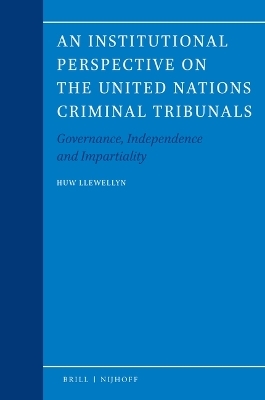
An Institutional Perspective on the United Nations Criminal Tribunals
Martinus Nijhoff (Verlag)
978-90-04-44769-1 (ISBN)
Huw Llewellyn offers a comparative institutional analysis of the five United Nations criminal tribunals (for the former Yugoslavia, Rwanda, Sierra Leone, Cambodia and Lebanon), assessing the strengths and weaknesses of their institutional forms in supporting the governance, independence and impartiality of these pioneering criminal justice bodies.
Largely overlooked in the otherwise comprehensive literature on international criminal justice, this book focuses on “parenthood”, “oversight” and “ownership” by the tribunals’ governing bodies, concepts unnecessary in national jurisdictions, and traces the tension between governance and judicial independence through the different phases of the tribunals’ lifecycles: from their establishment to commencement of operations, completion of mandates and closure, and finally to the “afterlife” of their residual phase.
Huw Llewellyn, Ph.D. (2019), Leiden University, is Director of the Codification Division, United Nations Office of Legal Affairs, New York. He has published articles on a number of public international law topics.
Foreword
Acknowledgements
Table of Treaties
Table of Cases
Table of Security Council resolutions
Table of Non-Binding International Instruments, Reports and Other Sources
1 The United Nations Criminal Tribunals and Their Oversight Bodies
1 An Institutional Perspective
2 The UN Criminal Tribunals and Their Oversight Bodies
3 The Lifecycle of the UN Criminal Tribunals and the Residual Bodies
4 Governance, Independence and Impartiality
2 Essential Concepts: Governance, Independence and Impartiality
1 The Universe of the Tribunals’ Relationships
1.1 The Universe
1.2 Parenthood and Oversight
1.3 Ownership
2 The Right to a Competent, Independent and Impartial Tribunal Established by Law
2.1 The Status of the Right to a Competent, Independent and Impartial Tribunal under International Law
2.2 Constitutional Establishment of the Tribunal: The Separation of Powers
2.3 Constitutional Establishment: Selection and Appointment of Senior Officials
2.4 Court Administration and Judicial Management
2.5 Resources
3 Governance
4 Political Considerations: The Institutional Logic of the Actors in the Tribunal’s Universe
5 Lessons Learned
3 Establishment Part I
Institutional Architecture of the UN Criminal Tribunals
1 Establishment
2 The Institutional Architecture of the UN Criminal Tribunals
2.1 The ICTY and the ICTR
2.2 The Voluntarily Funded UN Criminal Tribunals
3 Legal Protections for the Independence and Impartiality of the UN Criminal Tribunals
3.1 The Constituent Instruments
3.2 Inherent Judicial Authority
3.3 General International Law: Multilateral Conventions, Customary International Law and General Principles of Law
3.4 Who Is Bound by the Legal Rules Protecting the Independence and Impartiality of the UN Criminal Tribunals?
4 Authority and Control
4.1 The Constituent Instruments
4.2 Principles of International Institutional Law Applicable to the UN Criminal Tribunals
4.3 Authority and Control Over a National Court: The ECCC
5 Lessons Learned
4 Establishment Part II
1 Completing the Institutional Architecture
2 Establishment of the Oversight Bodies
2.1 Oversight Bodies of the ICTY and the ICTR
2.2 The SCSL Management Committee
2.3 Oversight and Funding of the ECCC
2.4 The STL Management Committee
3 The Continual Dialogue on UN Criminal Tribunals’ Issues
4 Internal Governance of the UN Criminal Tribunals
5 Some Lessons Learned
5 Commencement and Functioning
1 Commencement
2 Selection, Appointment and Security of Tenure of the Judges and Other Senior Officials
2.1 Judges
2.2 Prosecutors
2.3 Registrars and Tribunal Administrators
3 Transition from Existence on Paper to Functioning Tribunals
3.1 The ICTY and the ICTR
3.2 The Voluntarily Funded UN Criminal Tribunals
4 Oversight, Judicial Management and Independence
4.1 Oversight Activities
4.2 Oversight and Judicial Management
5 Lessons Learned
6 Completion and Closure
1 Completion and Closure
2 A Brief History of Time: The Development of the Completion Strategies
2.1 The ICTY and the ICTR
2.2 The Voluntarily Funded UN Criminal Tribunals
3 Independence, Impartiality and Completion Strategies
3.1 Completion Timelines: Suggested Criteria for Considering Their Compatibility with Independence and Impartiality
3.2 Completion Timelines: Impact on the Independence and Impartiality of the UN Criminal Tribunals?
3.3 Independence and Impartiality: Other Aspects of the ICTY and ICTR Completion Strategies
4 Completion and Closure
5 Lessons Learned
7 The Residual Phase
1 The Misnomer of “Residual” Functions
2 Residual Functions
2.1 Trial of Fugitives and Appeals
2.2 Trials and Appeals in Contempt Cases
2.3 Review of Judgments
2.4 Protection of Victims and Witnesses
2.5 Referral of Cases to National Jurisdictions and Revocation
2.6 Supervision of Enforcement of Sentences
2.7 Assistance to National Authorities
2.8 Protecting the Rights of the Accused and Convicted
2.9 Preservation and Management of the Archives
3 The UN Residual Bodies: Negotiation and Establishment
3.1 The Residual Mechanism for the ICTY and the ICTR
3.2 The Residual SCSL
4 The UN Residual Bodies: Institutional Architecture, Principles of International Institutional Law, Authority and Control
4.1 The Residual Mechanism
4.2 The Residual SCSL
4.3 Internal Governance of the UN Residual Bodies
5 The UN Residual Bodies: Legal Protections for Independence and Impartiality
5.1 Constituent Instruments
5.2 Inherent Judicial Authority
5.3 General International Law
5.4 Who Is Bound by the Legal Protections for the Independence and Impartiality of the UN Residual Bodies?
6 The UN Residual Bodies: Establishment of the Oversight Bodies and Funding Mechanisms
6.1 The Residual Mechanism
6.2 The Residual SCSL
7 The UN Residual Bodies: Commencement, Transitional Arrangements and Duration
8 UN Residual Bodies: Completion and Closure
9 Future UN Residual Bodies for the ECCC and the STL?
10 Challenges for the UN Residual Bodies in the Future
11 Lessons Learned
8 Conclusions
1 Parenthood, Oversight and Ownership, and the Independent and Impartial Functioning of the UN Criminal Tribunals
2 Lessons Learned from the Institutional Architecture of the UN Criminal Tribunals and Their Oversight Bodies
3 Lessons Learned from the Completion, Closure and Residual Phases of the UN Criminal Tribunals
4 Lessons Learned Relevant to Other International Criminal Justice Bodies
5 The Future of UN Engagement in International Criminal Justice Bodies
Bibliography
Index
| Erscheinungsdatum | 26.03.2021 |
|---|---|
| Reihe/Serie | Legal Aspects of International Organizations ; 62 |
| Sprache | englisch |
| Maße | 155 x 235 mm |
| Gewicht | 923 g |
| Themenwelt | Recht / Steuern ► Allgemeines / Lexika |
| Recht / Steuern ► EU / Internationales Recht | |
| Recht / Steuern ► Öffentliches Recht ► Völkerrecht | |
| ISBN-10 | 90-04-44769-5 / 9004447695 |
| ISBN-13 | 978-90-04-44769-1 / 9789004447691 |
| Zustand | Neuware |
| Informationen gemäß Produktsicherheitsverordnung (GPSR) | |
| Haben Sie eine Frage zum Produkt? |
aus dem Bereich