Real Estate Investment and Finance (eBook)
John Wiley & Sons (Verlag)
978-1-119-52615-5 (ISBN)
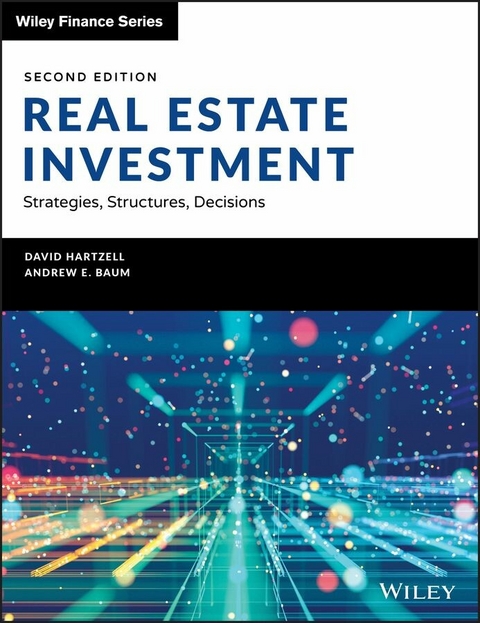
The fully revised and updated version of the leading textbook on real estate investment, emphasising real estate cycles and the availability and flow of global capital
Real Estate Investment remains the most influential textbook on the subject, used in top-tier colleges and universities worldwide. Its unique, practical perspective on international real estate investment focusses on real-world techniques which measure, benchmark, forecast and manage property investments as an asset class. The text examines global property markets and real estate cycles, outlines market fundamentals and explains asset pricing and portfolio theory in the context of real estate.
In the years since the text's first publication, conditions in global real estate markets have changed considerably following the financial crisis of 2008-2009. Real estate asset prices have increased past pre-crisis levels, signalling a general market recovery. Previously scarce debt and equity capital is now abundant, while many institutions once averse to acquiring property are re-entering the markets. The latest edition - extensively revised and updated to address current market trends and practices as well as reflect feedback from instructors and students - features new content on real estate development, improved practical examples, expanded case studies and more. This seminal textbook:
- Emphasises practical solutions to real investing problems rather than complex theory
- Offers substantial new and revised content throughout the text
- Covers topics such as valuation, leasing, mortgages, real estate funds, underwriting and private and public equity real estate
- Features up-to-date sections on performance measurement, real estate debt markets and building and managing real estate portfolios
- Includes access to a re-designed companion website containing numerous problems and solutions, presentation slides and additional instructor and student resources
Written by internationally-recognised experts in capital management and institutional property investing strategies, Real Estate Investment, Second Edition: Strategies, Structures, Decisions is an indispensable textbook for instructors and students of real estate fund management, investment management and investment banking, as well as a valuable reference text for analysts, researchers, investment managers, investment bankers and asset managers.
DAVID HARTZELL is Steven D. Bell and Leonard W. Wood Distinguished Professor of Finance and Real Estate and Director, Wood Center for Real Estate Studies, University of North Carolina. He is a Fellow of the Private Equity Research Consortium, Kenan Institute and serves on the Board of Directors of Highwoods Properties, a publicly traded Real Estate Investment Trust (REIT), and has served on the Investment Advisory Committee of the $100 billion North Carolina Retirement System.
ANDREW BAUM is Professor of Practice, Saïd Business School, University of Oxford and Professor Emeritus, University of Reading. He is Director of the Oxford Future of Real Estate Initiative, Chairman of Newcore Capital Management, and has held senior executive and non-executive positions with Grosvenor, The Crown Estate, CBRE Global Investors and others.
DAVID HARTZELL is Steven D. Bell and Leonard W. Wood Distinguished Professor of Finance and Real Estate and Director, Wood Center for Real Estate Studies, University of North Carolina. He is a Fellow of the Private Equity Research Consortium, Kenan Institute and serves on the Board of Directors of Highwoods Properties, a publicly traded Real Estate Investment Trust (REIT), and has served on the Investment Advisory Committee of the $100 billion North Carolina Retirement System. ANDREW BAUM is Professor of Practice, Saïd Business School, University of Oxford and Professor Emeritus, University of Reading. He is Director of the Oxford Future of Real Estate Initiative, Chairman of Newcore Capital Management, and has held senior executive and non-executive positions with Grosvenor, The Crown Estate, CBRE Global Investors and others.
Preface
It is a difficult challenge in a book like this which combines finance, law, and real estate to avoid over-complication while at the same time preventing over-simplification. This challenge is amplified many times when adopting a global perspective. In addition to periodic shocks and crashes (the latest of which, COVID-19, has shaken the foundations of real estate markets and challenged the globalization of finance), there are many different systems controlling land ownership; different approaches to investment regulation; different tax and accounting regimes; and a myriad of structures underpinning investment vehicles. To attempt to extract some global truths from this web could be regarded as over-ambitious. In deliberately adopting a global perspective, we must acknowledge the lens through which we view this world, which is designed in the UK and the USA, continental Europe and Asia, in that order.
Happily, increasing globalization allows some generalization from one US-based author and one European. We have been lucky to have worked together enough to know how and where to jump over the language barrier. The most widely accepted real estate transparency index (Jones Lang LaSalle, 2010) ranks, largely on the grounds of information availability, the UK and the USA in the top group of all global markets, with Canada, Australia, New Zealand, and Sweden. The longest, most detailed, and most heavily analysed datasets describing real estate performance in the modern era exist in the UK and the USA. The book is therefore the result of the authors’ varied experience of applied property research, property fund management, international property investment, and academic research in these two leading markets and elsewhere, including the Asian, Australian, European, and developing markets.
The subject matter can be described broadly as institutional investment in real estate, and the foundation is an international and capital markets context viewed from the perspective of property investment and finance professionals. The objective of this book is to provide insights that will help global real estate investors of all types make more informed decisions.
Investors in real estate can take many different forms. At one end of the investor spectrum are individual investors hoping to increase their wealth by buying and holding investment property. By holding direct investments in buildings, they hope to earn income from rents and from selling the asset at the end of a holding period for more than they paid for it.
At the other end of the spectrum are institutional investors like sovereign wealth funds, life insurance companies, and pension funds that may hold large portfolios of individual properties, or shares in partnerships or funds, or publicly traded securities secured on real estate. They do this to add diversification to portfolios that are often dominated by securities.
At either end of the spectrum, or anywhere in between, investors should be aware of four different aspects of real estate investment, which represent the four parts of this book.
PART I: REAL ESTATE AS AN INVESTMENT: AN INTRODUCTION
First, there is a context and a history for real estate investing around the globe. How does real estate compare to other asset classes, and how has it performed over time? What basic economics and finance theories help us to understand this context?
Real estate, usually seen as an excellent but illiquid diversifier (see Chapter 1), has been a part of investor portfolios for most of the 20th and 21st centuries. Since the 1970s, real estate has become more accessible for a broader cross-section of the investing universe. Through vehicles such as Real Estate Investment Trusts (REITs), individual investors have greater access to real estate investments. In addition, the development of real estate partnerships and other ownership forms has also led to more availability for investors. Further, regulations have created an incentive for institutional investors to expand the amount of money that they invest in real estate and pension funds, life insurance companies, and high-net-worth individuals have all increased their allocations to real estate. Since the 1970s, these investors have both made and lost a great deal of wealth, depending upon when they placed their money into the real estate asset class and where that money was invested. Understanding their motivation for investing in real estate is critical to developing an investor mindset.
An important aspect of real estate markets, and investment in them, is cyclicality (see Chapter 2). In the USA since the 1970s, three complete cycles have run their course. Similar cycles have been demonstrated around the world in the UK, Europe, and Asia Pacific. Generally, prices of real estate assets reach high levels due to strong interest by investors; prices paid as the cycle takes an upswing are unrelated to the underlying supply and demand for space in the local market where tenants lease space; and when the underlying demand and supply fundamentals deteriorate in the local market, prices must adjust downward.
The US real estate market has experienced three distinct cycles since the 1960s, and each was caused by similar occurrences. Some subset of investors or lenders miscalculated the risk of owning real estate, and bought property for prices that in retrospect were too high. Once the market corrected to more accurately reflect the risk, prices fell dramatically and large amounts of individual and institutional wealth were destroyed. This happened in the USA in the 1970s, again in the 1980s and early 1990s, and most recently in the latter part of the first decade of the 21st century. Similar cyclicality was experienced at different times and for slightly different reasons around the world. To deal with the inevitable cyclicality in future real estate markets, we need to understand the economics of rent (Chapter 3) and the finance-based theories of asset pricing (Chapter 4). We have to be able to answer this question: What is a fair price for real estate?
PART II: MAKING INVESTMENT DECISIONS AT THE PROPERTY LEVEL
Few, if any, of the investors that bought property as a wealth-enhancing asset during the upside of the last cycle anticipated that the property would lose value and that they would suffer a loss in wealth due to the investment. It is more likely that they expected to earn income and to have the value of the property appreciate during their holding period. However, due to a misunderstanding of the characteristics of real estate investment, these investors were sorely disappointed in their experience.
There are numerous techniques used to evaluate real estate investments, ranging from simple back-of-the-envelope heuristics to complex and dynamic valuation models using discounted cash flow analysis and real options. One thing that has clearly changed in the real estate industry is the level of sophistication among real estate investors and the amount of time and analytical power they devote to analyzing potential real estate investments. This has partly occurred due to the increasing professionalization of the industry, and also to the large amounts of money that are being invested in the real estate asset class.
Like any investment, determining investment value and how much to pay for a real estate asset requires making some judgment regarding the future cash flows expected to be earned by the property. Generally, income from a real estate asset comes in the form of income produced by renting the property to tenants and from value appreciation during the period which the asset is held. Since these cash flows must be forecast into the future, and the future is impossible to predict, the difference between realized cash flows earned and expected cash flows can be substantial.
Risk can be defined as uncertainty of future outcomes. For those investments that exhibit greater uncertainty, the risk will be greater as well. Generally, investors in real estate have valued assets too highly because they do not fully appreciate the risk, or uncertainty, that an investment exhibits. This mis-estimation allows them to pay prices that are too high relative to the property's fair value.
The ability to model cash flows using discounted cash flow analysis is essential to understanding how to value assets (see Chapter 5). Developing expertise in generating expectations of cash flows, and adjusting valuations for the risk involved in the investment, helps to ensure that an investor does not overpay for a real estate investment. We also need to understand the impact of leases (Chapter 6) and be able to build an income statement (Chapter 7). We have to understand the common forms of debt finance, especially mortgages (Chapter 8), and model the impact of leverage and taxes (Chapter 9). In a new chapter for this second edition, we have added a case-based discussion of real estate development viability (Chapter 10).
However, while we believe that spreadsheets are wonderful (and that they should be pushed hard to explore the various option pricing and simulation techniques we do not have space to deal with properly in this book), many investors have made the mistake of letting their spreadsheet analysis make their investment decisions for them. It is important to recognize that techniques for valuation are merely tools to be used in making decisions, and are only a small part of the overall assessment process.
PART III: REAL ESTATE INVESTMENT STRUCTURES
The nature of real estate as an asset class brings with it two key problems. It...
| Erscheint lt. Verlag | 28.10.2020 |
|---|---|
| Reihe/Serie | Wiley Finance |
| Wiley Finance Editions | Wiley Finance Editions |
| Sprache | englisch |
| Themenwelt | Recht / Steuern ► Wirtschaftsrecht |
| Wirtschaft ► Betriebswirtschaft / Management ► Finanzierung | |
| Wirtschaft ► Betriebswirtschaft / Management ► Rechnungswesen / Bilanzen | |
| Schlagworte | Business & Management • Finance & Investments • Finanz- u. Anlagewesen • global real estate investing textbook • Immobilien • Immobilien u. Grundbesitz • institutional real estate finance • institutional real estate investing • international real estate investing textbook • Property & Real Estate • property investing textbook • real estate finance textbook • real estate investing textbook • Wirtschaft u. Management |
| ISBN-10 | 1-119-52615-9 / 1119526159 |
| ISBN-13 | 978-1-119-52615-5 / 9781119526155 |
| Informationen gemäß Produktsicherheitsverordnung (GPSR) | |
| Haben Sie eine Frage zum Produkt? |
 EPUB (Adobe DRM)
Kopierschutz: Adobe-DRM
Adobe-DRM ist ein Kopierschutz, der das eBook vor Mißbrauch schützen soll. Dabei wird das eBook bereits beim Download auf Ihre persönliche Adobe-ID autorisiert. Lesen können Sie das eBook dann nur auf den Geräten, welche ebenfalls auf Ihre Adobe-ID registriert sind.
Details zum Adobe-DRM
Dateiformat: EPUB (Electronic Publication)
EPUB ist ein offener Standard für eBooks und eignet sich besonders zur Darstellung von Belletristik und Sachbüchern. Der Fließtext wird dynamisch an die Display- und Schriftgröße angepasst. Auch für mobile Lesegeräte ist EPUB daher gut geeignet.
Systemvoraussetzungen:
PC/Mac: Mit einem PC oder Mac können Sie dieses eBook lesen. Sie benötigen eine
eReader: Dieses eBook kann mit (fast) allen eBook-Readern gelesen werden. Mit dem amazon-Kindle ist es aber nicht kompatibel.
Smartphone/Tablet: Egal ob Apple oder Android, dieses eBook können Sie lesen. Sie benötigen eine
Geräteliste und zusätzliche Hinweise
Buying eBooks from abroad
For tax law reasons we can sell eBooks just within Germany and Switzerland. Regrettably we cannot fulfill eBook-orders from other countries.
aus dem Bereich