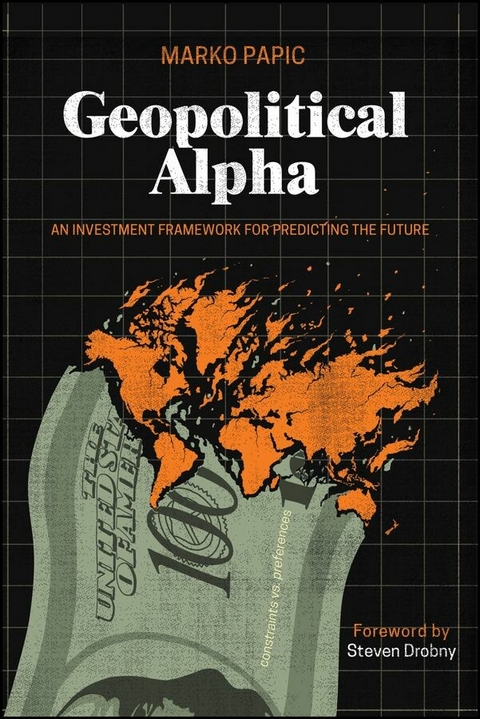
Geopolitical Alpha (eBook)
304 Seiten
Wiley (Verlag)
978-1-119-74022-3 (ISBN)
Forecast geopolitics and markets with this clear and insightful resource
Geopolitical Alpha - An Investment Framework for Predicting the Future provides readers with an original and compelling approach to forecasting the future and beating the markets while doing so. Persuasively written by author, investment strategist, and geopolitical analyst Marko Papic, the book applies a novel framework for making sense of the cacophony of geopolitical risks with the eye towards generating investment-relevant insights.
Geopolitical Alpha posits that investors should ignore the media-hyped narratives, insights from 'smoke-filled rooms,' and most of their political consultants and, instead, focus exclusively on the measurable, material constraints facing policymakers. In the tug-of-war between policymaker preferences and their constraints, the latter always win out in the end. Papic uses a wealth of examples from the past decade to illustrate how one can use his constraint-framework to generate Geopolitical Alpha. In the process, the book discusses:
- What paradigm shifts will drive investment returns over the next decade
- Why investment and corporate professionals can no longer treat geopolitics as an exogenous risk
- How to ignore the media and focus on what drives market narratives that generate returns
Perfect for investors, C-suite executives, and investment professionals, Geopolitical Alpha belongs on the shelf of anyone interested in the intersection of geopolitics, economics, and finance.
MARKO PAPIC is a Partner and Chief Strategist of Clocktower Group, an alternative investment management firm based in California. In 2011, he founded BCA Research's Geopolitical Strategy practice, the world's only dedicated investment consultancy focused on political analysis.
MARKO PAPIC is a Partner and Chief Strategist of Clocktower Group, an alternative investment management firm based in California. In 2011, he founded BCA Research's Geopolitical Strategy practice, the world's only dedicated investment consultancy focused on political analysis.
Foreword by Steven Drobny vii
Introduction xi
Part One Scaffolding 1
Chapter 1 We're Not in Kansas Anymore 3
Chapter 2 The Constraint Framework: Three Pillars 19
Chapter 3 The Wizards of Oz 44
Part Two The Constraints 69
Chapter 4 Politics 71
Chapter 5 The Economy and the Market 103
Chapter 6 Geopolitics 142
Chapter 7 Constitutional and Legal Constraints: The Constraint-Preference Hybrids 161
Chapter 8 The Time Constraint: When Preferences Run Down the Clock 174
Part Three Operationalization 201
Chapter 9 The Art of the Net Assessment 203
Chapter 10 Game Theory - It's Not a Game! 235
Chapter 11 Geopolitical Alpha 245
Chapter 12 Conclusion 261
Acknowledgements 265
Bibliography 271
Index 279
Introduction
“The German president just resigned. We are selling everything. This is it.”
It is May 31, 2010, and Horst Köhler, the president of Germany, has resigned.
I saw the news flash across my inbox in one of the hundreds of news items that I skimmed every morning, but I ignored it. I had triaged it, along with most articles that day, for the sake of sanity; I thought it was irrelevant.
Several hours later, I stare at the Polycom in the middle of the boardroom at Stratfor, the Austin, Texas–based geopolitical analysis firm that gave me my first job. My decision to ignore this one news item is about to cost me that first job. The knot in my stomach has knots.
The saleswoman whose client – a large Connecticut-based hedge fund – is on the line bores a hole in the side of my head with her gaze. I almost hear her thinking, Oh my God … this foreign kid is out of his depth.
I have no idea why the German president resigned or why it is market-relevant to a hedge fund (I have only a vague idea of what a hedge fund is in the first place). I have no idea who the German president even is!
* * * * *
By May 2010, the Euro Area sovereign debt crisis was already in full swing. The 2008 Great Recession had come and gone without the collapse of Western civilization, but things were still touch-and-go. People were on the lookout for the next shoe to drop. In October, 2009, incoming Greek Prime Minister George Papandreou revealed that the previous government had massively underreported the budget deficit. Instead of 6.7%, the figure was 12.7% (later revised to 15.4%!). The shoe dropped. By December 2009, the greatest economic crisis in the developed world since the Great Depression was afoot.
Nobody at my firm really cared. It was not the fault of the folks running the place; the firm was simply not designed to care about financial markets. For most of the past three decades, the investment and geopolitical communities rarely communicated, in part because they struggled to understand each other. They had become over-professionalized, erecting barriers to entry largely for job security, like medieval guilds.
When the Euro Area crisis hit, my marching orders at the firm were not to spend too much energy on it. I was told to focus on US ballistic missile defense in Europe and some other geopolitical matters that nobody outside the Beltway cared about. We had no edge in covering capital markets – few of the firm's analysts understood their own credit card statements. But as the firm's Europe analyst, it was impossible to ignore the evolving imbroglio. Not only did it flood my inbox with scary headlines and client emails, but I also sensed that this was the career opportunity of a lifetime.
By early 2010, my own career had stalled before it had even really begun. I was on leave from a PhD program at the University of Texas at Austin. Political science coursework and research ware easy, but not interesting. I would have coasted for the rest of my life teaching Poli Sci 101, but the oversupplied labor market in social science PhDs meant that I had to take whatever job was available, even if it deposited me and my family in some academic colony in the middle of nowhere.
I took the job at Stratfor because it was based in Austin. I got lucky. The place was fast-paced, young, and brutal. It taught me not to waffle, to digest information quickly, and to create knowledge shortcuts. But I was still missing the sense that I was making a difference in anybody's life.
My feeling of inadequacy was, in large part, a product of my job description. At the start of the decade, Europe had not produced geopolitical risks for a quarter of a century. The fall of the Berlin Wall, the dissolution of the Soviet Union, and the rise of the world's largest trading bloc were all epic events, but they were all tailwinds in the sails of the global economy. There was a sense that history had ended in Europe and that Jean-Claude Juncker was its Last Man.
At the same time, I was expressly hired to be the firm's Europe analyst. Given Stratfor's roots in “Great Power geopolitics,” my position was the equivalent of being the admiral of the Swiss Navy. Most of the all-hands meetings were about Tomahawks, car bombs, and jihad. I usually got to fight with the Africa analyst for the scraps left over by the Middle East, counterterrorism, and East Asia analysts.
“But … the Lisbon Treaty …” I could feel the sneers before I finished my sentences – sneers from the “real analysts” who subsidized my EU-watching.
Thankfully for my career – and sadly for 400 million European citizens – the Euro Area crisis hit with a vengeance. Even though I couldn't navigate my credit card statement either, I knew that this was my moment to add value.
That said, all this was not clear on the morning of May 31, 2010. I was ushered into the conference room by the salesperson who handled the firm's financial relationships. I tangentially knew what these clients did for a living. Most were passive in their use of the firm's services. They read the analyses we posted online. They gave little feedback. Most of the time I didn't know if anyone cared what I was writing. But over the course of the next 12 months, I would have the most professionally intense period of my life. I realized a lot of people who definitely understood how interest rates worked were reading my research.
* * * * *
“The German president just resigned. We are selling everything. This is it.”
I look at the Polycom. I have a choice to make. Do I waffle my way out of the conversation, or do I bite the bullet?
Something about the accent on the other end of the line instills fear. I think it is a Long Island accent. I cannot tell precisely, as I'm a Serb living my fourth year in the US. Before arriving, all I really understood about America came from movies and The Simpsons. My gut tells me not to waffle “Long Island”; he will know. So, I take a deep breath and ‘fess up.
“Guys, I don't know who the German president is.”
Silence. Uncomfortably long. I glance at my colleague; she is revising her résumé in real time. I imagine my boss decapitating me on the same boardroom table at the next all-hands meeting.
“What do you mean? Aren't you the Europe guy at this shop?!”
Ok, here we go. Long Island is angry. The man pays for a service and is not getting it. I respect that. But the Serb in me now starts to come out. I get irrationally confident for no good reason.
“No … sorry, I apologize. You misunderstood me … yes, I am the Europe guy. And if I don't know who the German president is …” Silence on the other line … time to go on the offensive.
“… Then it is not a significant piece of news. The president of Germany is the equivalent of Queen Elizabeth; he cuts ribbons, kisses babies, and shakes hands at the airport. I don't know why he resigned, but this event has zero relevance.”1
* * * * *
This was a risky move. The resignation could have been related to the Euro Area crisis.
The conventional view at the time was that Germany would not bail out the EU member states. Germans were obsessed with fiscal austerity, risks of inflation, and that “the Swabian housewife saved every pfennig.” Maybe the president was a “hard-money” zealot who objected to bailing out profligate Euro Area peers like Greece. Maybe he thought that the crisis was an opportunity to “liquidate everything” – in the words of former US Treasury Secretary Andrew Mellon, who almost single-handedly turned a severe recession into the Great Depression.
And yet … I had a reason for dismissing this news. I had a framework, and it had taught me to push hard against the Eurosceptic narrative for months. This view on Europe would become a successful investment theme, and the proto framework that I had developed would become my profession and passion over the ensuing decade.
This framework – which focuses on the material constraints policymakers face – is what this book is about.
The framework boils down to this: Niccolò Machiavelli was wrong. No amount of Virtù will help the Prince overcome Fortuna. So don't study the Prince. Study his constraints.
* * * * *
Back in 2010, I take a gamble because “Long Island” pushed my buttons. It is an educated gamble. Long Island's singular focus on relevance – the “so what?” – forces me to make a call. Not to waffle, not to talk about “on the one hand” and “on the other hand,” not to split hairs about “hard-to-estimate probabilities,” but to give him an investment-relevant view in three sentences. The resignation of the German president does not matter. Go back to making money.
“Oh … got it. Thank you. We'll talk later.”
Click.
Exhale.
I straighten up and turn to my colleague, chest flexed, a “What's up?” look on my face while maintaining an air of “I had this the entire time.” (I did not.)
In a slow, staccato voice, she says, “These guys don't know what they are doing.”
Boom. There it is. My Jerry Maguire...
| Erscheint lt. Verlag | 15.10.2020 |
|---|---|
| Vorwort | Steven Drobny |
| Sprache | englisch |
| Themenwelt | Recht / Steuern ► Wirtschaftsrecht |
| Wirtschaft ► Betriebswirtschaft / Management ► Unternehmensführung / Management | |
| Schlagworte | Beating the market • constraints in finance • constraints in investing • constraints in investment • Equity investing • Finance & Investments • Finance & Investments Special Topics • Finanz- u. Anlagewesen • Finanzwesen • geopolitics in finance • how to beat the market • how to invest • Investments & Securities • Kapitalanlagen u. Wertpapiere • political analysis in finance • Political investment • politics in finance • Spezialthemen Finanz- u. Anlagewesen |
| ISBN-10 | 1-119-74022-3 / 1119740223 |
| ISBN-13 | 978-1-119-74022-3 / 9781119740223 |
| Informationen gemäß Produktsicherheitsverordnung (GPSR) | |
| Haben Sie eine Frage zum Produkt? |
 EPUB (Adobe DRM)
Kopierschutz: Adobe-DRM
Adobe-DRM ist ein Kopierschutz, der das eBook vor Mißbrauch schützen soll. Dabei wird das eBook bereits beim Download auf Ihre persönliche Adobe-ID autorisiert. Lesen können Sie das eBook dann nur auf den Geräten, welche ebenfalls auf Ihre Adobe-ID registriert sind.
Details zum Adobe-DRM
Dateiformat: EPUB (Electronic Publication)
EPUB ist ein offener Standard für eBooks und eignet sich besonders zur Darstellung von Belletristik und Sachbüchern. Der Fließtext wird dynamisch an die Display- und Schriftgröße angepasst. Auch für mobile Lesegeräte ist EPUB daher gut geeignet.
Systemvoraussetzungen:
PC/Mac: Mit einem PC oder Mac können Sie dieses eBook lesen. Sie benötigen eine
eReader: Dieses eBook kann mit (fast) allen eBook-Readern gelesen werden. Mit dem amazon-Kindle ist es aber nicht kompatibel.
Smartphone/Tablet: Egal ob Apple oder Android, dieses eBook können Sie lesen. Sie benötigen eine
Geräteliste und zusätzliche Hinweise
Buying eBooks from abroad
For tax law reasons we can sell eBooks just within Germany and Switzerland. Regrettably we cannot fulfill eBook-orders from other countries.
aus dem Bereich