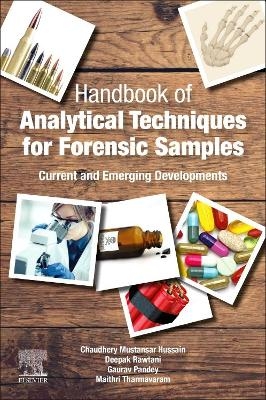
Handbook of Analytical Techniques for Forensic Samples
Elsevier Science Publishing Co Inc (Verlag)
978-0-12-822300-0 (ISBN)
Deepak Rawtani, M.E., PhD, Chartered Engineer, has over 21 years of extensive research experience spanning private and government organizations. He is an accomplished researcher with a focus on molecular medicine, discovery biology, and nanobiotechnology. His career includes roles at the Industrial Toxicology Research Centre, Lucknow; USV Limited, Mumbai; and Torrent Research Centre, Gandhinagar. His primary research areas include forensic nanobiotechnology, with a particular emphasis on DNA–nanoparticle interactions and the functionalization of halloysite nanotubes for applications such as enzyme immobilization, drug delivery, and environmental remediation. Dr. Rawtani has authored over 120 papers and seven books in nanotechnology and environmental science, published in AQ1, a reputable international journal and publisher. He has been recognized among the top 2% of researchers worldwide by Stanford University for 2021, 2022, and 2023. Additionally, he is a NABL-empaneled Technical Assessor (ISO/IEC 17025) with the Quality Council of India. Gaurav Pandey is working as a Research Fellow at the Institute of Research & Development (IRD), Gujarat Forensic Sciences University (GFSU), Gandhinagar, India. His research interests include the use of Nanomaterials for biological applications, especially in the areas of Environmental Science, Drug Delivery and Enzyme Immobilization. He has received his M.S. degree in Forensic Nanotechnology with specialization in Nanobiotechnology from IRD, GFSU. He has also received his B. Tech. degree in Biotechnology from SRM Institute of Science & Technology, Chennai, India. Maithri Tharmavaram is a Teaching and Research Assistant at the National Forensic Sciences University in Gandhinagar, Gujarat. Her research focuses on creating techniques for surface modification of halloysite nanotubes so they can be used in a variety of biological and environmental applications. She has authored and co-edited a book that was published by Elsevier and has more than 28 articles in peer-reviewed journals to her credit. Chaudhery Mustansar Hussain is an adjunct professor and lab director in the Department of Chemistry & Environmental Sciences at the New Jersey Institute of Technology (NJIT), United States. His research is focused on sustainability, nanotechnology & advanced materials, environmental management, analytical chemistry, and other various industries. Dr. Hussain is the author of numerous papers in peer-reviewed journals as well as a prolific author and editor of several books, including scientific monographs and handbooks in his research areas. He has published with ELSEVIER, American Chemical Society, Royal Society of Chemistry, John Wiley & Sons, CRC Press, and Springer.
Part 1: TheorySection I: Sample Analysis in Forensic Science1. Introduction to Chemical Analysis of Forensic Samples2. Forensic Sampling and Sample Preparation Techniques
Section II: Spectroscopic Analytical Techniques in Forensic Science 2. UV-Visible and Fluorescence Spectroscopy for Forensic Samples 3. FTIR and NIR Spectroscopy in Forensic Science 4. Atomic Absorption and Emission Spectrometry in Forensic Analysis 5. NMR Spectroscopy for Forensic Samples
Section III: Electrochemical Analytical Techniques in Forensic Science 6. Voltammetry for Forensic Samples7. Amperometry for Forensic Samples
Section IV: Microscopic Techniques in Forensic Science 8. Optical Microscopy for Forensic Samples 9. Electron Microscopy for Forensic Samples10. Atomic Force Microscopy for Forensic Samples
Section V: Emerging Analytical Techniques for Forensic Samples11. Mass Spectrometry in Forensic Chemistry12. Lab on Chip Devices (Point of care & Point of Need)13. Laser Spectroscopy14. Nanotechnology in Forensic Science
Section VI: Forensic Sample Analysis and Ethics15. Ethics and Legal Issues of Forensic Analysis Techniques
Section VII: Economic and Commercial Aspects of Forensic Analysis16. Economics & Commercialization of Forensic Analysis Techniques
Section VIII: Forensic Analytical Techniques and Future17. Future of Analytical Techniques for Forensic Analysis of Samples
Part 2: Experimental Section1. UV-Visible Spectroscopic Analysis of forensic samples (chemical and biological)2. Fluorescence Spectroscopic Analysis of forensic samples (biological)3. FTIR Analysis of forensic samples (chemical, physical and biological)4. NIR Spectroscopic Analysis of forensic samples (chemical and biological)5. Atomic Absorption Spectrometric Analysis (AAS) of forensic samples (chemical and biological)6. Optical Microscopic Analysis of Physical and Biological Forensic Samples7. SEM Analysis of Physical and Biological Forensic Samples8. TEM Analysis of Physical and Biological Forensic Samples9. AFM Analysis of Physical and Biological Forensic Samples10. Mass Spectrometric Analysis of Forensic Samples (chemical and biological)
| Erscheinungsdatum | 15.01.2021 |
|---|---|
| Sprache | englisch |
| Maße | 152 x 229 mm |
| Gewicht | 750 g |
| Themenwelt | Naturwissenschaften ► Chemie ► Analytische Chemie |
| Recht / Steuern ► Strafrecht ► Kriminologie | |
| ISBN-10 | 0-12-822300-6 / 0128223006 |
| ISBN-13 | 978-0-12-822300-0 / 9780128223000 |
| Zustand | Neuware |
| Informationen gemäß Produktsicherheitsverordnung (GPSR) | |
| Haben Sie eine Frage zum Produkt? |
aus dem Bereich