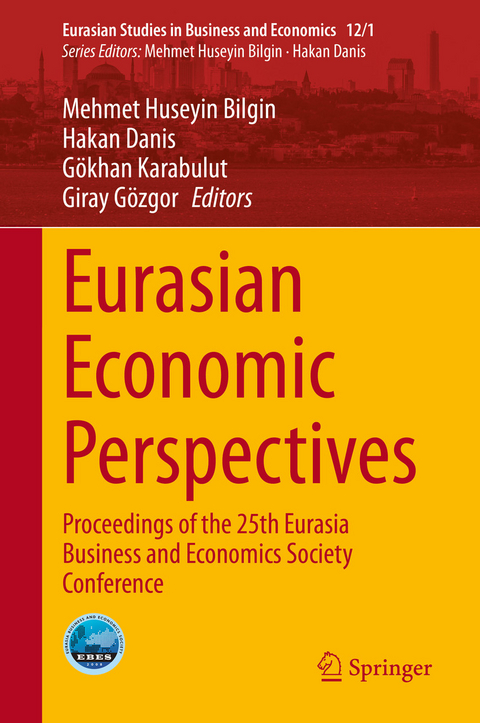
Eurasian Economic Perspectives (eBook)
XVII, 420 Seiten
Springer International Publishing (Verlag)
978-3-030-35040-6 (ISBN)
This volume of Eurasian Studies in Business and Economics includes selected papers from the 25th Business and Economics Society (EBES) Conference, held in Berlin, Germany, in May 2018. While the theoretical and empirical papers presented cover diverse areas of economics and finance from different geographic regions, the main focus is on the latest research in the economics of innovation, investment and risk management together with regional studies. The book also includes studies on law and regulation themes such as economic offences by women, formation of contracts via the internet and public tender for residents of communes.
Mehmet Huseyin Bilgin is a Professor at the Istanbul Medeniyet University (Turkey). He also held several visiting faculty positions at Indiana University-Purdue University Indianapolis (IUPUI) (USA), Jacksonville University (USA), Zagreb University (Croatia), and Nanyang Technological University (Singapore). Prof. Bilgin has published many articles in reputable international journals and is the Associate Editor of the Eurasian Economic Review (Springer). He is the founder and current Chairman of the Istanbul Economic Research Association, and is the founder and current Vice President of the Eurasia Business and Economics Society (EBES, Turkey). He has also been active as a consultant in several institutions, as a newspaper columnist, and featured in several television programs.
Hakan Danis is Assistant Professor of Economics at the Istanbul Sehir University (Turkey), Vice President of Eurasia Business and Economics Society (EBES), and Director in Credit Strategies Group at the Mitsubishi UFJ Financial Group (MUFG) (USA). Previously, he worked at the Spanish multinational global bank Banco Bilbao Vizcaya Argentaria (BBVA) in USA as a Senior Economist. He is one of the founders and first President of EBES. He has published articles in many leading economics and finance journals and currently serves as the Managing Editor of Eurasian Economic Review (Springer). He is a frequent guest editor at the Emerging Markets Finance & Trade and Singapore Economic Review, and has published several academic books. His current research and teaching interests include monetary policy, nonlinear applied time series, risk management in financial institutions and macroeconomics. Gökhan Karabulut is a Professor at Istanbul University (Turkey). He also holds visiting faculty positions at the University of New Orleans (USA) in Economics, and the State University of New York (SUNY) at Albany (USA) in Psychology. He has published articles in reputed international academic journals, presented his research at international conferences and published several books. His research interests are in behavioral economics and macroeconomics.Dr. Giray Gözgor is an Associate Professor at the Istanbul Medeniyet University, Faculty of Political Sciences in Istanbul (Turkey). Dr. Gözgor has received a Ph.D. in Economics from Istanbul University in 2012. He became Associate Professor of Economics in 2014. He has also worked at Ghent University and the University of California, Irvine as a visiting scholar. He has solely published in peer-reviewed international journals, including Annals of Tourism Research, Emerging Markets Review, and the World Economy. His research interest includes the effects of globalization and digitalization on the financial markets and financial market regulations. His research also focuses on public policies on the outcome of financial development
Preface 6
Eurasia Business and Economics Society (EBES) 8
Contents 11
List of Contributors 14
Part I: Regional Studies 17
Residential Real Estate in the Municipalities Located in the Naturally Valuable Areas in Poland 18
1 Introduction 18
2 Methodology 19
3 Research Results 22
4 Conclusions 28
References 29
Contemporary Trade Regionalism on the Example of Free Trade Area of the Asia-Pacific (FTAAP) 32
1 Introduction 32
2 Bilateralism, Inter-regionalism, Mega-Regionalism in Trade: Explaining the Conceptual Intricacies 33
3 Asia-Pacific Economic Cooperation (APEC) and Trade Regionalism 35
4 Economic Potential of FTAAP 38
5 Scenarios for FTAAP 45
6 Conclusion 48
References 49
Financial Vulnerability of NGOs in Southeast Anatolia and Mediterranean Regions 51
1 Introduction 52
2 Data and Methodology 53
2.1 Data 53
2.2 Methodology 54
2.2.1 Dependent Variable 54
2.2.2 Independent Variables 54
2.2.3 Revenue Concentration Index 56
2.2.4 The Multiple Regression Model 56
3 The Findings and Discussions 57
3.1 Revenue Concentration of Youth NGOs 59
3.2 Revenue Types of Youth NGOs 59
3.3 Financial Vulnerability of Youth NGOs 61
3.4 Multiple Regression Analysis 63
4 Conclusion 64
References 65
Structural Changes on Polish Housing Market: Has the Market Returned to the Level Before the Crisis? 68
1 Introduction 68
2 The State of the Polish Housing Market in Historical Terms: The Effects Currently 69
3 Data and Methodology 71
3.1 Data 71
3.2 Methodology 71
4 Results 73
5 Conclusion 80
References 81
Part II: Macro Economics 83
Effect of GDP, Energy Consumption, and Material Consumption on Waste Generation: The Case of EU-28 Countries 84
1 Introduction 84
2 Related Literature 86
3 Data 87
4 Econometric Model 89
5 Empirical Results 91
6 Conclusion 93
References 94
A Comparative Global Overview for Flat-Plate Solar Collectors (FPSCS) in G-7 and G-20 Countries 97
1 Introduction 98
2 Theoretical Frame: An Economic Shift of Gravity Center from G-7 Countries to G-20 Countries 98
3 Chosen Countries: Economic Performances of the Advanced and the Largest Emerging Market Economies in the G-20 100
3.1 Current Renewable Energy Support Policies in the G-20 Countries 101
3.2 Recent Solar Energy Systems´ Market and Policy Trends 101
3.2.1 Introducing the FPSC: A General View 103
3.2.2 Features of the FPSC: A Technical View 103
3.2.3 A Specific Global Comparison by FPSCs on the G-20 Countries Among Top World Countries 104
4 Application: Creating a Policy Development Index on Applied Renewable Energy Policy 104
5 Conclusions and Policy Recommendations 106
References 107
Cluster Analysis of Sustainable Development Goal Indicators in the European Union 109
1 Introduction 109
2 Theoretical Foundations and Literature Review 110
3 Data and Methods Applied 114
3.1 Cluster Analysis 114
3.2 Sets of Indicators Applied in the Cluster Analysis 115
4 Results of the Analysis 117
4.1 Results of the Cluster Analysis 117
4.2 Deeper Analysis of the Relations Between Selected Indicators 123
4.3 Overall Assessment of the Results 129
5 Conclusions 131
References 133
An Investigation of Turkey´s Competitiveness on Different Products Groups in Automotive Sector via Revealed Comparative Advant... 135
1 Introduction 136
2 Literature Review on RCA Index for Turkey 137
3 Methodology 138
4 Findings 142
5 Conclusion 148
References 148
Intra-industry Trade Development and Adjustment Cost: Testing Smooth Adjustment Hypothesis for the Estonian Labor Market 151
1 Introduction 151
2 Literature Review 152
3 Data and Model Specification 154
4 Empirical Results 155
5 Conclusion 156
References 157
Underemployment Among Educated Poles 159
1 Introduction 159
2 The Extent of Inadequate Employment in Poland: Survey Results 161
2.1 Invisible Underemployment (Overeducation) 161
3 Outcomes Associated with Visible and Invisible Underemployment 163
3.1 Descriptive Statistics 163
3.2 Estimation of Model 165
4 Conclusion 167
References 167
Part III: Investment and Risk Management 169
A Factor Model for Country-Level Equity Returns 170
1 Introduction 170
2 Data and Methods 173
2.1 Data Sources and Sample Preparation 173
2.2 Country-Level Anomalies 173
2.3 Asset-Pricing Models 175
2.4 Asset-Pricing Factors 177
2.5 Robustness Checks 179
3 Results 179
3.1 Overview of the Anomalies 179
3.2 Comparison of Asset-Pricing Models 182
3.3 Country-Level Asset-Pricing Tests 188
4 Conclusion 193
Appendix 194
References 198
Earnings Quality and Market Efficiency: Evidence from Romanian Capital Market 201
1 Introduction 201
2 Literature Review 202
2.1 The Quality of the Information and the Efficiency of Financial Markets 203
2.2 Accounting Criteria for the Estimation of the Financial Information Quality 204
2.3 The Estimation of the Capital Markets´ Efficiency Degree 205
3 Hypotheses Development 206
4 Research Design 209
4.1 Data, Population, and Sample 209
4.2 Data Analysis Models 209
4.2.1 Measures for Earnings´ Quality 210
4.2.2 Market Efficiency Estimation 211
4.2.3 The Influence of the Earnings´ Quality on the Market Performance 211
5 Empirical Results 212
6 Conclusions 216
References 217
Assessing the Risk Associated with Lease Certificates in the Turkish Capital Market 219
1 Introduction 219
2 Sukuk Market in Turkey 221
3 Literature Review 223
4 Data and Methodology 226
4.1 Data 226
4.2 Methodology: Value at Risk and Conditional Value at Risk Approaches 226
4.3 Findings of the VaR and CVaR Calculations 230
5 Concluding Remarks 231
References 232
A Tale of Two States: An Application of a Markov Switching Model to Anomaly Returns 235
1 Introduction 235
2 Equity Anomalies 237
3 Predicting Returns with a Markov Switching Model 240
4 Additional Robustness Tests 244
5 Concluding Remarks 244
References 247
Influence of the Correlation Coefficient on the Risk of the Exchange Option 249
1 Introduction 249
2 Payoff Function and Price of the Exchange Options 250
3 Sensitivity Measures of Exchange Option and Correlation Coefficient 253
3.1 Delta Parameter 253
3.2 Vega Parameter 254
3.3 Theta Parameter 256
4 Conclusion 257
References 257
Part IV: Economics of Innovation 258
Evaluation of Creative Industries´ Economic Impact in the EU Countries 259
1 Introduction 259
2 Peculiarities of the Creative Industries Sector 260
2.1 Structure of the CI Sector 260
2.2 Unpredictable Cyclical Demand 261
2.3 One of the Main Innovation-Promoting Sectors 261
3 Impact of Creative Industries on National Economy 262
4 Assessment of Creative Industries´ Economic Impact in the EU Countries Through Employment, Added Value and Exports 266
4.1 Creative Industries´ Impact Through Employment 267
4.2 Creative Industries´ Impact Through Value Added 268
4.3 Creative Industries´ Impact Through Exports 269
4.4 Overall Creative Industries´ Impact on National Economy 270
5 Discussion and Conclusions 273
References 274
Disruptive Innovation and Dynamic Capabilities Approach: Sensing, Seizing, and Transforming 277
1 Introduction 278
2 Methodology 279
3 Disruptive Innovation 279
3.1 Marginal Markets 279
3.2 Value Proposition in Main Attribute 281
3.3 Performance Oversupply 281
4 Dynamic Capabilities 282
5 Disruptive Innovation and Dynamic Capabilities 284
5.1 Identification of Disruption Opportunities 285
6 Disruptive Strategy Deployment 286
7 Transformation of Organizational Capabilities 287
8 Organizational Capabilities 288
9 Conclusions 290
References 291
Part V: Law and Regulation 293
Formation of Contracts via the Internet 294
1 Introduction 294
2 The Concept of ``Electronic Contract´´ 296
2.1 Methods of Electronic Contracting via the Internet and Their Legal Aspects 296
2.2 Electronic Contracts and Distance Contracts 299
3 The Legal Aspects of Electronic Contracting Process 299
3.1 Commercial Website Display: Offer or Invitation to Treat? 300
3.2 Communication of Acceptance via the Internet 305
4 Conclusions 308
References 309
Restraint of Trade Clauses in Commercial Agency Contracts: A Comparative Perspective 314
1 Basic Concepts 314
1.1 Restraint of Trade Clause 314
1.2 Commercial Agent 316
2 Restraint of Trade Clauses in Commercial Agency Contracts 317
2.1 Interests and Reasons Behind Restraint of Trade Clauses in Commercial Agency Contracts 317
2.2 Legislation 318
3 Scope of Restraint of Trade Clauses 319
3.1 Personal Scope of Application 319
3.2 Time Scope 319
4 Conditions for a Valid Restraint of Trade Clause After Termination of Commercial Agency Contract 320
4.1 Time Limit for Restraint 320
4.2 Scope of Restraints 320
4.2.1 Limitation by Geographical Area or Group of Customers 321
4.2.2 Limitation by Kind of Goods or Services Covered by Commercial Agency 321
4.3 Formal Conditions 321
4.4 Payment of a Reasonable Compensation 322
5 Waiver 323
6 Effect of Termination of Commercial Agency Contract for a Significant Reason on Restraint of Trade Clause 323
7 Agreements Against HGB Article 90a and TCC Article 123 323
8 Conclusion 324
References 324
Equalization Demand of the Agent and Its Importance in Business Law 327
1 Introductions 327
2 Definition and Types of Agent 328
3 Reasons for Equalization Demand 330
4 Concepts and Legal Characteristic of Equalization Demand 331
5 Conditions of Equalization Demand 332
5.1 Expiration of the Agency Contract 332
5.1.1 If the Agent Is Not Capable of Continuing His/Her Activity Due to Reasons Such as Illness or Old Age 333
5.1.2 Transfer of Contract/a Third Party Enters into Contract 333
5.2 Other Terms 334
5.2.1 The Principal Must Be Able to Obtain Significant Benefits After the Termination of the Contract from the New Customers, ... 334
5.2.2 Agency´s Loss of Commission 335
5.2.3 The Equalization Demand Must Not Be Contrary to Equity 335
6 Calculating the Equalization Demand 336
7 Period of Submission of the Equalization Demand 336
8 Applying the Equalization Claims on Other Contractual Relationships That Grant Exclusivity Right 337
9 Conclusions 337
References 338
Commercial Agency Contract and Comparison with Similar Contracts (Exclusive Distribution, Franchising, Brokerage, and Commissi... 340
1 Introduction 340
2 The Concept of Agent and Its Characteristics 341
2.1 The Agent 341
2.2 Intermediary Agent 342
2.3 Agent Authorized to Conclude Contract 342
3 Agency Contract in General 343
3.1 Legal Character 343
3.2 Form 344
3.3 Rights and Obligations of Agent 345
3.3.1 Rights 345
In General 345
Right to Remuneration 345
3.3.2 Obligations 346
3.4 Agent´s Representation Authority and Its Scope 346
4 Comparing Agency Contract with Similar Contracts 347
4.1 Comparing with Exclusive Distribution Contract 347
4.1.1 Exclusive Distribution Contract in General 347
4.1.2 The Differences Between Exclusive Distribution Contract and Agency Contract 347
4.2 Comparing with Franchising Contract 348
4.2.1 Franchising Contract in General 348
4.2.2 The Differences Between Franchising Contract and Agency Contract 348
4.3 Comparing with Brokerage Contract 349
4.3.1 Brokerage Contract in General 349
4.3.2 The Differences Between Brokerage Contract and Agency Contract 350
4.4 Comparing with Commission Contract 350
4.4.1 Commission Contract in General 350
4.4.2 The Differences Between Commission Contract and Agency Contract 351
5 Conclusion 351
References 352
Women as Perpetrators of Economic Offences in France 353
1 Introduction 353
2 Economic Offences: Characteristics 355
2.1 Fraud 355
2.2 Abuse of Trust 356
2.3 Other Economic Offences 357
2.4 Specificity of ``Female Perpetration´´ of Economic Offences 358
3 The Analysis of Statistics: French Experiences 358
4 Conclusions 363
References 364
Criteria for the Proper Management of Public Property and the Control of Public Procurement 366
1 Introduction 367
2 Criteria of Proper Management of Public Property 368
3 Control of Public Procurement and Application of Criteria for Proper Management of Public Property 370
4 Conclusions 374
References 375
The Jurisdiction of the European Commission and National Competition Authorities in the Control of Legal and Economic Aspects ... 377
1 Introduction 378
2 The Concentration Procedure in the Light of Regulation 139/2004 379
3 The Relevant Markets and the Market Position of the Merging Undertakings in Assessing the Legitimacy of the Concentration 382
4 Division of Jurisdiction in the Control of Concentrations Between the European Commission and National Competition Authoriti... 384
5 Substantive Legal and Economic Criteria of the Control of Concentrations by the European Commission and National Competition... 387
6 Conclusion 390
References 391
Public Tender as a Form of Selection of the Electricity Supplier for the Residents of the Commune 393
1 Introduction 393
2 Legal and Factual Application of the Third-Party Access (TPA) Principle by Communes 394
3 Selection of the Energy Supplier by Way of a Public Procurement Procedure for the Purchase of Energy by the Commune 396
4 Conclusion 400
References 401
The Most Economically Advantageous Tender in the Public Procurement System in the European Union 403
1 Introduction 404
2 The Most Economically Advantageous Tender in the EU Law 405
3 The Most Economically Advantageous Tender in Selected Member States 407
4 Evaluation of the Most Economically Advantageous Tender 410
5 Priority Services, Non-priority Services, and Construction Works 412
5.1 Priority Services 414
5.2 Non-priority Services 415
5.3 Construction Works 416
6 Conclusion 417
References 419
| Erscheint lt. Verlag | 4.2.2020 |
|---|---|
| Reihe/Serie | Eurasian Studies in Business and Economics | Eurasian Studies in Business and Economics |
| Zusatzinfo | XVII, 420 p. 38 illus., 4 illus. in color. |
| Sprache | englisch |
| Themenwelt | Recht / Steuern ► Wirtschaftsrecht |
| Wirtschaft ► Volkswirtschaftslehre | |
| Schlagworte | Automotive Sector • cluster analysis • Economic Offences by Women • Formation of Contracts • Intra-Industry Trade Development • Investment and Risk Management • Markov Switching Model • Public Tender as Selection Form • Residential Real Estate in Municipalities • strategic networking • Trade Regionalism • underemployment |
| ISBN-10 | 3-030-35040-1 / 3030350401 |
| ISBN-13 | 978-3-030-35040-6 / 9783030350406 |
| Informationen gemäß Produktsicherheitsverordnung (GPSR) | |
| Haben Sie eine Frage zum Produkt? |
 PDF (Wasserzeichen)
DRM: Digitales Wasserzeichen
Dieses eBook enthält ein digitales Wasserzeichen und ist damit für Sie personalisiert. Bei einer missbräuchlichen Weitergabe des eBooks an Dritte ist eine Rückverfolgung an die Quelle möglich.
Dateiformat: PDF (Portable Document Format)
Mit einem festen Seitenlayout eignet sich die PDF besonders für Fachbücher mit Spalten, Tabellen und Abbildungen. Eine PDF kann auf fast allen Geräten angezeigt werden, ist aber für kleine Displays (Smartphone, eReader) nur eingeschränkt geeignet.
Systemvoraussetzungen:
PC/Mac: Mit einem PC oder Mac können Sie dieses eBook lesen. Sie benötigen dafür einen PDF-Viewer - z.B. den Adobe Reader oder Adobe Digital Editions.
eReader: Dieses eBook kann mit (fast) allen eBook-Readern gelesen werden. Mit dem amazon-Kindle ist es aber nicht kompatibel.
Smartphone/Tablet: Egal ob Apple oder Android, dieses eBook können Sie lesen. Sie benötigen dafür einen PDF-Viewer - z.B. die kostenlose Adobe Digital Editions-App.
Buying eBooks from abroad
For tax law reasons we can sell eBooks just within Germany and Switzerland. Regrettably we cannot fulfill eBook-orders from other countries.
aus dem Bereich