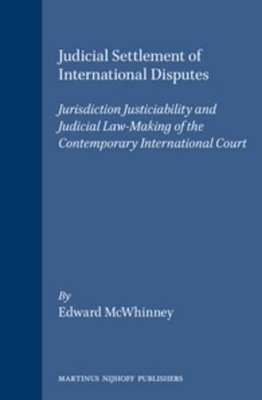
Judicial Settlement of International Disputes
Kluwer Academic Publishers (Verlag)
978-0-7923-0991-8 (ISBN)
- Titel wird leider nicht erscheinen
- Artikel merken
Within the Court's ranks in recent years there has been a marked philosophical division between those judges (usually from Western or Western-influenced states) who have sought to maintain traditional positivist, strict construction (`neutral') approaches, and those who would in American legal Realist-style, essay a more frankly critical, liberal activist rôle in the up-dating or re-making of old legal doctrines inherited from earlier eras in international relations.
The intellectual-legal conflicts within the Court are canvassed in some of the major political-legal cases of recent years (South West Africa and Namibia; Nuclear Tests; Western Sahara; Nicaragua v. US).
The contemporary rôle of the Court and its relation to and cooperation with other principal United Nations (especially the General Assembly) organs, in World Community problem-solving, are fully explored, in terms of the potential problems but also the opportunities and challenges for the Court and its judges today in an historical era of transition and rapid change in the World Community.
Foreword. I: Contemporary Conceptions of the Rôle of International Judicial Settlement. II: The Contemporary International Judicial Process. Law and Logic, and the `Law'/`Politics' dichotomy. III: The Jurisdiction of the Full Court of the International Court, and the Special Chambers Gloss to Jurisdiction. IV: The Contemporary International Court as Independent, and as Representative Tribunal. V: A Contemporary, Operational Approach to Court Jurisdiction and Justiciability. Conclusion: New Agenda, and New Client-States for the International Court. Appendices: A. Covenant of the League of Nations (1920), (Art. 12-15, Art. 19). B. Charter of the United Nations (1945), (Chapter XIV. Art. 92-96). C. Statute of the International Court of Justice. D. U.N. General Assembly Resolution 44/23, 9 January 1990. (`United Nations Decade of International Law'). Table of Principal Cases. Index.
| Sprache | englisch |
|---|---|
| Maße | 155 x 235 mm |
| Gewicht | 455 g |
| Einbandart | gebunden |
| Themenwelt | Recht / Steuern ► EU / Internationales Recht |
| Recht / Steuern ► Privatrecht / Bürgerliches Recht ► Zivilverfahrensrecht | |
| ISBN-10 | 0-7923-0991-X / 079230991X |
| ISBN-13 | 978-0-7923-0991-8 / 9780792309918 |
| Zustand | Neuware |
| Informationen gemäß Produktsicherheitsverordnung (GPSR) | |
| Haben Sie eine Frage zum Produkt? |
aus dem Bereich