


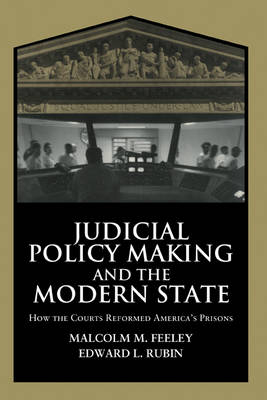
Judicial Policy Making and the Modern State
How the Courts Reformed America's Prisons
Seiten
1998
Cambridge University Press (Verlag)
978-0-521-59353-3 (ISBN)
Cambridge University Press (Verlag)
978-0-521-59353-3 (ISBN)
Between 1965 and 1990, federal judges in almost all of the states handed down sweeping rulings that affected virtually every prison and jail in the United States. This book provides an account of this process, and uses it to explore the more general issue of the role of courts in the modern bureaucratic state.
Between 1965 and 1990, federal judges in almost all of the states handed down sweeping rulings that affected virtually every prison and jail in the United States. Without a doubt judges were the most important prison reformers during this period. This book provides an account of this process, and uses it to explore the more general issue of the role of courts in the modern bureaucratic state. In doing so, it provides detailed accounts of how the courts formulated and sought to implement their orders, and how this action affected the traditional conception of federalism, separation of powers, and the rule of law.
Between 1965 and 1990, federal judges in almost all of the states handed down sweeping rulings that affected virtually every prison and jail in the United States. Without a doubt judges were the most important prison reformers during this period. This book provides an account of this process, and uses it to explore the more general issue of the role of courts in the modern bureaucratic state. In doing so, it provides detailed accounts of how the courts formulated and sought to implement their orders, and how this action affected the traditional conception of federalism, separation of powers, and the rule of law.
1. Introduction; Part I. The Case of Judicial Prison Reform: 2. An overview of judicial prison reform; 3. Two classic prison reform cases: Arkansas and Texas; 4. Three variations on a theme: the Colorado penitentiary, the Santa Clara county jails and Marion penitentiary; Part II. The Theory of Judicial Policy-Making: 5. Defining the problem, identifying the goal, and rejecting the principle of federalism; 6. Creating doctrine, choosing solutions and transforming the rule of law; 7. Implementing the solution, muddling through and ignoring the separation of powers principle; 8. Conclusion; 9. CODA: assessing the successes of judicial prison reform.
| Erscheint lt. Verlag | 13.6.1998 |
|---|---|
| Reihe/Serie | Cambridge Studies in Criminology |
| Verlagsort | Cambridge |
| Sprache | englisch |
| Maße | 152 x 229 mm |
| Gewicht | 910 g |
| Themenwelt | Recht / Steuern ► Allgemeines / Lexika |
| Recht / Steuern ► EU / Internationales Recht | |
| Recht / Steuern ► Strafrecht ► Kriminologie | |
| ISBN-10 | 0-521-59353-0 / 0521593530 |
| ISBN-13 | 978-0-521-59353-3 / 9780521593533 |
| Zustand | Neuware |
| Informationen gemäß Produktsicherheitsverordnung (GPSR) | |
| Haben Sie eine Frage zum Produkt? |
Mehr entdecken
aus dem Bereich



aus dem Bereich
Mein Leben zwischen Kokain und Waffen
Buch | Softcover (2025)
Piper (Verlag)
CHF 24,90
zwei Essays
Buch | Softcover (2025)
Reclam, Philipp (Verlag)
CHF 9,80
der berühmte FBI-Profiler über die Fahndung nach Serienmördern und …
Buch | Softcover (2023)
riva (Verlag)
CHF 20,95


