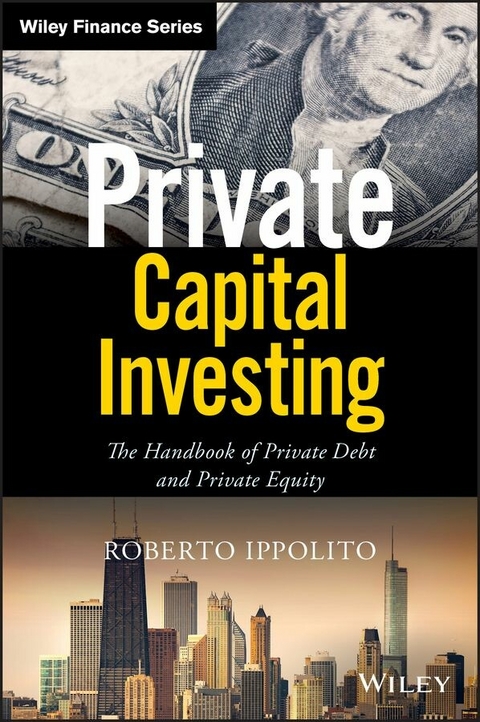
Private Capital Investing (eBook)
John Wiley & Sons (Verlag)
978-1-119-52619-3 (ISBN)
A step-by-step, comprehensive approach to private equity and private debt
Private Capital Investing: The Handbook of Private Debt and Private Equity is a practical manual on investing in the two of the most common alternative asset classes (private equity and private debt) and provides a unique insight on how principal investors analyze investment opportunities. Unlike other textbooks available in the market, Private Capital Investing covers the various phases that principal investors follow when analyzing a private investment opportunity.
The book combines academic rigor with the practical approach used by leading institutional investors. Chapters are filled with practical examples, Excel workbooks (downloadable from the book website), examples of legal clauses and contracts, and Q&A. Cases are referred at the end of every chapter to test the learning of the reader. Instructors will find referrals to both third-party cases or cases written by the author.
• Covers analytical tools
• Includes the most common methods used to structure a debt facility and a private equity transaction
• Looks at the main legal aspects of a transaction
• Walks readers through the different phases of a transaction from origination to closing
Bridging the gap between academic study and practical application, Private Capital Investing enables the reader to be able to start working in private equity or private debt without the need for any further training. It is intended for undergraduates and MBA students, practitioners in the investment banking, consulting and private equity business with prior academic background in corporate finance and accounting.
ROBERTO IPPOLITO is Managing Partner of a leading Italian Hybrid Capital (private equity and private debt) fund and Professor of Principal Investing at Università degli Studi Guglielmo Marconi. He has 20 years' private capital experience in sourcing, structuring and investing in all parts of the capital structure (senior debt, junior debt and private equity) of Italian SMEs across several industries and three years' management consulting experience (with a focus on business due diligence and performance improvement).
Former Head of Leverage Finance at General Electric Capital Italy, Roberto has held managerial roles at European Bank for Reconstruction and Development, DAM Capital (Anschutz Group), Bain & Co. and junior positions at Goldman Sachs (Merchant and Investment Banking) and Istituto Mobiliare Italiano (Merchant Banking). He is a Fulbright scholar and a British Chevening scholar.
Roberto received a MBA from the University of Chicago, a MSc in Economics from the University of Warwick and a Summa Cum Laude BSc in Business from LUISS University. He is a CFA and CPA in Italy and FSA registered in the UK.
ROBERTO IPPOLITO is Managing Partner of a leading Italian Hybrid Capital (private equity and private debt) fund and Professor of Principal Investing at Università degli Studi Guglielmo Marconi. He has 20 years' private capital experience in sourcing, structuring and investing in all parts of the capital structure (senior debt, junior debt and private equity) of Italian SMEs across several industries and three years' management consulting experience (with a focus on business due diligence and performance improvement). Former Head of Leverage Finance at General Electric Capital Italy, Roberto has held managerial roles at European Bank for Reconstruction and Development, DAM Capital (Anschutz Group), Bain & Co. and junior positions at Goldman Sachs (Merchant and Investment Banking) and Istituto Mobiliare Italiano (Merchant Banking). He is a Fulbright scholar and a British Chevening scholar. Roberto received a MBA from the University of Chicago, a MSc in Economics from the University of Warwick and a Summa Cum Laude BSc in Business from LUISS University. He is a CFA and CPA in Italy and FSA registered in the UK.
Introduction
The alternative investment industry has grown from $1 trillion in 1999 to nearly $6 trillion in 2018 (source: PreQin) and is expected to more than double to $15 trillion by 2022 (source: PWC AWM Research Center analysis). Within the various alternative asset classes, private debt and private equity already represent a significant share and are expected to grow faster than other asset classes.
The main drivers of growth are represented, on the supply side, by regulatory changes (constraining bank lending). On the demand side, small and mid size companies find it increasingly interesting to be financed by principal investors (alternative lenders and private equity funds) which are not only mere providers of specialised capital but – from due diligence to monitoring and value creation – also support entrepreneurs in their strategic, business and financial decisions.
Alternative assets classes are also an appealing investment opportunity for institutional investors because they offer both income and capital appreciation.
These dramatic changes in the financial landscape have been only partially accompanied by adequate educational tools: no handbook on private debt is available, whilst private equity textbooks take a very partial view (the financial analysis one) of investment decisions.
The book Private Capital Investing. Handbook of Private Debt and Private Equity (henceforth Private Capital Investing) is a practical handbook on investing in the most common alternative asset classes and provides a unique insight into how principal investors analyse investment opportunities.
Unlike other textbooks available in the market, the book covers the various phases that principal investors follow when analysing a private investment opportunity. Private Capital Investing combines academic rigour with the practical approach used by leading investors. Every chapter is filled with practical examples, Excel workbooks (downloadable on the book companion website), and examples of legal clauses and contracts. Further reading and cases are suggested at the end of every chapter to guide further in-depth analysis and test the learning of the reader.
Purpose of the book is to build a bridge between study and real-life case studies so that the reader will be able to start working in the principal investing world without need for further training. It is intended for undergraduates and MBA students, practitioners in investment banking, consulting, private debt, and private equity business with prior academic background in corporate finance and accounting.
THE RISE OF PRIVATE MARKETS (ALTERNATIVE ASSETS) IN THE INVESTORS' ALLOCATION
The key reasons for allocating to private markets are:
- Potential for alpha: one of the main reasons to invest in alternative assets is to earn a premium (i.e. alpha) over the return offered by public market assets. There are at least three sources of alpha:
- illiquidity premium: premium paid to the investor to compensate them for not having short-term access to their money, hence making private capital asset classes suited for investors with a longer time horizon (also called patient capital);
- active premium: this derives from the active management of the private investment;
- complexity premium: origination, structuring, and managing private assets is one of the key features and challenges of private capital investing.
- Diversification: alternative investments lack correlation with the major traditional asset classes of public equities and public fixed-income assets. Risk within the asset classes can be further diversified by geography, industry/sector, and capital structure (equity, senior debt, junior debt).
The private markets space is varied and hard to define in its entirety: according to McKinsey (see Figure I.1), private market assets under management (AUM) in 2018 totalled $5.8 trillion. Out of total AUM, private equity, growth equity, and private debt represent 54%.
FIGURE I.1 Private market assets under management in 2018.
Source: ‘Private markets come of age’, February 2019, McKinsey & Company, www.mckinsey.com. (c) 2019 McKinsey & Company. All rights reserved. Reproduced with permission.
Figure I.2 breaks down AUM by asset class and by region. In all regions, private equity commands the bulk of AUM, with real estate and private debt funds competing for the second place. The USA has by far the largest AUM, with China growing at the fastest pace.
FIGURE I.2 Private market assets under management by region and by asset class in 2018 (US$ bn).
Source: © 2018, CFA Institute. Reproduced and republished from Capital Formation: The Evolving Role of Public and Private Markets with permission from CFA Institute. All rights reserved.
THE RISE OF PRIVATE MARKETS AS A FAVOURED ALTERNATIVE SOURCE OF COMPANY FINANCING
Private markets have also become a favoured funding alternative for corporates following the structural changes that have occurred in both debt and equity markets.
In the debt market, after the financial crisis of 2008, different regulatory directives (Dodd–Frank, Volcker rule, Basel III) have been introduced in order to reduce the probability of bank insolvency. These regulatory requirements have forced banks to reduce their exposure to small and mid caps and also diminish the size of their asset book. This reduction has been particularly evident in Europe, as shown in Figure I.3, where c. 80% of corporate financing is still provided by bank loans (with the remaining 20% provided by capital markets and credit funds). This 80/20 split is the exact opposite in the US, where markets provide the majority of corporate financing. Bank disintermediation in fact started in the US in the early 1960s, when the provisions set forth by the Glass–Steagall Act in 1933 were gradually eased, allowing for a quick development of the high-yield market and of private debt (whose size, as we have seen before, is ten times larger than the European one).
Increased competition from other intermediation channels has caused the banking system's share of total financial institution assets to decline, as shown in Figure I.4.
FIGURE I.3 Banking system assets as a percentage of GDP.
Source: Reproduced from Bank for International Settlements. Structural changes in banking after the crisis. CGFS Papers No 60, 2018.
FIGURE I.4 Share of banking system assets in total financial institution assets.
Source: Reproduced from Bank for International Settlements. Structural changes in banking after the crisis. CGFS Papers No 60, 2018.
In the equity market, according to a study of the Miken Institute,1 in the US there are more firms owned by private equity investors than are listed on all the US stock exchanges.
Statistics on listed (see Figure I.5) companies similarly confirm that around the world (with the only exception of China) the appeal of public markets has stalled or diminished.
There are different explanations for this trend:
- Reduced short-term pressure: public markets are often blamed for the excessive focus on short-term financial goals.
- Regulatory disclosure and reporting requirements: being listed implies compliance with regulatory rules and continuous communication with the market.
- Flexibility and speed to execute changes in strategy and operations: operating in a private context allows owners and managers to swiftly implement changes in strategies, personnel, and operations without the need to explain and convince the market.
- Increasing relative importance of institutional investors vs. retail investors: the growing importance of institutional investors allows companies to raise funds without all the requirements necessary for publicly traded companies with retail investors.
FIGURE I.5 Number of listed companies by region.
Source: © 2018, CFA Institute. Reproduced and republished from Capital Formation: The Evolving Role of Public and Private Markets with permission from CFA Institute. All rights reserved.
Amongst alternative investments, this book will focus on two of the most popular asset classes: private equity and private debt.
PRIVATE EQUITY
Private equity is the investment activity by institutional investors in the equity capital of non-listed companies, with the goal of increasing their equity value in order to divest it within the medium/long term. Financial scholars describe private equity as a function of the different life stages of a company, as shown in Table I.1.
Venture capital can be further divided into the following.
- Seed financing: investment in risk capital when there is no product at all, when the entrepreneur only has an idea or an invention.
TABLE I.1 Different types of private equity as a function of the investee company life cycle.
Life stage Type of private equity Start-up Venture capital (early-stage financing) Development Growth equity (development or expansion capital) Maturity Leveraged buy out...
| Erscheint lt. Verlag | 16.12.2019 |
|---|---|
| Reihe/Serie | Wiley Finance |
| Wiley Finance Editions | Wiley Finance Editions |
| Sprache | englisch |
| Themenwelt | Recht / Steuern ► Wirtschaftsrecht |
| Wirtschaft ► Betriebswirtschaft / Management ► Finanzierung | |
| Schlagworte | analytical tools • aspects of a transaction • direct private investing • Finance & Investments • Finance & Investments Special Topics • Finanz- u. Anlagewesen • Finanzwesen • Investing • Kapitalanlage • legal aspects of a transaction • <p>Private capital investing • Private Capital Investing: The Handbook of Private Debt and Private • Private Debt • Private Equity • Roberto Ippolito</p> • Spezialthemen Finanz- u. Anlagewesen • tools in principal investing • what are tools in principal investing • what is principal investing |
| ISBN-10 | 1-119-52619-1 / 1119526191 |
| ISBN-13 | 978-1-119-52619-3 / 9781119526193 |
| Informationen gemäß Produktsicherheitsverordnung (GPSR) | |
| Haben Sie eine Frage zum Produkt? |
 EPUB (Adobe DRM)
Kopierschutz: Adobe-DRM
Adobe-DRM ist ein Kopierschutz, der das eBook vor Mißbrauch schützen soll. Dabei wird das eBook bereits beim Download auf Ihre persönliche Adobe-ID autorisiert. Lesen können Sie das eBook dann nur auf den Geräten, welche ebenfalls auf Ihre Adobe-ID registriert sind.
Details zum Adobe-DRM
Dateiformat: EPUB (Electronic Publication)
EPUB ist ein offener Standard für eBooks und eignet sich besonders zur Darstellung von Belletristik und Sachbüchern. Der Fließtext wird dynamisch an die Display- und Schriftgröße angepasst. Auch für mobile Lesegeräte ist EPUB daher gut geeignet.
Systemvoraussetzungen:
PC/Mac: Mit einem PC oder Mac können Sie dieses eBook lesen. Sie benötigen eine
eReader: Dieses eBook kann mit (fast) allen eBook-Readern gelesen werden. Mit dem amazon-Kindle ist es aber nicht kompatibel.
Smartphone/Tablet: Egal ob Apple oder Android, dieses eBook können Sie lesen. Sie benötigen eine
Geräteliste und zusätzliche Hinweise
Buying eBooks from abroad
For tax law reasons we can sell eBooks just within Germany and Switzerland. Regrettably we cannot fulfill eBook-orders from other countries.
aus dem Bereich