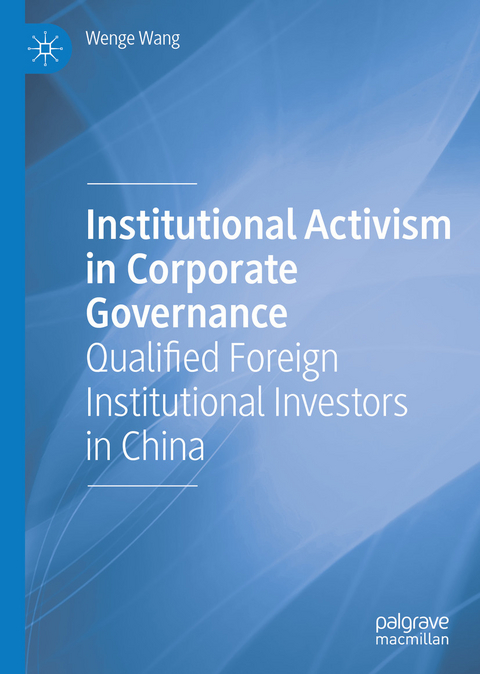
Institutional Activism in Corporate Governance (eBook)
XIV, 253 Seiten
Springer International Publishing (Verlag)
978-3-030-19577-9 (ISBN)

This book is an invaluable resource for anyone interested in learning about ways to invest in one of the world's largest economies. Wang discusses in depth what specific opportunities, challenges and restrictions to expect in the process, and how investing in China differs from investing in countries with a more open capital account.
Wenge Wang is EU Marie Curie Global Fellow at the University of Sheffield, UK. Before coming to Sheffield, he was a professional of versatility with experiences in business, legal practice and other sectors for more than 20 years in China.
Acknowledgements 5
Contents 6
List of Figures 8
List of Tables 11
Part I: Introduction 13
1: Description of the Research 15
1.1 Problem Statement 15
1.2 Purposes of the Research 18
1.3 Research Questions 21
1.4 Organization of the Research 24
References 27
Part II: Capital Globalization andInstitutional Activism: ForeignInstitutional Investors in EmergingEconomies 29
2: Institutional Investment and Integration of Global Capital System 31
2.1 Introduction 31
2.2 International Investment Can Improve Allocative Efficiency of Global Capitalization 32
2.2.1 The Two-Gap Model 32
2.2.2 Cross-Border Flow of Capital 33
2.2.3 Financial Deepening 35
2.3 Allocative Efficiency of Global Capitalization May Export Institutional Activism Globally 36
2.3.1 American Style of Shareholder Activism 36
2.3.1.1 CalPERS’ Shareholder Activism 37
2.3.1.2 The Real Driver Behind American Style of Shareholder Activism 37
2.3.1.3 Institutional Shareholder Activism as a Political Model 39
2.3.2 The Spread of American Style of Shareholder Activism 40
2.3.2.1 Institutional Shareholder Activism in the UK 40
2.3.2.2 Institutional Shareholder Activism in Continental Europe 43
2.4 Summary 48
References 50
3: QFIIs’ Institutional Activism in Emerging Economies 54
3.1 Introduction 54
3.2 QFIIs’ Institutional Activism in Taiwan 56
3.2.1 A “Shadow Plate” Stock Market 56
3.2.2 Three-Phase Policy 57
3.2.3 QFIIs Scheme 58
3.2.3.1 QFIIs and the Taiwan Stock Market 61
3.2.3.2 QFIIs and the Corporate Governance of Taiwan Listed Companies 63
3.3 QFIIs’ Institutional Activism in China 65
3.3.1 A Policy Initiative 65
3.3.2 Some Typical Characteristics of the Chinese Stock Market 65
3.3.3 QFIIs Equity Investment in the Chinese Stock Market 69
3.3.4 QFIIs in the Corporate Governance of Chinese Listed Companies 73
3.4 Summary 74
References 76
Part III: The Mechanisms of InstitutionalActivism: The West and ChinaCompared 78
References 80
4: The Mechanisms of Institutional Activism in the US and Europe 82
4.1 Introduction 82
4.2 The Mechanism of Institutional Activism in the US 83
4.2.1 Types of Mechanisms 83
4.2.2 Hedge Fund Activism 88
4.2.3 Rationale Behind Hedge Fund Activism 89
4.3 The Mechanisms of Institutional Activism in Europe 91
4.3.1 The Mechanism of Institutional Activism in the UK 91
4.3.1.1 Acting in Concert 92
4.3.1.2 Dialogue 93
4.3.2 The Mechanisms of Institutional Activism in Continental Europe 94
4.3.2.1 Regulation Restraints 94
4.3.2.2 Shareholder Engagement 95
4.3.2.3 Shareholder Coalition 96
4.4 Summary 97
References 99
5: The Mechanism of QFIIs’ Institutional Activism in China 101
5.1 Introduction 101
5.2 Structural Barriers to Shareholder Activism in China 103
5.3 Legal and Regulatory Barriers to Shareholder Activism in China 104
5.3.1 Portfolio Limit 105
5.3.2 Insider-Dealing Liability 106
5.3.3 Disclosure Obligation 106
5.4 Technical Barriers to QFIIs’ Institutional Activism 108
5.4.1 Shapley-Shubik and Banzhaf-Coleman Indices 109
5.4.1.1 Power Indices to Measure the Voting Power 110
5.4.1.2 The Oceanic Games Theory 113
5.4.2 The Capacity of QFIIs to Form Shareholder Consortium 116
5.4.2.1 Characteristics of Shareholder Structure and Shareholding Distribution 116
5.4.2.2 Differentiation of First Largest Shareholders 118
5.4.2.3 Players of the Oceanic Games 120
5.4.2.4 QFIIs’ Shapley-Shubik and Banzhaf-Coleman Indices 121
QFIIs’ Shapley-Shubik Index 121
QFIIs’ Banzhaf-Coleman Index 124
5.4.2.5 QFIIs’ Capability to Form Shareholder Consortium 126
5.5 Summary 128
References 130
Part IV: The Capacity and Motivation forInstitutional Activism: QFIIs in China 132
References 138
6: QFII’s Capacity for Institutional Activism 140
6.1 Introduction 140
6.2 The Power of Engagement 144
6.3 The Power of Checks and Balances 149
6.3.1 The Weight of the Size of the Stake of Shares 149
6.3.2 Z Index and S Index 151
6.4 Threshold for the Size of Stake in Shares Needed by QFIIs to Intervene 154
6.4.1 QFIIs’ Choice of Actions Equilibrium 155
6.4.2 Z Index and S Index of QFIIs 157
6.4.3 QFIIs’ Threshold for the Size of Stake in Shares 162
6.5 Summary 164
References 165
7: The Motivation for QFIIs’ Institutional Activism 167
7.1 Introduction 167
7.2 Herding Behaviour 169
7.3 Trading Frequency 173
7.4 QFIIs’ Trading Behaviour 177
7.4.1 QFIIs’ Herding Behaviour 177
7.4.2 QFIIs’ Trading Frequency 181
7.5 Summary 186
References 187
Part V: Institutional Activism and FirmPerformance: QFIIs in China 190
8: Background, Data and Analytic Strategy 192
8.1 Introduction 192
8.2 Literature Review 193
8.2.1 Three Hypotheses on Institutional Ownership and Firm Performance 194
8.2.2 Empirical Evidence on QFIIs’ Institutional Ownership and Firm Performance 195
8.2.2.1 International Empirical Evidence 195
8.2.2.2 Empirical Evidence from China 197
The Percentage Shareholdings Held by QFIIs and Firm Performance 197
The Degree of Checks and Balances Among QFIIs and Firm Performance 199
8.3 Development of Hypotheses 201
8.3.1 The Percentage Shareholding of QFIIs and Firm Performance 201
8.3.2 The Degree of Checks and Balances of QFIIs and Firm Performance 202
8.3.3 Chinese Regulation on QFIIs’ Shareholding and Firm Performance 203
8.4 Samples and Data 204
8.4.1 Sample Selection 204
8.4.2 Data Description 205
8.5 Methodology 208
8.5.1 Multiple Regression 208
8.5.2 Description of Variables 209
8.5.3 Model Specification 211
8.6 Summary 213
References 214
9: Hypothesis Tests, Analysis and Discussion 218
9.1 Introduction 218
9.2 Hypothesis Tests 219
9.2.1 Diagnostic Checks and Model Selection 219
9.2.1.1 Diagnostic Checks 219
9.2.1.2 Model Selection 221
9.2.2 Results of Hypothesis Tests 222
9.2.2.1 Percentage Shareholding of QFIIs and Firm Performance 227
9.2.2.2 Degree of Checks and Balances Imposed by QFIIs and Firm Performance 228
9.2.2.3 Relaxation of Chinese Regulation and the Percentage Shareholding and Degree of Checks and Balances of QFIIs 229
Relaxation of Chinese Regulation and the Percentage Shareholding of QFIIs 229
Relaxation of Chinese Regulation and the Degree of Checks and Balances Imposed by QFIIs 230
9.2.2.4 Percentage Shareholding and Degree of Checks and Balances of Different Types of QFIIs and Firm Performance 231
Percentage Shareholding of Different Types of QFIIs and Firm Performance 231
Degree of Checks and Balances of Different Types of QFIIs and Firm Performance 233
9.3 Robustness Check 234
9.3.1 QFIIs’ Percentage Shareholding and Firm Performance 235
9.3.2 Degree of Checks and Balances Imposed by QFIIs and Firm Performance 235
9.3.3 Relaxation of Chinese Regulation on the Percentage Shareholding and Degree of Checks and Balances of QFIIs and Firm Performance 236
9.3.3.1 Relaxation of Chinese Regulation on the Percentage Shareholding of QFIIs and Firm Performance 236
9.3.3.2 Relaxation of Chinese Regulation on the Degree of Checks and Balances of QFIIs and Firm Performance 236
9.3.4 Percentage Shareholding and Degree of Checks and Balances of Different Types of QFIIs and Firm Performance 237
9.3.4.1 Percentage Shareholding of Different Types of QFIIs and Firm Performance 237
9.3.4.2 Degree of Checks and Balances in Different Types of QFIIs and Firm Performance 238
9.4 Further Analysis and Discussion 239
9.5 Summary 243
References 244
Part VI: Conclusion 245
10: Overview and Way Forward 247
10.1 Findings 247
10.2 Obstacles 248
10.3 Challenges 250
10.4 Implications 253
Index 257
| Erscheint lt. Verlag | 22.11.2019 |
|---|---|
| Zusatzinfo | XIV, 253 p. 23 illus. |
| Sprache | englisch |
| Themenwelt | Recht / Steuern ► Wirtschaftsrecht |
| Sozialwissenschaften ► Politik / Verwaltung | |
| Wirtschaft ► Betriebswirtschaft / Management ► Finanzierung | |
| Wirtschaft ► Volkswirtschaftslehre | |
| Schlagworte | Capital globalization • China Economic Policy • Chinese economics • Chinese stock market • Corporate governance in China • emerging economies • Global Capital System • Institutional Activism in Corporate Governance • Institutional Investments • QFIIs • QFIIs Activism • Qualified Foreign Institutional Investors • Shareholder Activism |
| ISBN-10 | 3-030-19577-5 / 3030195775 |
| ISBN-13 | 978-3-030-19577-9 / 9783030195779 |
| Informationen gemäß Produktsicherheitsverordnung (GPSR) | |
| Haben Sie eine Frage zum Produkt? |
 PDF (Wasserzeichen)
DRM: Digitales Wasserzeichen
Dieses eBook enthält ein digitales Wasserzeichen und ist damit für Sie personalisiert. Bei einer missbräuchlichen Weitergabe des eBooks an Dritte ist eine Rückverfolgung an die Quelle möglich.
Dateiformat: PDF (Portable Document Format)
Mit einem festen Seitenlayout eignet sich die PDF besonders für Fachbücher mit Spalten, Tabellen und Abbildungen. Eine PDF kann auf fast allen Geräten angezeigt werden, ist aber für kleine Displays (Smartphone, eReader) nur eingeschränkt geeignet.
Systemvoraussetzungen:
PC/Mac: Mit einem PC oder Mac können Sie dieses eBook lesen. Sie benötigen dafür einen PDF-Viewer - z.B. den Adobe Reader oder Adobe Digital Editions.
eReader: Dieses eBook kann mit (fast) allen eBook-Readern gelesen werden. Mit dem amazon-Kindle ist es aber nicht kompatibel.
Smartphone/Tablet: Egal ob Apple oder Android, dieses eBook können Sie lesen. Sie benötigen dafür einen PDF-Viewer - z.B. die kostenlose Adobe Digital Editions-App.
Buying eBooks from abroad
For tax law reasons we can sell eBooks just within Germany and Switzerland. Regrettably we cannot fulfill eBook-orders from other countries.
aus dem Bereich