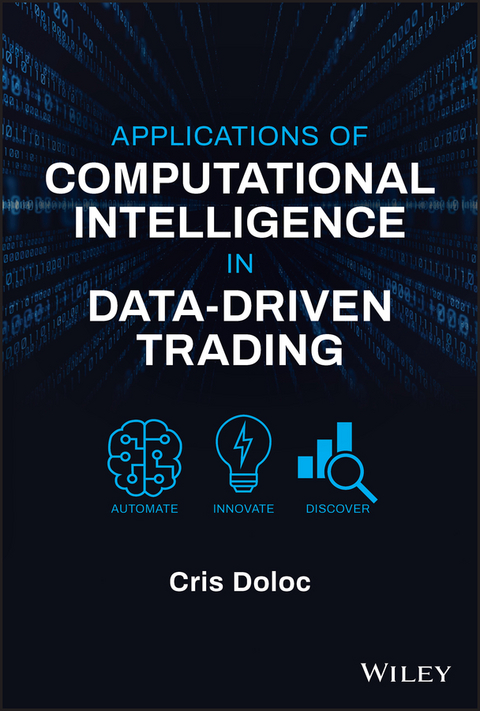
Applications of Computational Intelligence in Data-Driven Trading (eBook)
John Wiley & Sons (Verlag)
978-1-119-55051-8 (ISBN)
'Life on earth is filled with many mysteries, but perhaps the most challenging of these is the nature of Intelligence.'
- Prof. Terrence J. Sejnowski, Computational Neurobiologist
The main objective of this book is to create awareness about both the promises and the formidable challenges that the era of Data-Driven Decision-Making and Machine Learning are confronted with, and especially about how these new developments may influence the future of the financial industry.
The subject of Financial Machine Learning has attracted a lot of interest recently, specifically because it represents one of the most challenging problem spaces for the applicability of Machine Learning. The author has used a novel approach to introduce the reader to this topic:
- The first half of the book is a readable and coherent introduction to two modern topics that are not generally considered together: the data-driven paradigm and Computational Intelligence.
- The second half of the book illustrates a set of Case Studies that are contemporarily relevant to quantitative trading practitioners who are dealing with problems such as trade execution optimization, price dynamics forecast, portfolio management, market making, derivatives valuation, risk, and compliance.
The main purpose of this book is pedagogical in nature, and it is specifically aimed at defining an adequate level of engineering and scientific clarity when it comes to the usage of the term 'Artificial Intelligence,' especially as it relates to the financial industry.
The message conveyed by this book is one of confidence in the possibilities offered by this new era of Data-Intensive Computation. This message is not grounded on the current hype surrounding the latest technologies, but on a deep analysis of their effectiveness and also on the author's two decades of professional experience as a technologist, quant and academic.
CRIS DOLOC is a leading computational scientist with more than 25 years of experience in quantitative finance. He holds a PhD in Computational Physics and is currently teaching at the University of Chicago in the Financial Mathematics program. Cris is also the founder of FintelligeX, a technology platform designed to promote data-driven education, and he is very passionate about the opportunities that recent developments in Cognitive Computing and Computational Intelligence could bring to the field of Quant education.
CRIS DOLOC is a leading computational scientist with more than 25 years of experience in quantitative finance. He holds a PhD in Computational Physics and is currently teaching at the University of Chicago in the Financial Mathematics program. Cris is also the founder of FintelligeX, a technology platform designed to promote data-driven education, and he is very passionate about the opportunities that recent developments in Cognitive Computing and Computational Intelligence could bring to the field of Quant education.
Introduction
“Life on earth is filled with many mysteries, but perhaps the most challenging of these is the nature of Intelligence.”
–Terrence J. Sejnowski, computational neurobiologist
Two decades of participation in the digital transformation of the trading industry as a system architect, quant, and trader, coupled with the experience of teaching in the Financial‐Mathematics program at the University of Chicago, provided me with a unique perspective that I will convey to the reader throughout this book. As both a practitioner and an educator, I wrote this book to assert the fact that the trading industry was, and continues to be, a very fertile ground for the adoption of cutting‐edge technologies.
The central message of this book is that the development of problem‐solving skills is much more important for the career advancement of a quantitative practitioner than the accretion and mastering of an ever‐increasing set of new tools that are flooding both the technical literature and the higher education curricula. While the majority of these tools become obsolete soon after their release into the public domain, acquiring an adequate level of problem‐solving expertise will endow the learner with a long‐lasting know‐how that will transcend ephemeral paradigms and cultural trends.
If the use of an exhaustive tool set is providing the solution architect with horizontal scalability, mastering the expertise of what tools should be used for any given problem will grant the user with the vertical scalability that is absolutely necessary for implementing intelligent solutions. While the majority of books about the application of machine intelligence to practical problem domains are focused on how to use tools and techniques, this book is built around six different types of problems that are relevant for the quantitative trading practitioner. The tools and techniques used to solve these problem types are described here in the context of the case studies presented, and not the other way around.
MOTIVATION
The impetus to write this book was triggered by the desire to introduce to my students the most recent scientific and technological developments related to the use of computationally intelligent techniques in quantitative finance. Given the strong interest of my students in topics related to the use of Machine Learning in finance, I decided to write a companion textbook for the course that I teach in the Financial‐Mathematics program, titled Case Studies in Computing for Finance.
Soon after I started working on the book, I realized that this project could also benefit a much larger category of readers, the quantitative trading practitioners. An important motivation for writing this book was to create awareness about the promises as well as the formidable challenges that the era of data‐driven decision‐making and Machine Learning (ML) are bringing forth, and about how these new developments may influence the future of the financial industry. The subject of Financial Machine Learning has attracted a lot of interest recently, specifically because it represents one of the most challenging problem spaces for the applicability of Machine Learning.
I want to reiterate that the central objective of this book is to promote the primacy of developing problem‐solving skills and to recommend solutions for evading the traps of keeping up with the relentless wave of new tools that are flooding the markets. Consequently the main purpose of this book is pedagogical in nature, and it is specifically aimed at defining an adequate level of engineering and scientific clarity when it comes to the usage of the term artificial intelligence, especially as it relates to the financial industry.
The term AI has become the mantra of our time, as this label is used more and more frequently as an intellectual wildcard by academicians and technologists alike. The AI label is particularly abused by media pundits, domain analysts, and venture capitalists. The excessive use of terms like AI disruption or AI revolution is the manifestation of a systemic failure to understand the technical complexity of this topic. The hype surrounding the so‐called artificial intelligence revolution is nothing but the most noticeable representation of a data point on Gartner's hype curve of inflated expectations.
This hype could be explained eventually by a mercantile impulse of using any opportunity to promote products and services that could benefit from the use of the AI label. It is rather common that a certain level of misunderstanding surrounds novel technology concepts when they are leaving the research labs and are crossing into the public domain. The idea that we are living in an era where the emergence of in silico intelligence could compete with human intelligence could very well qualify as “intellectual dishonesty”, as Professor Michael Jordan from Berkeley said on several occasions. Consequently, one of the main goals of this book is to clarify the terminology and to adjust the expectations of the reader in regard to the use of the term AI in quantitative finance.
Another very important driver behind this book is my own opinion about the necessity of updating the Financial‐Mathematics curriculum on two contemporary topics: data‐driven decision‐making (trading and investing) and Computational Intelligence. As a result, the first half of this book is dedicated to the introduction of two modern topics:
- Data‐driven trading, as a contemporary trading paradigm and a byproduct of the fourth scientific paradigm of data‐intensive computation.
- Computational Intelligence, as an umbrella of computational methods that could be successfully applied to the new paradigm of data‐driven trading.
The general confusion created by the proliferation of the term AI is at the same time enthralling and frightening. While mass fascination comes from the failure to grasp the complexity of applying machine intelligence techniques to practical problems, the fear of an AI‐world taking over humanity is misleading, distracting, and therefore counterproductive. Whether or not Science will be able any time soon to understand and properly model the concept of Intelligence, enrolling both computers and humans into the fight to enhance human life is a major challenge ahead.
While solving the challenge of understanding general intelligence will be quintessential to the development of Artificial Intelligence it may also represent the foundation of a new branch of engineering. I will venture to call this new discipline Quantitative and Computational Engineering (Q&CE). Like many other classic engineering disciplines that have emerged in the past (e.g. Civil, Electrical, or Chemical), this new engineering discipline is going to be built on already mature concepts (i.e. information, data, algorithm, computing, and optimization). Many people call this new discipline Data Science. No matter the label employed, this new field will be focused on leveraging large amounts of data to enhance human life, so its development will require perspectives from a variety of other disciplines: from quantitative sciences like Mathematics and Statistics to Computational, Business, and Social sciences. One of the main goals of writing this book is to acknowledge the advent and to promote the development of this new engineering discipline that I label Quantitative and Computational Engineering.
The intended purpose of this book is to be a practical guide for both graduate students and quantitative practitioners alike. If the majority of books and papers published on the topic of Financial Machine Learning are structured around the different types and families of tools, I decided to center this book on practical problems, or Case Studies. I took on the big challenge to bridge the perceived gap between the academic literature on quantitative finance, which is sometimes seen as divorced from the practical reality, and the world of practitioners that is sometimes labeled as being short on scientific rigor. As a result I dedicated the second half of the book to the presentation of a set of Case Studies that are contemporarily relevant to the needs of the financial industry and at the same time representative of the problems that practitioners have to deal with. For this purpose I will consider categories of problems such as trade execution optimization, price dynamics forecast, portfolio management, market making, derivatives valuation, risk, and compliance. By reviewing dozens of recently peer‐reviewed publications, I selected what I believed to be the most practical, yet scientifically sound studies that could illustrate the current state‐of‐the‐art in Financial Machine Learning. I earnestly hope that this review of recently published information will be useful and engaging for both Financial‐Mathematics students as well as practitioners in quantitative finance who have high hopes for the applicability of Machine Learning, or more generally Computational Intelligence techniques in their fields of endeavor.
Last but not least I hope that other industries and sectors of the digital economy could use the financial industry's adoption model to further their business goals in two main directions: automation and innovation. Therefore,...
| Erscheint lt. Verlag | 5.11.2019 |
|---|---|
| Sprache | englisch |
| Themenwelt | Recht / Steuern ► Wirtschaftsrecht |
| Wirtschaft ► Betriebswirtschaft / Management ► Finanzierung | |
| Schlagworte | Applications of Computational Intelligence in Data-Driven Trading</p> • Computational Intelligence • Cris Doloc • Doloc • execution strategies • Finance & Investments • Finance & Investments Special Topics • Finanz- u. Anlagewesen • Finanzwesen • <p>Data-driven trading and investing • machine learning • Market microstructure • portfolio optimization • Quantitative and Computational Finance • Reinforcement Learning • Risk Management • Spezialthemen Finanz- u. Anlagewesen • Surveillance and Compliance • Valuation |
| ISBN-10 | 1-119-55051-3 / 1119550513 |
| ISBN-13 | 978-1-119-55051-8 / 9781119550518 |
| Informationen gemäß Produktsicherheitsverordnung (GPSR) | |
| Haben Sie eine Frage zum Produkt? |
 EPUB (Adobe DRM)
Kopierschutz: Adobe-DRM
Adobe-DRM ist ein Kopierschutz, der das eBook vor Mißbrauch schützen soll. Dabei wird das eBook bereits beim Download auf Ihre persönliche Adobe-ID autorisiert. Lesen können Sie das eBook dann nur auf den Geräten, welche ebenfalls auf Ihre Adobe-ID registriert sind.
Details zum Adobe-DRM
Dateiformat: EPUB (Electronic Publication)
EPUB ist ein offener Standard für eBooks und eignet sich besonders zur Darstellung von Belletristik und Sachbüchern. Der Fließtext wird dynamisch an die Display- und Schriftgröße angepasst. Auch für mobile Lesegeräte ist EPUB daher gut geeignet.
Systemvoraussetzungen:
PC/Mac: Mit einem PC oder Mac können Sie dieses eBook lesen. Sie benötigen eine
eReader: Dieses eBook kann mit (fast) allen eBook-Readern gelesen werden. Mit dem amazon-Kindle ist es aber nicht kompatibel.
Smartphone/Tablet: Egal ob Apple oder Android, dieses eBook können Sie lesen. Sie benötigen eine
Geräteliste und zusätzliche Hinweise
Buying eBooks from abroad
For tax law reasons we can sell eBooks just within Germany and Switzerland. Regrettably we cannot fulfill eBook-orders from other countries.
aus dem Bereich