


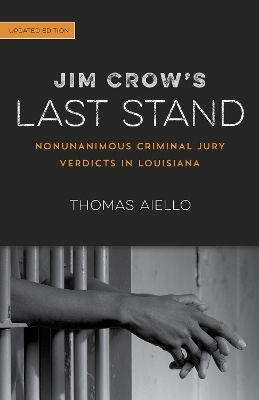
Jim Crow's Last Stand
Nonunanimous Criminal Jury Verdicts in Louisiana
Seiten
2019
Louisiana State University Press (Verlag)
978-0-8071-7237-7 (ISBN)
Louisiana State University Press (Verlag)
978-0-8071-7237-7 (ISBN)
Louisiana's non-unanimous jury-verdict law permitted juries to convict criminal defendants with only nine, and later ten, out of twelve votes. This updated edition of Jim Crow's Last Stand unpacks the origins of the statute, traces its survival through the civil rights era, and ends with the successful effort to overturn the practice.
A remnant of the racist post-Reconstruction Redeemer sociopolitical agenda, Louisiana's nonunanimous jury-verdict law permitted juries to convict criminal defendants with only nine, and later ten, out of twelve votes: a legal oddity. On the surface, it was meant to speed convictions. In practice, the law funneled many convicts- especially African Americans- into Louisiana's burgeoning convict lease system. Although it faced multiple legal challenges through the years, the law endured well after convict leasing had ended. Few were aware of its existence, let alone its original purpose. In fact, the original publication of Jim Crow's Last Stand was one of the first attempts to call attention to the historical injustice caused by this law.
This updated edition of Jim Crow's Last Stand unpacks the origins of the statute in Bourbon Louisiana, traces its survival through the civil rights era, and ends with the successful effort to overturn the nonunanimous jury practice, a policy that officially went into effect on January 1, 2019.
A remnant of the racist post-Reconstruction Redeemer sociopolitical agenda, Louisiana's nonunanimous jury-verdict law permitted juries to convict criminal defendants with only nine, and later ten, out of twelve votes: a legal oddity. On the surface, it was meant to speed convictions. In practice, the law funneled many convicts- especially African Americans- into Louisiana's burgeoning convict lease system. Although it faced multiple legal challenges through the years, the law endured well after convict leasing had ended. Few were aware of its existence, let alone its original purpose. In fact, the original publication of Jim Crow's Last Stand was one of the first attempts to call attention to the historical injustice caused by this law.
This updated edition of Jim Crow's Last Stand unpacks the origins of the statute in Bourbon Louisiana, traces its survival through the civil rights era, and ends with the successful effort to overturn the nonunanimous jury practice, a policy that officially went into effect on January 1, 2019.
Thomas Aiello is associate professor of history and African American studies at Valdosta State University. He is the author of dozens of books and articles analyzing black cultural and intellectual history.
| Erscheinungsdatum | 29.07.2019 |
|---|---|
| Verlagsort | Baton Rouge |
| Sprache | englisch |
| Maße | 139 x 215 mm |
| Gewicht | 281 g |
| Themenwelt | Sachbuch/Ratgeber ► Geschichte / Politik ► Allgemeines / Lexika |
| Sachbuch/Ratgeber ► Geschichte / Politik ► Regional- / Landesgeschichte | |
| Geisteswissenschaften ► Geschichte ► Allgemeine Geschichte | |
| Geisteswissenschaften ► Geschichte ► Regional- / Ländergeschichte | |
| Geschichte ► Teilgebiete der Geschichte ► Kulturgeschichte | |
| Geschichte ► Teilgebiete der Geschichte ► Militärgeschichte | |
| Recht / Steuern ► Rechtsgeschichte | |
| Sozialwissenschaften ► Soziologie | |
| ISBN-10 | 0-8071-7237-5 / 0807172375 |
| ISBN-13 | 978-0-8071-7237-7 / 9780807172377 |
| Zustand | Neuware |
| Informationen gemäß Produktsicherheitsverordnung (GPSR) | |
| Haben Sie eine Frage zum Produkt? |
Mehr entdecken
aus dem Bereich


aus dem Bereich
Die Revolution des Gemeinen Mannes
Buch | Softcover (2024)
C.H.Beck (Verlag)
CHF 16,80
Eine Geschichte des Geschmacks
Buch | Hardcover (2025)
C.H.Beck (Verlag)
CHF 49,95


