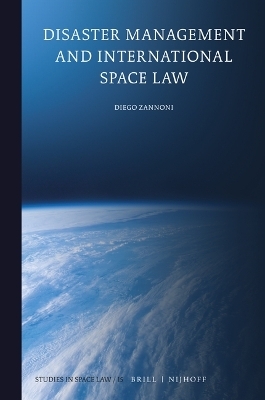
Disaster Management and International Space Law
Martinus Nijhoff (Verlag)
978-90-04-38835-2 (ISBN)
Is international law equipped to tackle the challenges posed by the dramatic increase in disasters? In Disaster Management and International Space Law Diego Zannoni attempts to answer this crucial question through an analysis of the main legal issues involved, addressing both prevention and relief, with a special focus on major space applications such as remote sensing and telecommunications, and the attendant specific legal regimes.
It is argued that, when lives of human beings are in danger, territorial sovereignty becomes, to a certain extent, porous and bends in front of the value of human life and the urgent need to rescue. On the other hand, specific obligations were identified to cooperate in the prevention and management of disasters, particularly in terms of data sharing.
Diego Zannoni, Ph.D. in International and European Union Law (University of Padua); Postdoctoral Fellow at the Institute of Air and Space Law (McGill University). Diego Zannoni currently is a researcher in International and European Union Law at the University of Padua. He has published several articles on International and European Union Law issues.
Foreword
Acronyms
Introduction
1Addressing Disasters in Today’s World
2A Premise on the Method
1Disaster Prevention
1.1A Historical Overview
1.2What Is a “Disaster” of International Significance?
1.3Natural and Man-Made Disasters
1.4The Prohibition of Transboundary Pollution
1.5The Duty to Notify Impending Man-Made Disasters
1.6Conclusions
2Humanitarian Assistance in the Wake of Disasters
2.1The Consent of an Affected State to Humanitarian Assistance
2.2Explicit and Implicit Refusal to Humanitarian Assistance in International Practice
2.3Arbitrary Refusal to Humanitarian Assistance in Situations of Armed Conflict
2.4Arbitrary Refusal to Relief Flights
2.5Arbitrary Refusal to Humanitarian Assistance in Situations of Disaster
2.6Refusing Humanitarian Assistance and Human Rights
2.7What Happens When Humanitarian Assistance Is Arbitrarily Refused?
2.8Refusing Humanitarian Assistance and the Role of the Security Council
2.9Towards a Responsibility to Protect in Case of Disaster?
2.10Airdrops and the Defence of Necessity
2.11Ascertaining the Arbitrariness of Refusal
2.12The Duty to Provide Humanitarian Assistance upon Request
2.13Conclusions
3The Operation of Satellites and the Consent of the Underlying State
3.1Introduction
3.2Is a Delimitation between Airspace and Outer Space Needed?
3.3Usque ad Coelum
3.4Spatialist Theories
3.5Functional Theory
3.6Conclusions
4Remote Sensing and Disaster Management
4.1Introduction
4.2The Legal Value of General Assembly Resolutions
4.3The Legal Value of the Remote Sensing Principles
4.4The Principles of Remote Sensing as a Means to Interpret the Outer Space Treaty
4.5The State’s Right to Privacy
4.6The Right to Disseminate Sensed Data to Third Countries
4.7The Transfer of Remote Sensing Technology
4.8The Sensed State’s Right to Access Sensed Data
4.9Access to Sensed Data and Customary Law
4.10Reasonable Cost Terms in Practice
4.11Provisions and Omissions of the Resolution on Early-Warning of Disaster and Relief
4.12Data Transmission for Early-Warning of Disaster and Relief
4.13Verification of Remote Sensing Principles
4.14Conclusions
5Telecommunications and Disaster Management
5.1Introduction
5.2The Consent of the Target State for Fixed Services
5.3The Consent of the Target State for Non-fixed Services
5.4The Priority of Distress and Safety Telecommunications
5.5The Special Protective Regime for Distress and Safety Frequencies
5.6Conclusions
Final Remarks
Bibliography
Index
| Erscheinungsdatum | 02.07.2019 |
|---|---|
| Reihe/Serie | Studies in Space Law ; 15 |
| Sprache | englisch |
| Maße | 155 x 235 mm |
| Gewicht | 566 g |
| Themenwelt | Recht / Steuern ► EU / Internationales Recht |
| ISBN-10 | 90-04-38835-4 / 9004388354 |
| ISBN-13 | 978-90-04-38835-2 / 9789004388352 |
| Zustand | Neuware |
| Informationen gemäß Produktsicherheitsverordnung (GPSR) | |
| Haben Sie eine Frage zum Produkt? |
aus dem Bereich