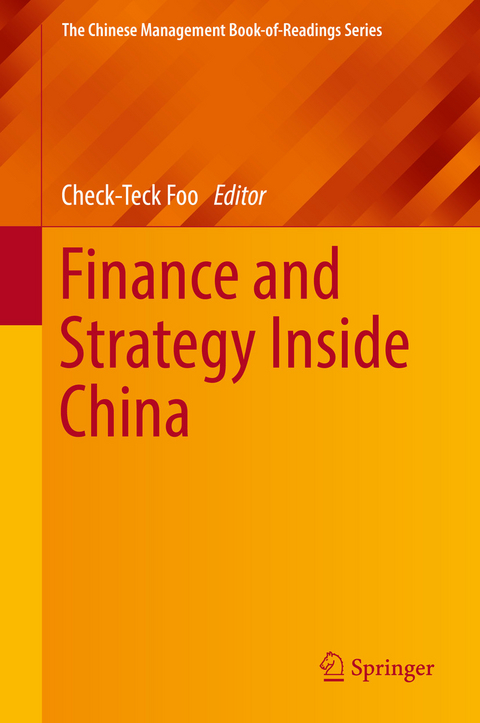
Finance and Strategy Inside China (eBook)
V, 146 Seiten
Springer Singapore (Verlag)
978-981-13-2841-1 (ISBN)
This volume presents the current thinking on finance and strategy inside China. It begins with research presented at the China Financial Markets Conference in 2016, jointly organized by the University of Malaya and the Sun Tzu Art of War Institute. It includes a talk by Check Teck Foo on Currency-at-War: A Longer View, as well as a highly innovative piece by Kishan on the New Chinese Paradigm in Finance, and Tianyue Lu and Wee-Yeap Lau's empirical work on China's Shadow Banking. Ignatius Roni Setyawan and Buddi Wibowo also offer compelling contributions on Determinants of Market Integration in ASEAN. Other topics include The intriguing poser: integrating China into ASEAN, will determinants be the same? and Real Estate and Inflation in China by Siew Peng Lee and Mansor Isa.The book also features contributions from the 7th Global Chinese Management Conference held in 2017. Of the several papers on Sun Tzu, Seow Wah Sheh's on Modeling of the Dao of SunTzu for Business was chosen along with Shi Yong Song's Legal Risks inside China and Sustainability Reporting by Xin Sheng Duan and Check-Teck Foo. Furthermore, contributions on Company Secretaries on Chinese Board of Directors by Guang You Liu and Xiao Hui Wang are included. Lastly, it presents Check-Teck Foo's interview with Singaporean Chinese forecaster, Jason Tan Beng Siang, discussing Chinese approaches to forecasting as well as his invention, San Bian Shu.
Check-Teck Foo, LLB (Hons) London MBA (Award Winner) Cass Business School, Ph.D. (1990) St Andrews CA FCCA FCMA FCIM Barrister Advocate & Solicitor, was a Tenured Associate Professor of System Engineering Management at the School of Aerospace and Mechanical Engineering, Nanyang Technological University, Singapore from 1988 to 2010. From 2004 to 2011 he was an Honorary Professor and Chair of Strategy at the University of St Andrews, Scotland. He has travelled across China, lecturing on research, Sunzi and management as a Visiting Professor at 21 Universities (most recently, Consulting Professor, Hunan University and Research Professor, Fudan University). He held a Research Professorship (2012-2015; Talent Program) at Harbin Institute of Technology, Harbin. He has held numerous Visiting Professorships around the globe: Europe (UMEA University, Sweden; Consulting Professor, INSEAD, France, and Honorary Research Professor, College of Business, Denmark); USA (New York Institute of Technology and Visiting Distinguished Professor, City University of New York) and Asia (ASEAN Distinguished Professor, University of Malaya; Solbridge Business School, Korea and Government Fellow, Japan Productivity Center, Tokyo).
Contents 6
Chapter 1: Currency at War: A Longer View 7
1 Introduction 8
References 20
Chapter 2: Forecasting, Yi Ching and San Bian Shu: A Chinese Approach for Gaining Foresight – An Interview of Jason Tan Beng Siang 21
1 Interview 22
Chapter 3: Sustainability Reporting: Case of a University in Beijing 32
1 Introduction 33
2 Reporting for a Local University: Who Cares? 33
2.1 Local Government 33
2.2 Ministry of Education 34
2.3 Local Community 34
3 Sustainable Development of a Local University: How Can It Be Done? 34
4 Contents of Sustainability Report for Sample Local University 35
4.1 Vision and Strategy 36
4.2 Introduction to the Organization 36
4.3 Organizational Structure 38
4.4 Influences on the Economy, Society, and Community 39
4.5 Performance 39
5 Conclusion and Future Development 40
References 40
Chapter 4: Wanted: A New, Chinese Paradigm in Finance 42
1 Introduction 42
2 Conceptual Overview 43
2.1 Positivistic School of Thought in Social Sciences 43
2.2 Positivism in Business and Management Research 44
2.3 Positivistic School of Social Sciences Research Preoccupations 45
2.3.1 Causality or Internal Validity 45
2.3.2 Reliability and Replication 45
2.3.3 Generalizability 45
2.3.4 Operationalism 46
3 Positivism and Finance Research 46
3.1 Equilibrium 47
3.2 Ceteris Paribus Assumption 47
3.3 Beta Coefficient 48
3.4 Capital Asset Pricing Model (CAPM) 48
3.5 Efficient Market Hypothesis (EMH) 48
3.6 Black-Scholes Model 49
4 Case Studies 49
4.1 Long-Term Capital Management (LTCM) 49
4.2 The 2007–2008 Financial Crisis 50
5 Why It Concerns Finance Managers in China 51
6 Conclusion and Key Propositions 52
References 53
Chapter 5: Real Estate and Inflation in China 54
1 Introduction 54
2 An Overview of Real Estate Markets Developments in China 55
3 Inflation Hedges: Theoretical Framework 56
4 The Growth of China Real Estate Market 58
4.1 China’s Housing Reform 58
4.2 Is There a Bubble in China’s Real Estate Market? 59
4.3 Factors Driving Real Estate Price 60
5 Housing Price and Inflation 61
5.1 Test for Inflation Hedges 63
5.2 Cities with a Peak House Price Growth Rate 64
6 Conclusion and Key Propositions 69
References 69
Chapter 6: Managing Trade Secret Legal Risks for Food Company in China 71
1 Introduction 72
2 Conceptual Overview 72
2.1 The Definition of Food Companies’ Trade Secrets 72
2.2 Provisions in the “People’s Republic of China Food Safety Law” for Food Companies to Protect Their Trade Secrets 73
2.3 The Lack of Legal Provisions on Specific Issues and the Reasons for the Food Business Trade Secret Protection of “People’s Republic of China Food Safety Law” 73
3 Why It Concerns Finance Manager Having Interests in China 74
4 Major Case Studies 75
5 Key Statistical Insights 76
6 Illustrative Example 77
6.1 Food Companies Without Proper Law Awareness of Trade Secrets 77
6.2 Food Companies Lack of Trade Secret Management System Standard and Practical and Effective Measures 77
7 Key Propositions 78
7.1 Basic General Ways 78
7.2 The Main Measures for Food Companies’ Management on Trade Secret Law Risk 79
7.2.1 The First Is to Build a Special Department in the Companies to Protect Trade Secrets and Equip with Specialized Personnel 79
7.2.2 The Second Is to Develop the Perfect System of Fixed Trade Secret Protection and Isolation Area 79
7.2.3 The Third Is to Develop Lifelong Learning and Education Environment for All Employees Within the Food Company 79
References 80
Chapter 7: Company Secretaries in Chinese Board of Directors 81
1 Introduction 81
2 A Conceptual Overview 82
2.1 Company Secretaries and Corporate Governance 82
2.2 Demographical Features of Company Secretaries in Boards 84
2.3 Human Resource Capital of Company Secretaries in Boards 85
2.4 Conceptual Overview of Company Secretaries in Corporate Governance 85
3 An Illustrative Case in China 86
4 Further Illustration: An Empirical Evidence 87
4.1 Data Collection 87
4.2 Testing Methods 89
4.3 Correlation Analysis 89
4.4 Regression Results and Discussion 89
5 Concluding Remarks 92
References 92
Chapter 8: Determinants of Capital Market Integration: The Case of ASEAN and Implications to China 94
1 Introduction 95
2 Conceptual Overview 97
3 Why This Is of Concern to a Finance Manager 99
4 Key Statistical Insight 99
5 Illustrative Example 101
5.1 Hypothesis Testing for Differences of Integration Levels from 5 ASEAN Countries 101
5.2 Unconditional Correlation (UCC) and Dynamic Conditional Correlation (DCC) 103
5.3 Hypothesis Testing for Determinants of Capital Market Integration 106
5.3.1 Level of Intra-industry Competition 106
5.3.2 Intensity of Role of Global Investors 108
6 Concerning China 109
6.1 Before ASEAN China Free Trade Area (ACFTA) 109
6.2 After ASEAN China Free Trade Area (ACFTA) 110
7 Concluding Remarks 110
7.1 Conclusion 110
7.2 Implications 111
References 112
Chapter 9: Modelling the Dao of Sun Tzu for Business 115
1 Introduction 115
2 A Conceptual Overview 116
2.1 A Brief Review of Dao Philosophers 116
2.2 A Review of the Sunzi’s 13 Chapter of the Art of War 117
2.2.1 The Dao of Camouflage 119
2.2.2 The Dao of Non-action (“‘wu-wei”) 121
2.2.3 The Dao of Paradoxical 123
2.2.4 The Dao of Fluidity 125
2.3 A Proposed Conceptual Model 126
3 Why It Concerns Management 126
4 Key Insights from Data Analyses 128
4.1 Proposed Research 128
4.2 Data Analyses 128
5 Illustrative Example, Cases and Mapping 129
6 Concluding Remarks 129
References 132
Chapter 10: China’s Shadow Banking: Dynamics of Policy and Economy 133
1 Introduction 133
2 Conceptual Overview 135
3 Why It Concerns the Finance Manager in China? 137
3.1 The Drivers of China Shadow Banking 137
3.1.1 Interest Rate 137
3.1.2 Inflation Rate 137
3.1.3 Money Supply 138
3.1.4 Trust Loans 138
3.1.5 Entrusted Loans 138
3.2 Shadow Banking System due to Policy Changes 139
3.3 Government’s Regulation 139
4 Hypothesis Development 140
5 A Case Study 141
6 Key Statistical Insights 141
6.1 Unit Root Test 141
6.2 Granger’s Causality Test 142
6.3 Augmented VAR 143
6.4 Results and Discussion 144
6.4.1 Unit Root and Stationary Test Results 144
6.4.2 Granger’s Causality Results 144
7 Key Results and Proposition 146
7.1 Policy Implications 147
References 147
| Erscheint lt. Verlag | 11.3.2019 |
|---|---|
| Reihe/Serie | The Chinese Management Book-of-Readings Series | The Chinese Management Book-of-Readings Series |
| Zusatzinfo | V, 146 p. 41 illus. |
| Verlagsort | Singapore |
| Sprache | englisch |
| Themenwelt | Recht / Steuern ► Wirtschaftsrecht |
| Wirtschaft ► Betriebswirtschaft / Management ► Finanzierung | |
| Wirtschaft ► Betriebswirtschaft / Management ► Unternehmensführung / Management | |
| Schlagworte | China Financial Markets Conference • China’s Shadow Banking • Currency-at-War • Finance in China • San Bian Shu |
| ISBN-10 | 981-13-2841-2 / 9811328412 |
| ISBN-13 | 978-981-13-2841-1 / 9789811328411 |
| Informationen gemäß Produktsicherheitsverordnung (GPSR) | |
| Haben Sie eine Frage zum Produkt? |
 PDF (Wasserzeichen)
DRM: Digitales Wasserzeichen
Dieses eBook enthält ein digitales Wasserzeichen und ist damit für Sie personalisiert. Bei einer missbräuchlichen Weitergabe des eBooks an Dritte ist eine Rückverfolgung an die Quelle möglich.
Dateiformat: PDF (Portable Document Format)
Mit einem festen Seitenlayout eignet sich die PDF besonders für Fachbücher mit Spalten, Tabellen und Abbildungen. Eine PDF kann auf fast allen Geräten angezeigt werden, ist aber für kleine Displays (Smartphone, eReader) nur eingeschränkt geeignet.
Systemvoraussetzungen:
PC/Mac: Mit einem PC oder Mac können Sie dieses eBook lesen. Sie benötigen dafür einen PDF-Viewer - z.B. den Adobe Reader oder Adobe Digital Editions.
eReader: Dieses eBook kann mit (fast) allen eBook-Readern gelesen werden. Mit dem amazon-Kindle ist es aber nicht kompatibel.
Smartphone/Tablet: Egal ob Apple oder Android, dieses eBook können Sie lesen. Sie benötigen dafür einen PDF-Viewer - z.B. die kostenlose Adobe Digital Editions-App.
Buying eBooks from abroad
For tax law reasons we can sell eBooks just within Germany and Switzerland. Regrettably we cannot fulfill eBook-orders from other countries.
aus dem Bereich