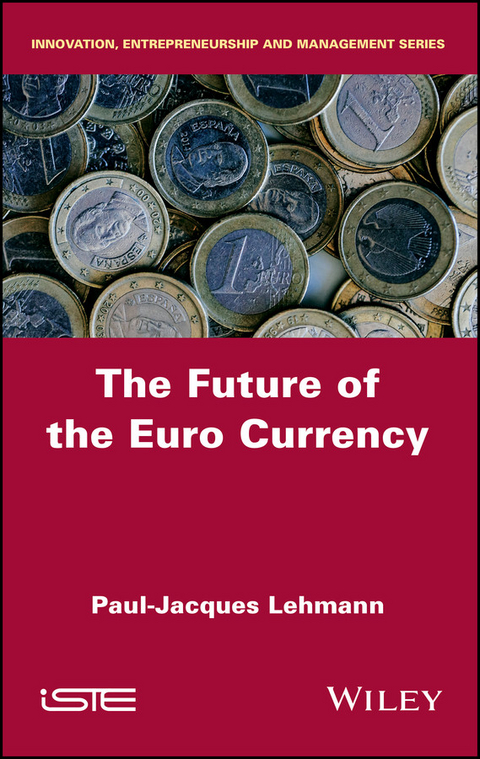
The Future of the Euro Currency (eBook)
192 Seiten
John Wiley & Sons (Verlag)
978-1-119-59742-1 (ISBN)
Encouraged by some who believe that its introduction gives more cohesion and strength to Europe in an increasingly globalized economy, the euro is criticized by others who believe that the constraints it imposes are a source of austerity and favor northern European countries at the expense of countries in the south.
The Future of the Euro Currency traces the evolution of the monetary policy which the European Central Bank instituted at a time when economic, monetary and financial crises were legion. The book presents, as objectively as possible, the advantages and disadvantages of this new currency, while considering the improvements that could promote its durability.
Paul-Jacques Lehmann, Emeritus Professor of Economics at the University of Rouen, is the author of numerous theoretical, practical and historical works in monetary and financial fields.
Preface ix
Introduction xi
Chapter 1 The Monetary Steps that Preceded the Introduction of the Euro 1
1.1 The lack of a sustainable international monetary system 1
1.1.1 From the gold standard to the gold exchange standard system 2
1.1.2 The Bretton Woods international monetary system 3
1.1.3 The International Monetary Fund (IMF), guarantor of the Bretton Woods Agreements 4
1.1.4 The end of convertibility of the dollar and the instability of floating exchange rates 5
1.2 From the Treaty of Rome to the Maastricht Treaty 8
1.2.1 The lack of a monetary target at the beginning of the European Economic Community 8
1.2.2 The Werner Plan and the temporary failure to establish an Economic and Monetary Union 10
1.2.3 The Single European Act and the Delors Report 14
1.2.4 The Maastricht Treaty 18
1.3 Monetary experiences prior to the euro 19
1.3.1 The snake in the tunnel 20
1.3.2 The European Monetary System (EMS) 22
1.3.3 The European Monetary Cooperation Fund (EMCF) 25
1.3.4 The European Monetary Institute (EMI) 26
Chapter 2 The Monetary Policy Decisions Facing the European Monetary Institute 33
2.1 The central bank, Bank of Banks 35
2.1.1 The original function of the lender of last resort 35
2.1.2 The modern function of lender of last resort 37
2.1.3 Controversy over the choice of body to control banking risks 39
2.1.4 The limitations of the lender of last resort 41
2.2 The central bank, a body responsible for monetary policy 44
2.2.1 Conditions for implementing monetary policy 45
2.2.2 The main objective of the fight against inflation 47
2.2.3 Methods for achieving the objective of maintaining price stability 49
2.2.4 Monetary policy tools 50
2.3 The independence of the central bank 53
2.3.1 Institutional independence 54
2.3.2 Effective independence 57
Chapter 3 Monetary Policy Conducted by the European Central Bank 61
3.1 The monetary policy in force when the euro was introduced 62
3.1.1 The bodies responsible for European monetary policy 63
3.1.2 Organization of payment and prudential control systems 67
3.1.3 The choice of monetary policy objective 69
3.1.4 Monetary policy tools 72
3.1.5 Independence of the European Central Bank 75
3.2 Developments in conventional monetary policy between 1999 and 2007 77
3.2.1 Bank liquidity factors 77
3.2.2 Interest rates 83
3.2.3 Refinancing tools 87
3.3 Non-conventional monetary policy since 2008 94
3.3.1 The evolution of liquidity needs 95
3.3.2 Interest rates that gradually became zero and even became negative 97
3.3.3 Refinancing operations 102
Chapter 4 Consequences of the European Central Bank's Monetary Policy 117
4.1 Monetary consequences 118
4.1.1 About the balance sheet of the European Central Bank 118
4.1.2 On the monetary aspects of the euro zone 125
4.1.3 Improvements in banking and financial prudential supervision 130
4.2 Economic consequences 133
4.2.1 An increase in fluctuating price 134
4.2.2 Limited growth and an unemployment that is difficult to combat 136
4.2.3 A heavily deteriorated fiscal situation and public debt 138
Conclusion 145
References 151
Index 153
| Erscheint lt. Verlag | 1.3.2019 |
|---|---|
| Sprache | englisch |
| Themenwelt | Recht / Steuern ► Wirtschaftsrecht |
| Wirtschaft ► Betriebswirtschaft / Management ► Finanzierung | |
| Wirtschaft ► Betriebswirtschaft / Management ► Rechnungswesen / Bilanzen | |
| Schlagworte | Finance & Investments • Finance & Investments Special Topics • Finanz- u. Anlagewesen • Internationales Finanzwesen • International finance • Spezialthemen Finanz- u. Anlagewesen |
| ISBN-10 | 1-119-59742-0 / 1119597420 |
| ISBN-13 | 978-1-119-59742-1 / 9781119597421 |
| Informationen gemäß Produktsicherheitsverordnung (GPSR) | |
| Haben Sie eine Frage zum Produkt? |
 PDF (Adobe DRM)
Kopierschutz: Adobe-DRM
Adobe-DRM ist ein Kopierschutz, der das eBook vor Mißbrauch schützen soll. Dabei wird das eBook bereits beim Download auf Ihre persönliche Adobe-ID autorisiert. Lesen können Sie das eBook dann nur auf den Geräten, welche ebenfalls auf Ihre Adobe-ID registriert sind.
Details zum Adobe-DRM
Dateiformat: PDF (Portable Document Format)
Mit einem festen Seitenlayout eignet sich die PDF besonders für Fachbücher mit Spalten, Tabellen und Abbildungen. Eine PDF kann auf fast allen Geräten angezeigt werden, ist aber für kleine Displays (Smartphone, eReader) nur eingeschränkt geeignet.
Systemvoraussetzungen:
PC/Mac: Mit einem PC oder Mac können Sie dieses eBook lesen. Sie benötigen eine
eReader: Dieses eBook kann mit (fast) allen eBook-Readern gelesen werden. Mit dem amazon-Kindle ist es aber nicht kompatibel.
Smartphone/Tablet: Egal ob Apple oder Android, dieses eBook können Sie lesen. Sie benötigen eine
Geräteliste und zusätzliche Hinweise
Buying eBooks from abroad
For tax law reasons we can sell eBooks just within Germany and Switzerland. Regrettably we cannot fulfill eBook-orders from other countries.
aus dem Bereich