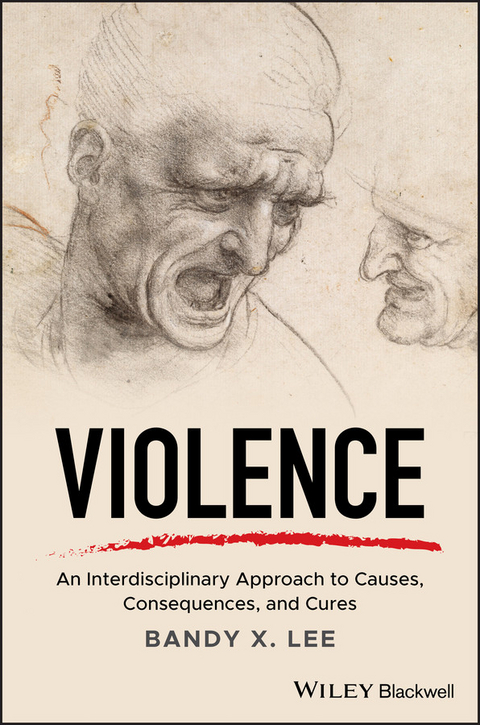
Violence (eBook)
John Wiley & Sons (Verlag)
978-1-119-24070-9 (ISBN)

A comprehensive overview of the integrative study of violence
Violence continues to be one of the most urgent global public health problems that contemporary society faces. Suicides and homicides are increasing at an alarming rate, particularly in younger age groups and lower-income countries. Historically, the study of violence has been fragmented across disparate fields of study with little cross-disciplinary collaboration, thus creating a roadblock to decoding the underlying processes that give rise to violence and hindering efforts in research and prevention. Violence: An Interdisciplinary Approach to Causes, Consequences, and Cures assembles and organizes current information into one comprehensive volume, introducing students to the multiple sectors, disciplines, and practices that collectively comprise the study of violence.
This innovative textbook presents a unified perspective that integrates the sociological, biological, politico-economic, structural, and environmental underpinnings of violence. Each chapter examines a distinct point of learning, beginning with an overview of the content and concluding with discussion questions and an analytical summary. The chapters focus on key domains of research encouraging interdisciplinary investigation and helping students to develop critical analytical skills and form their own conclusions.
- Fills a significant gap in the field by providing a coherent text that consolidates information on the multiple aspects of violence
- Examines current legal, medical, public health, and policy approaches to violence prevention and their application within a global context
- Illustrates how similar causes of violence may have dissimilar manifestations
- Presents a multidisciplinary examination of the symptoms and underlying processes of violence
- Offers a thorough yet accessible learning framework to undergraduate and graduate students without prior knowledge of the study of violence
More than just an accumulation of facts and data, this essential text offers a broad introduction to a thinking process that can produce rigorous scholarship across disciplines and lead to a deeper understanding of violence in its many forms.
Bandy X. Lee, MD, MDiv, is on the faculty of Yale School of Medicine's Law and Psychiatry Division, USA. She has taught at Yale Law School for over fifteen years and has served as project group leader for the Violence Prevention Alliance of the World Health Organization. She has also consulted with UNESCO and other United Nations bodies, helped initiate reforms at New York City's Rikers Island Correctional Center, and co-founded Yale's Violence and Health Study Group. Dr. Lee teaches a range of courses on violence including 'Violence: Causes and Cures.' She has authored numerous peer-reviewed articles and edited 13 academic books.
A comprehensive overview of the integrative study of violence Violence continues to be one of the most urgent global public health problems that contemporary society faces. Suicides and homicides are increasing at an alarming rate, particularly in younger age groups and lower-income countries. Historically, the study of violence has been fragmented across disparate fields of study with little cross-disciplinary collaboration, thus creating a roadblock to decoding the underlying processes that give rise to violence and hindering efforts in research and prevention. Violence: An Interdisciplinary Approach to Causes, Consequences, and Cures assembles and organizes current information into one comprehensive volume, introducing students to the multiple sectors, disciplines, and practices that collectively comprise the study of violence. This innovative textbook presents a unified perspective that integrates the sociological, biological, politico-economic, structural, and environmental underpinnings of violence. Each chapter examines a distinct point of learning, beginning with an overview of the content and concluding with discussion questions and an analytical summary. The chapters focus on key domains of research encouraging interdisciplinary investigation and helping students to develop critical analytical skills and form their own conclusions. Fills a significant gap in the field by providing a coherent text that consolidates information on the multiple aspects of violence Examines current legal, medical, public health, and policy approaches to violence prevention and their application within a global context Illustrates how similar causes of violence may have dissimilar manifestations Presents a multidisciplinary examination of the symptoms and underlying processes of violence Offers a thorough yet accessible learning framework to undergraduate and graduate students without prior knowledge of the study of violence More than just an accumulation of facts and data, this essential text offers a broad introduction to a thinking process that can produce rigorous scholarship across disciplines and lead to a deeper understanding of violence in its many forms.
Bandy X. Lee, MD, MDiv, is on the faculty of Yale School of Medicine's Law and Psychiatry Division, USA. She has taught at Yale Law School for over fifteen years and has served as project group leader for the Violence Prevention Alliance of the World Health Organization. She has also consulted with UNESCO and other United Nations bodies, helped initiate reforms at New York City's Rikers Island Correctional Center, and co-founded Yale's Violence and Health Study Group. Dr. Lee teaches a range of courses on violence including "Violence: Causes and Cures." She has authored numerous peer-reviewed articles and edited 13 academic books.
Preface
This volume aims to be an introductory textbook on a single topic that is an offspring of many fields—a topic of rapid growth in information and research but lacking in overall guidance. It may surprise some that a single author should undertake a text of such wide‐ranging disciplines. However, as even a thousand‐page thesis should be summarizable in a sentence, so should this project be possible. It seems indispensable for coherence and consolidation in this day of disparate scholarship. No doubt there will be compromises, since it will not be possible to do justice to every topic, but my hope is that the benefits are many: what we greatly need in our day is a unified framework capable of bringing our knowledge to completion and not just ever more pockets of complete knowledge.
Such a framework, I believe, is akin to teaching students to fish and feeding them for a lifetime. Students will learn to build a perspective for placing existing knowledge and advancing information in context, and this will prepare them for new developments, which are swiftly to come. It is natural for specialists of every area to believe that theirs is of central importance, but with the burgeoning of fields and subfields, an ability to integrate knowledge and to converse with other fields, more so than knowing more and more about less and less, has become an essential skill. Eventually, students will develop better ways to fish.
Human violence is a phenomenon that disciplines us in this way, due to its complexity and urgency—which require all our capacity for sufficient understanding and efficient application. We now know more than ever about the genetic, interpersonal, cultural, and structural causes of violence. Yet, seldom are the advances of multiple disciplines brought together under a single rubric. The purpose of this text is to present an integrative and interactionist, rather than a reductionist, approach to the study of violence, so as to prepare the student for such integration.
Aristotle observed that the whole is greater than the sum of its parts, to which I would add that synergy works better than fragmentation. While there will always be a need for new and better data, it is equally important to take an occasional pause to appraise the data we already have. A coherent body of knowledge—insofar as is possible—can give the student bearing with respect to what is important, which questions to ask, and how everything fits together. Persistent practice that builds on such groundwork may even go beyond knowledge to achieve wisdom.
This text assumes no previous exposure to the study of violence. It might serve as a comprehensive overview before delving into whatever field students choose: criminal violence reduction, conflict resolution, legal interventions, global health ethics, or human rights advocacy. It can also be a guideline for bringing together the disparate information one ordinarily has to study piecemeal. In order to make the material accessible, as well as to encourage an interdisciplinary conversation, this book has a unique structure: it starts not with a list of topics but domains of research, starting with the most basic but not implying a hierarchy in either direction. Each chapter attempts to explain how its topic relates to the others.
This volume contains enough material for a one‐year course. It could also be taught as a semester course, with an emphasis on broad concepts. Each chapter constitutes a unit of understanding with an overview, summary, and discussion questions. The progression of the chapters goes from a general introduction (Part I) to the intra‐ and interpersonal framework (Part II) to the social and societal framework (Part III) to consequences (Part IV), interventions (Part V) and prevention (Part VI), and then back to a general synthesis and integration (Part VII). Thematically, it covers biological, psychological and symbolic, sociocultural and political, and structural and environmental perspectives on violence; consequences of violence; and legal, medical, and nonviolent approaches to preventing violence, before putting it all together.
The purpose of a textbook is to compile existing information and to present it in the most reasonable way based on current knowledge. I expect that this will entail a letting go of many doctrines inherent in the particular fields and a deeper look at human nature than may be initially comfortable. It will challenge our ordinary notions of responsibility and require us to expand our notion of boundaries to include wider segments of scholarship as well as of society. However, the point is to equip the aspiring student with a broad range of material and an analytical armamentarium that will bolster efforts to arrive at one's own conclusions—and to cultivate that ability.
I believe in my institution's motto: Lux et Veritas, or light and truth. The purpose of education is not to inculcate a certain “truth” but to provide the learner with the “light” that is required to see one's own truth. If this text fulfills its purpose, it will not only teach content but the tools for learning, which the student can apply to other areas of life. A body of knowledge can change entirely over the course of a career, but this aptitude remains. True knowledge transcends mere accumulation of facts to become understanding, and inner sight. Therefore, while this is perhaps the first text of its scope for an emerging field, my hope is that it will not be the last—for each new generation has the task of restructuring and redefining knowledge for itself.
No ideas are freshly one's own. This applies especially here, for I am fortunate to stand on the shoulders of many giants: first and foremost, my long‐term teacher, mentor, colleague, and friend, Dr James Gilligan, who taught me everything I know, and whose many thoughts I echo, however imperfectly; Dr Robert Jay Lifton, who gave me light in times of darkness; Dr Leon Eisenberg, who was my first inspiration and terrific mentor; Dr Arthur Kleinman, who encouraged me to do my own scholarship; Dr Kathy Sanders, who saw me through that transition; Dr Judith Herman, who accompanied me through another transition; Drs Howard Zonana and Madelon Baranoski, who gave me a home and nurtured my growth; Dr John Young, who came to all my lectures and supported me; and Dr Bruce Wexler, who guided and believed in me from my very beginnings as a medical student. I appreciate Drs Sylvia Kaaya, Jessie Mbwambo, Gad Kilonzo, and the villagers of Chamazi who gave me glimpses of the level of humanity that is possible, in peaceful Tanzania. I am also grateful to Drs Kaveh Khoshnood, James Leckman, and Catherine Panter‐Brick for being my chief partners on this topic, as well as Drs Alexander Butchart, Etienne Krug, Christopher Mikton, and Berit Kieselbach at the World Health Organization Violence and Injury Prevention Department. I owe a great debt to the guest lecturers of my course who gave me feedback and offered essential guidance in their disciplines: Drs John Strauss, James Leckman (biology), Elijah Anderson (sociology), Francesca Grandi, David Simon (political science), Thomas Pogge, Atty James Silk (human rights), Dr Amity Doolittle (environmental studies), Prof Jonathan Schell (nuclear violence and nonviolence), Dr Michael Reed‐Hurtado, Attys Fiona Doherty (criminal justice), Noah Zatz (public interest law), Drs Maya Prabhu (international law), Kathryn Falb, Kaveh Khoshnood, and Unni Karunakara (public health). In terms of editorial and research help, I am greatly indebted to Dr Grace Lee, Morkeh Blay‐Tofey, James Tierney, Nick Oliver, and Liz Seif. I would also like to acknowledge the student deciding to embark upon this text to get to the heart of a problem that is the source of much of humanity's suffering.
All that I do has one consistent guide: my mother, Dr Inmyung Lee, who taught me half of all the medicine I know, even before I entered medical school; she also showed me that the impulse to serve humanity offers a compass for all knowledge. Because of her, I could model my life after my grandfather, Dr Geun‐Young Lee, whom I never met but who came to stir my vision of healing, including of society. My mother came to play a crucial role in the work that culminated in this book. When I was originally aiming for publication in 2015 while teaching and attending a busy clinic, she offered to spend an exceptional few months with me in the spring of 2014 and helped with literature searches, brought me books, collated thousands of pages of notes, and created indices for navigation. Like the parent who helps one to give birth of one’s own, she was critical in my giving birth to this book. Most influential was her wellspring of ideas and lifetime of insights, which became the rock and the foundation of this volume. Although I put my name to it, she is more the book's author than I. She would not come to see its publication, but I trust that the student will benefit from her spirit as much as I. Here is one lesson from her: “Play, play with your subject of study—by the time you learn it, this will have been the shortcut!”
To close, I wish to thank all the students, patients, and prisoners who have taught me about human potential, who have shown me reasons for hope and convinced me of possibilities. They, above all, have demonstrated to me how we are all interconnected and could learn from one another. Finally, I also thank all my other colleagues at the Harvard Department of Social Medicine and the Yale Law and Psychiatry Division, my grandmother Eun‐Suk Jang, my uncles...
| Erscheint lt. Verlag | 27.2.2019 |
|---|---|
| Sprache | englisch |
| Themenwelt | Recht / Steuern ► Allgemeines / Lexika |
| Recht / Steuern ► EU / Internationales Recht | |
| Recht / Steuern ► Strafrecht ► Kriminologie | |
| Sozialwissenschaften ► Politik / Verwaltung | |
| Sozialwissenschaften ► Soziologie | |
| Schlagworte | Anthropology of violence • biology of violence • causes of violence • causes of violence introduction • causes of violence overview • causes of violence research • causes of violence textbook • Consequences of Violence • consequences of violence introduction • consequences of violence overview • consequences of violence research • consequences of violence textbook • Criminology • economics of violence • environmental violence • Gewalt • Kriminologie • Law • Political Revolution / Violence / Terrorism • Political Science • political science of violence • Politikwissenschaft • Politische Revolution, Gewalt, Terrorismus • Psychologie • Psychology • psychology of violence • Rechtswissenschaft • sociology of violence • Structural Violence • symbolism of violence • violence and global health • violence and public health • Violence Prevention • violence prevention introduction • violence prevention methods • violence prevention overview • violence prevention research • violence prevention textbook |
| ISBN-10 | 1-119-24070-0 / 1119240700 |
| ISBN-13 | 978-1-119-24070-9 / 9781119240709 |
| Informationen gemäß Produktsicherheitsverordnung (GPSR) | |
| Haben Sie eine Frage zum Produkt? |
 EPUB (Adobe DRM)
Kopierschutz: Adobe-DRM
Adobe-DRM ist ein Kopierschutz, der das eBook vor Mißbrauch schützen soll. Dabei wird das eBook bereits beim Download auf Ihre persönliche Adobe-ID autorisiert. Lesen können Sie das eBook dann nur auf den Geräten, welche ebenfalls auf Ihre Adobe-ID registriert sind.
Details zum Adobe-DRM
Dateiformat: EPUB (Electronic Publication)
EPUB ist ein offener Standard für eBooks und eignet sich besonders zur Darstellung von Belletristik und Sachbüchern. Der Fließtext wird dynamisch an die Display- und Schriftgröße angepasst. Auch für mobile Lesegeräte ist EPUB daher gut geeignet.
Systemvoraussetzungen:
PC/Mac: Mit einem PC oder Mac können Sie dieses eBook lesen. Sie benötigen eine
eReader: Dieses eBook kann mit (fast) allen eBook-Readern gelesen werden. Mit dem amazon-Kindle ist es aber nicht kompatibel.
Smartphone/Tablet: Egal ob Apple oder Android, dieses eBook können Sie lesen. Sie benötigen eine
Geräteliste und zusätzliche Hinweise
Buying eBooks from abroad
For tax law reasons we can sell eBooks just within Germany and Switzerland. Regrettably we cannot fulfill eBook-orders from other countries.
aus dem Bereich