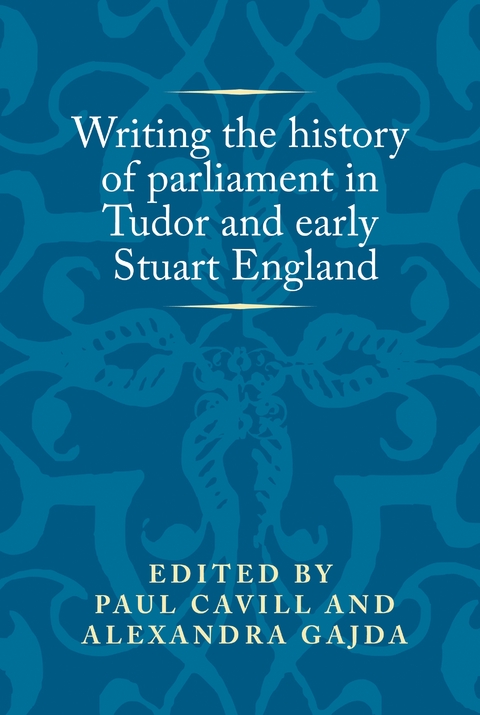
Writing the history of parliament in Tudor and early Stuart England (eBook)
Manchester University Press (Verlag)
978-1-5261-1591-1 (ISBN)
This volume of essays explores the rise of parliament in the historical imagination of early modern England. The enduring controversy about the nature of parliament informs nearly all debates about the momentous religious, political and governmental changes of the period - most significantly, the character of the Reformation and the causes of the Revolution. Meanwhile, scholars of ideas have emphasised the historicist turn that shaped political culture. Religious and intellectual imperatives from the sixteenth century onwards evoked a new interest in the evolution of parliament, framing the ways that contemporaries interpreted, legitimised and contested Church, state and political hierarchies. Parliamentary 'history' is explored through the analysis of chronicles, more overtly 'literary' texts, antiquarian scholarship, religious polemic, political pamphlets, and of the intricate processes that forge memory and tradition.
Paul Cavill is a Lecturer in Early Modern British History at the University of Cambridge and Fellow of Pembroke College Alexandra Gajda is Associate Professor in History at the University of Oxford and John Walsh Fellow and Tutor at Jesus College
Introduction – Alexandra Gajda and Paul Cavill
1. Polydore Vergil and the first English parliament – Paul Cavill
2. ‘The consent of the body of the whole realme’: Edward Hall’s parliamentary history – Scott Lucas
3. The Elizabethan Church and the antiquity of parliament – Alexandra Gajda
4. Parliament and the principle of elective succession in Elizabethan England – Paulina Kewes
5. Elizabethan chroniclers and parliament – Ian W. Archer
6. The significance (and insignificance) of precedent in early Stuart parliaments – Simon Healy
7. The politic history of early Stuart parliaments – Noah Millstone
8. ‘That memorable parliament’: medieval history in parliamentarian polemic, 1641–42 – Jason Peacey
9. Institutional memory and contemporary history in the House of Commons, 1547–1640 – Paul Seaward
10. Afterword – Peter Lake
Index
| Erscheint lt. Verlag | 1.9.2018 |
|---|---|
| Reihe/Serie | Politics, Culture and Society in Early Modern Britain |
| Verlagsort | Manchester |
| Sprache | englisch |
| Themenwelt | Geschichte ► Allgemeine Geschichte ► Neuzeit (bis 1918) |
| Geisteswissenschaften ► Geschichte ► Regional- / Ländergeschichte | |
| Recht / Steuern ► EU / Internationales Recht | |
| Recht / Steuern ► Öffentliches Recht | |
| Schlagworte | ancient constitution • Antiquarianism • England • English Civil Wars • English Revolution • History • J. G. A. Pocock • parliament • Reformation • Stuart • Tudor |
| ISBN-10 | 1-5261-1591-3 / 1526115913 |
| ISBN-13 | 978-1-5261-1591-1 / 9781526115911 |
| Informationen gemäß Produktsicherheitsverordnung (GPSR) | |
| Haben Sie eine Frage zum Produkt? |
 EPUB (Adobe DRM)
Kopierschutz: Adobe-DRM
Adobe-DRM ist ein Kopierschutz, der das eBook vor Mißbrauch schützen soll. Dabei wird das eBook bereits beim Download auf Ihre persönliche Adobe-ID autorisiert. Lesen können Sie das eBook dann nur auf den Geräten, welche ebenfalls auf Ihre Adobe-ID registriert sind.
Details zum Adobe-DRM
Dateiformat: EPUB (Electronic Publication)
EPUB ist ein offener Standard für eBooks und eignet sich besonders zur Darstellung von Belletristik und Sachbüchern. Der Fließtext wird dynamisch an die Display- und Schriftgröße angepasst. Auch für mobile Lesegeräte ist EPUB daher gut geeignet.
Systemvoraussetzungen:
PC/Mac: Mit einem PC oder Mac können Sie dieses eBook lesen. Sie benötigen eine
eReader: Dieses eBook kann mit (fast) allen eBook-Readern gelesen werden. Mit dem amazon-Kindle ist es aber nicht kompatibel.
Smartphone/Tablet: Egal ob Apple oder Android, dieses eBook können Sie lesen. Sie benötigen eine
Geräteliste und zusätzliche Hinweise
Buying eBooks from abroad
For tax law reasons we can sell eBooks just within Germany and Switzerland. Regrettably we cannot fulfill eBook-orders from other countries.
aus dem Bereich