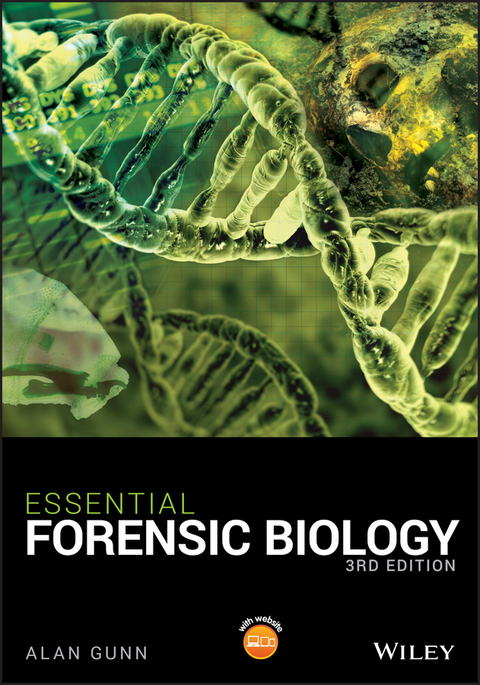
Essential Forensic Biology (eBook)
John Wiley & Sons (Verlag)
978-1-119-14142-6 (ISBN)
A completely revised and updated edition that teaches the essentials of forensic biology, with increased coverage of molecular biological techniques and new information on wildlife forensics, wound analysis and the potential of microbiomes as forensic indicators
This fully revised and updated introduction to forensic biology carefully guides the reader through the science of biology in legal investigations. Full-colour throughout, including many new images, it offers an accessible overview to the essentials of the subject, providing balanced coverage of the range of organisms used as evidence in forensic investigations, such as invertebrates, vertebrates, plants and microbes. The book provides an accessible overview of the decay process and discusses the role of forensic indicators like human fluids and tissues, including bloodstain pattern analysis, hair, teeth, bones and wounds. It also examines the study of forensic biology in cases of suspicious death.
This third edition of Essential Forensic Biology expands its coverage of molecular techniques throughout, offering additional material on bioterrorism and wildlife forensics. The new chapter titled 'Wildlife Forensics' looks at welfare legislation, CITES and the use of forensic techniques to investigate criminal activity such as wildlife trafficking and dog fighting. The use of DNA and RNA for the identification of individuals and their personal characteristics is now covered as well, along with a discussion of the ethical issues associated with the maintenance of DNA databases.
- Fully revised and updated third edition of the successful student-friendly introduction to the essentials of Forensic Biology
- Covers a wide variety of legal investigations such as homicide, suspicious death, neglect, real and fraudulent claims for the sale of goods unfit for purpose, the illegal trade in protected species of plants and animals and bioterrorism
- Discusses the use of a wide variety of biological material for forensic evidence
- Supported by a website that includes numerous photographs, interactive MCQs, self-assessment quizzes and a series of questions and topics for further study to enhance student understanding
- Includes a range of important, key case studies in which the difficulties of evaluating biological evidence are highlighted
Essential Forensic Biology, Third Edition is an excellent guide for undergraduates studying forensic science and forensic biology.
ALAN GUNN, PHD, is Principal Lecturer and Subject Leader for Biosciences at the School of Natural Sciences & Psychology, Liverpool John Moores University, UK.
A completely revised and updated edition that teaches the essentials of forensic biology, with increased coverage of molecular biological techniques and new information on wildlife forensics, wound analysis and the potential of microbiomes as forensic indicators This fully revised and updated introduction to forensic biology carefully guides the reader through the science of biology in legal investigations. Full-colour throughout, including many new images, it offers an accessible overview to the essentials of the subject, providing balanced coverage of the range of organisms used as evidence in forensic investigations, such as invertebrates, vertebrates, plants and microbes. The book provides an accessible overview of the decay process and discusses the role of forensic indicators like human fluids and tissues, including bloodstain pattern analysis, hair, teeth, bones and wounds. It also examines the study of forensic biology in cases of suspicious death. This third edition of Essential Forensic Biology expands its coverage of molecular techniques throughout, offering additional material on bioterrorism and wildlife forensics. The new chapter titled Wildlife Forensics looks at welfare legislation, CITES and the use of forensic techniques to investigate criminal activity such as wildlife trafficking and dog fighting. The use of DNA and RNA for the identification of individuals and their personal characteristics is now covered as well, along with a discussion of the ethical issues associated with the maintenance of DNA databases. Fully revised and updated third edition of the successful student-friendly introduction to the essentials of Forensic Biology Covers a wide variety of legal investigations such as homicide, suspicious death, neglect, real and fraudulent claims for the sale of goods unfit for purpose, the illegal trade in protected species of plants and animals and bioterrorism Discusses the use of a wide variety of biological material for forensic evidence Supported by a website that includes numerous photographs, interactive MCQs, self-assessment quizzes and a series of questions and topics for further study to enhance student understanding Includes a range of important, key case studies in which the difficulties of evaluating biological evidence are highlighted Essential Forensic Biology, Third Edition is an excellent guide for undergraduates studying forensic science and forensic biology.
ALAN GUNN, PHD, is Principal Lecturer and Subject Leader for Biosciences at the School of Natural Sciences & Psychology, Liverpool John Moores University, UK.
Introduction xvii
Acknowledgements xxv
About the Companion Website xxvii
Part I Decay and the Discovery and Recovery of Human Remains 1
1 The Decay of Human Bodies 3
2 The Discovery, Recovery, and Study of Human Bodies 29
Part II DNA Analysis 41
3 Molecular Biology 43
Part III Body Tissues and Fluids and Wound Analysis 81
4 Blood 83
5 Saliva, Semen, Vitreous Humour, Urine, and Faeces 109
6 Human Tissues 123
7 Wounds 157
Part IV Invertebrates 205
8 Invertebrates 1: Biological Aspects 207
9 Invertebrates 2: Practical Aspects 239
Part V Vertebrates and Wildlife Crime 271
10 Vertebrates 273
11 Wildlife Forensics 301
Part VI Plants, Protists, Fungi, and Microbes 327
12 Protists, Fungi, and Plants 329
13 Microbes and Viruses 365
References 397
Index 435
Introduction
The word ‘forensic’ derives from the Latin forum meaning ‘a market place’: in Roman times, the forum was where people conducted business transactions and some legal proceedings. For many years, the term ‘forensic’ had a restricted definition and denoted a legal investigation. However, nowadays it applies to any detailed analysis of past events, i.e. when one looks for evidence. For example, tracing the source of a pollution incident is now a ‘forensic environmental analysis’, determining past planetary configurations is ‘forensic astronomy’, whilst ‘forensic musicology’ refers to the comparison of two pieces of music in cases of alleged copyright infringement. For the purposes of this book, ‘forensic biology’ is defined broadly as ‘the application of biological sciences to legal investigations’ and therefore covers human anatomy and physiology, viruses to vertebrates and topics from murder to the trade in protected plant species.
Although forensic medicine and forensic science only became specialised areas of study within the last 200 or so years, their origins are traceable back to the earliest civilisations. The first person in recorded history to have medico‐legal responsibilities was Imhotep, Grand Vizier, Chief Justice, architect and personal physician to the Egyptian pharaoh Zozer (or Djoser). Zozer reigned from 2668 to 2649 BC and charged Imhotep with investigating deaths occurring under suspicious circumstances. The Sumerian king Ur‐Nammu (ca 2060 BC) began the first codification of laws with the eponymous ‘Ur‐Nammu Code’, in which penalties of various crimes were stipulated. The first record of a murder trial appears on clay tablets inscribed in 1850 BC at the Babylonian city of Nippur.
In England, the office of coroner dates back to the era of Alfred the Great (871–899), although his precise functions at this time remain uncertain. It was during the reign of Richard I (1189–1199) that the coroner became an established figure in the legal system. The early coroners had widespread powers and responsibilities that included the investigation of crimes ranging from burglary to murder and suspicious death. The body of anyone dying unexpectedly had to be kept for inspection by the coroner, even if the circumstances were not suspicious. Failure to do so meant that those responsible for the body were fined, even though it might have putrefied and created a noisome stench by the time he arrived. It was therefore common practice for unwanted bodies to be dragged away at night to become another village's problem. The coroner's responsibilities changed considerably over the centuries, but up until 1980, he was required to view the body of anyone dying in suspicious circumstances.
Although the coroner was required to observe the corpse, he did not undertake an autopsy. In England and other European countries, dissection of the human body was considered sinful and was banned or permitted only in exceptional circumstances until the nineteenth century. Most Christians believed that after a person died, their body had to be buried ‘whole’. If it was not, the chances of material resurrection on Judgement Day were slight. The first authorised human dissections took place in 1240, when the Holy Roman Emperor Frederick II decreed that a corpse could be dissected at the University of Naples every five years to provide teaching material for medical students. Subsequently, other countries followed suit, albeit slowly. In 1540, King Henry VIII became the first English monarch to legislate for the provision of human dissections by permitting the Company of Barber Surgeons to examine the corpses of four dead criminals per annum. In 1663, King James II increased this figure to six per annum. Subsequently, after passing the death sentence, judges had the option of decreeing the body of the convict to be buried (albeit without ceremony), or exposed on a gibbet or dissected. Nevertheless, the lack of bodies and an eager market among medical colleges created the trade of body snatching. Body snatchers usually left behind the coffin and the burial shroud, because taking these counted as a serious criminal offence – which was potentially punishable by hanging. Removing a body from its grave was merely a ‘misdemeanour’. The modern‐day equivalent is the Internet market in human bones of uncertain provenance. A notorious case arose in 2004 when the body of the eminent journalist Alistair Cooke was plundered whilst ‘resting’ in a funeral parlour in New York. Despite being 95 years old at the time of his death and suffering from cancer, his arms, legs, and pelvis were surreptitiously removed. These were then sold to a tissue processing company for use in surgery or as dental filler. The trade in human bones is legal provided the correct protocols are followed, but it is also highly lucrative and this tempts some people into criminal behaviour.
Although the ancient Greeks performed human dissections, Julius Caesar (102/100–44 BC) has the dubious distinction of being the first recorded murder victim in history to undergo an autopsy. After the assassination, the physician Antistius examined his body. He concluded that although Julius Caesar was stabbed 23 times, only the second of these blows, struck between the first and second ribs, was fatal. The first recorded post mortem to determine the cause of a suspicious death took place in Bologna in 1302. A local man called Azzolino collapsed and died suddenly after a meal and his body quickly became bloated whilst his skin turned olive and then black. Azzolino had many enemies and his family believed that he had been poisoned. A famous surgeon, Bartolomeo de Varignana, was called upon to determine the cause and he was permitted to undertake an autopsy. He concluded that Azzolino died because of an accumulation of blood in veins of the liver and that the death was therefore not suspicious. Although this case set a precedent, there are few records from the following centuries of autopsies to determine the cause of death in suspicious circumstances.
The first book on forensic medicine may have been written by the Chinese physician Hsu Chich‐Ts'si in the sixth century CE but this has since been lost. Subsequently, in 1247, the Chinese magistrate Sung Tz'u wrote a treatise entitled ‘Xi Yuan Ji Lu’ that is usually translated as ‘The Washing Away of Wrongs’, and this is generally accepted as the first forensic textbook. Sung Tz'u would also appear to be the first person to apply an understanding of biology to a criminal investigation. He relates how he identified the person guilty of a murder by observing the swarms of flies attracted to bloodstains on the man's sickle. In Europe, medical knowledge advanced slowly over the centuries and forensic medicine really only started to be identified as a separate branch of medicine in the 1700s (Chapenoire and Benezech 2003). The French physician Francois‐Emanuel Foderé (1764–1835) wrote a landmark 3‐volume publication in 1799 entitled Les lois éclairées par les sciences physiques: ou Traité de médecine‐légale et d'hygiène publique that is recognised as a major advancement in forensic medicine. In 1802, the first chair in Forensic Medicine in the UK was established at Edinburgh University and in 1821 John Gordon Smith wrote the first book on forensic medicine in the English language, entitled ‘The Principles of Forensic Medicine’.
Today, forensic medicine is a well‐established branch of the medical profession. Clinical forensic medicine deals with cases in which the subject is living (e.g. non‐accidental injuries, child abuse, rape), whilst forensic pathology deals with investigations into causes of death that might result in criminal proceedings (e.g. suspected homicide, fatal air accident). Pathology is the study of changes to tissues and organs caused by disease, trauma, toxins, and other harmful processes. Theoretically, any qualified medical doctor can perform an autopsy. However, in practise, at least in the UK, only those doctors who have received specialist training in post‐mortem pathology conduct autopsies.
The majority of deaths are not suspicious, so an autopsy is unlikely to take place. Indeed, even if a doctor requests an autopsy, the relatives of the dead person must give their permission. Some religious groups are opposed to autopsies and/or require a person to be buried within a short period of death so an autopsy may be refused. For example, many Muslims, orthodox Jews and some Christian denominations oppose autopsies. Some doctors are concerned about how few autopsies take place. This is because some estimates suggest that 20–30% of death certificates in the UK incorrectly state the cause of death. The errors are seldom owing to incompetence or a ‘cover‐up’, but result from the difficulty of diagnosing the cause of death without a detailed examination of the dead body.
There are rogue elements in all professions and the GP Dr Harold Shipman murdered over 200 mostly elderly patients over the course of many years. He did this through administering morphine overdoses and then falsifying the death certificates (Pounder 2003). Dr Shipman's victims suffered from a range of chronic ailments and because of their age and infirmities, nobody questioned the certificates he signed. He also falsified his computer patient records. It therefore...
| Erscheint lt. Verlag | 15.1.2019 |
|---|---|
| Sprache | englisch |
| Themenwelt | Naturwissenschaften ► Biologie |
| Naturwissenschaften ► Chemie | |
| Recht / Steuern ► EU / Internationales Recht | |
| Recht / Steuern ► Strafrecht ► Kriminologie | |
| Sozialwissenschaften | |
| Schlagworte | Analytische Chemie / Forensik • animal forensics • animal necropsy • Autopsy • biological forensics • Biology • biology in crime scene investigation • biology in legal investigations • bioterrorism • Biowissenschaften • Cause of Death • Cell & Molecular Biology • Chemie • Chemistry • crime scene evidence • crime scene study • criminal science • examining human remains • forensic biology • forensic DNA biology • Forensic Entomology • forensic investigation • forensic pathology • Forensics • Forensic Science • Forensische Biologie • guide to forensic biology • guide to forensic science • Human remains • investigation cause of death • Life Sciences • microbiome • Molecular Biology • murder investigation • necropsy • studying human remains • taphonomy • wildlife death • wildlife forensics • Zell- u. Molekularbiologie • zoological forensics • zoological science |
| ISBN-10 | 1-119-14142-7 / 1119141427 |
| ISBN-13 | 978-1-119-14142-6 / 9781119141426 |
| Informationen gemäß Produktsicherheitsverordnung (GPSR) | |
| Haben Sie eine Frage zum Produkt? |
 EPUB (Adobe DRM)
Kopierschutz: Adobe-DRM
Adobe-DRM ist ein Kopierschutz, der das eBook vor Mißbrauch schützen soll. Dabei wird das eBook bereits beim Download auf Ihre persönliche Adobe-ID autorisiert. Lesen können Sie das eBook dann nur auf den Geräten, welche ebenfalls auf Ihre Adobe-ID registriert sind.
Details zum Adobe-DRM
Dateiformat: EPUB (Electronic Publication)
EPUB ist ein offener Standard für eBooks und eignet sich besonders zur Darstellung von Belletristik und Sachbüchern. Der Fließtext wird dynamisch an die Display- und Schriftgröße angepasst. Auch für mobile Lesegeräte ist EPUB daher gut geeignet.
Systemvoraussetzungen:
PC/Mac: Mit einem PC oder Mac können Sie dieses eBook lesen. Sie benötigen eine
eReader: Dieses eBook kann mit (fast) allen eBook-Readern gelesen werden. Mit dem amazon-Kindle ist es aber nicht kompatibel.
Smartphone/Tablet: Egal ob Apple oder Android, dieses eBook können Sie lesen. Sie benötigen eine
Geräteliste und zusätzliche Hinweise
Buying eBooks from abroad
For tax law reasons we can sell eBooks just within Germany and Switzerland. Regrettably we cannot fulfill eBook-orders from other countries.
aus dem Bereich