


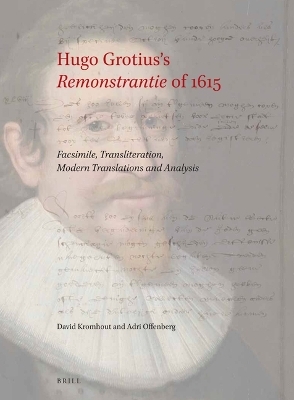
Hugo Grotius’s Remonstrantie of 1615
Facsimile, Transliteration, Modern Translations and Analysis
Seiten
2019
Brill (Verlag)
978-90-04-39607-4 (ISBN)
Brill (Verlag)
978-90-04-39607-4 (ISBN)
- Keine Verlagsinformationen verfügbar
- Artikel merken
Grotius’ Remonstrantie, being his recommendations to the States of Holland on the subject of the admission of the Jews in the Dutch Republic, offers insight in the political and religious constraints and in Grotius’ carefully crafted line of thought and reasoning.
Grotius wrote the Remonstrantie around 1615 at the request of the States of Holland, to define the conditions under which Jews were to be admitted to the Dutch Republic. At that time, he was already an internationally recognized legal expert in civic and canonic law. The position taken by Grotius with respect to the admission of the Jews was strongly connected with the religious and political tensions existing in the Dutch Republic of the early 17th century. The Remonstrantie shows how Grotius’s views evolved within the confines of the philosophical and religious concepts of his time. It is an example of tolerance within political limits, analyzed by the author David Kromhout and made accessible through a modern translation.
Grotius wrote the Remonstrantie around 1615 at the request of the States of Holland, to define the conditions under which Jews were to be admitted to the Dutch Republic. At that time, he was already an internationally recognized legal expert in civic and canonic law. The position taken by Grotius with respect to the admission of the Jews was strongly connected with the religious and political tensions existing in the Dutch Republic of the early 17th century. The Remonstrantie shows how Grotius’s views evolved within the confines of the philosophical and religious concepts of his time. It is an example of tolerance within political limits, analyzed by the author David Kromhout and made accessible through a modern translation.
David Kromhout (*1976) studied Hebrew and Jewish Studies at the University of Amsterdam. He wrote a dissertation on the Synod of Dort as a foucauldian event and its repercussions on the literary discourse of the Leiden humanists (University of Amsterdam, 2016). Adri Offenberg (*1939 ) studied Dutch Philology, Bibliology, Hebrew and Danish at the University of Amsterdam. He was curator of the Bibliotheca Rosenthaliana from 1974 to 2004, editor-in-chief of Studia Rosenthaliana and of the volume Bibliotheca Rosenthaliana: Treasures of Jewish Booklore (1994).
Contributors: Marijke J. Blankman, Piet Hein Donner, Cis van Heertum, David Kromhout, Marianka van Lunteren-Spanjaard, Adri K. Offenberg.
| Erscheinungsdatum | 21.07.2019 |
|---|---|
| Verlagsort | Leiden |
| Sprache | englisch |
| Maße | 193 x 260 mm |
| Gewicht | 1057 g |
| Themenwelt | Geschichte ► Allgemeine Geschichte ► Neuzeit (bis 1918) |
| Geisteswissenschaften ► Geschichte ► Regional- / Ländergeschichte | |
| Geisteswissenschaften ► Religion / Theologie ► Judentum | |
| Recht / Steuern ► EU / Internationales Recht | |
| Recht / Steuern ► Öffentliches Recht ► Völkerrecht | |
| ISBN-10 | 90-04-39607-1 / 9004396071 |
| ISBN-13 | 978-90-04-39607-4 / 9789004396074 |
| Zustand | Neuware |
| Informationen gemäß Produktsicherheitsverordnung (GPSR) | |
| Haben Sie eine Frage zum Produkt? |
Mehr entdecken
aus dem Bereich
aus dem Bereich
Geschichte einer wilden Handlung
Buch | Hardcover (2024)
C.H.Beck (Verlag)
CHF 47,60


