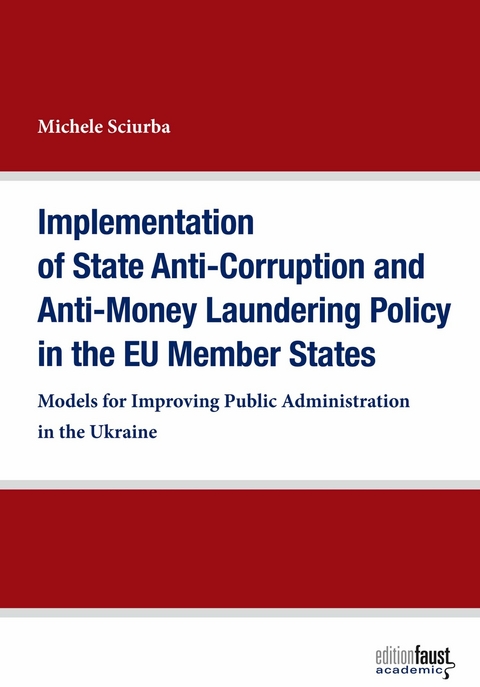
Implementation of State Anti-Corruption and Anti-Money Laundering Policy in the EU Member States (eBook)
168 Seiten
Edition Faust (Verlag)
978-3-945400-63-0 (ISBN)
This monograph offers a new approach to implementing an anti-corruption strategy in Ukraine and suggests how the fight against corruption within government can be streamlined using modern methods and a risk-based approach. Drawing on the experience of EU countries through a comparative analysis of the rules and procedures for structuring public administration policy, this work proposes developing recommendations to strengthen the Ukrainian anti-money laundering and corruption policy. Corruption remains a widespread problem at various levels within Ukrainian public administration and it has significantly weakened public confidence in government and in the judicial system. In an international comparison of corruption in 180 countries, Ukraine ranks 130th, making it one of the most corrupt countries in the world.
At the same time, Ukraine has an AML/CTF legal administrative framework in place that largely meets the current formal requirements of the FATF. The Ukraine has implemented AML and anti-corruption measures under the Council of Europe's Moneyval monitoring mechanism. In addition, Moneyval has been an associate member of the FATF since 2006. The National Bank of Ukraine (NBU) practices risk-based banking supervision and has made significant progress in creating transparency regarding the beneficial ownership of banks. In recent years, Ukraine has consistently removed criminal owners from the banking sector and established an efficient sanction regime in response to breaches of legal obligations, including the withdrawal of banking licenses. Furthermore, the establishment of a unified state register for beneficial ownership allows authorities to identify banking clients. In terms of mutual legal assistance on money laundering and corruption, the Ukraine has also made significant progress.
Ultimately, the Ukrainian AML/CTF framework has been refined significantly in recent years. Today, there is a clear understanding of money laundering and terrorist financing risks in Ukraine both at the administrative level and at the level of the supervisory authorities. As a result, far-reaching legislation has been established. Nevertheless, this development cannot hide the fact that money laundering via shell companies is still part of everyday life in Ukraine. The Ukrainian criminal justice system continues to be heavily influenced by corruption and has failed to effectively combat it. Ukrainian cross-border prosecution of money laundering offences, in particular the confiscation of proceeds of crime in other countries, is ineffective due to a lack of experience and the absence of legislation spelling out direct areas of responsibility and formal procedures. Finally, a central problem is the lack of confiscation orders which impedes the efficient prosecution of corruption and money laundering.
Dr. Michele Sciurba, born 1968 in Palermo, Italy, studied Common and International Law at the University of Liverpool and Administrative Law at the Interregional Academy of Personnel Management in Kyiv. He was a member of the European Industrial Relations Observatory (EIRO) and worked as a lecturer for industrial and operating policies. During his career, he advised various government organisations concerning economic development issues (2008 e.g. he participated in the High Level Conference on World Food Security of the Food and Agriculture Organisation (FAO) in Rome). Sciurba is active for NGOs in the field of international law and human rights issues as a caseworker. Since 1999, he is managing director of the Frankfurt-based think tank GMVV & Co. GmbH. Besides, Michele Sciurba is a journalist for national and international media, including the "Journal Frankfurt" and the Ukrainian Newspaper "Kyiv Post". He is also a columnist for the international magazine "Impakter" and published various essays on legal and socio-political issues.
| Erscheint lt. Verlag | 1.10.2018 |
|---|---|
| Reihe/Serie | Edition Faust Academic |
| Verlagsort | Frankfurt |
| Sprache | englisch |
| Themenwelt | Recht / Steuern ► EU / Internationales Recht |
| Schlagworte | Anti-money laundering • Financial Monitoring • Improvement of International Cooperation • public administration • State Policy • Transition economy |
| ISBN-10 | 3-945400-63-5 / 3945400635 |
| ISBN-13 | 978-3-945400-63-0 / 9783945400630 |
| Informationen gemäß Produktsicherheitsverordnung (GPSR) | |
| Haben Sie eine Frage zum Produkt? |
 EPUB (Wasserzeichen)
DRM: Digitales Wasserzeichen
Dieses eBook enthält ein digitales Wasserzeichen und ist damit für Sie personalisiert. Bei einer missbräuchlichen Weitergabe des eBooks an Dritte ist eine Rückverfolgung an die Quelle möglich.
Dateiformat: EPUB (Electronic Publication)
EPUB ist ein offener Standard für eBooks und eignet sich besonders zur Darstellung von Belletristik und Sachbüchern. Der Fließtext wird dynamisch an die Display- und Schriftgröße angepasst. Auch für mobile Lesegeräte ist EPUB daher gut geeignet.
Systemvoraussetzungen:
PC/Mac: Mit einem PC oder Mac können Sie dieses eBook lesen. Sie benötigen dafür die kostenlose Software Adobe Digital Editions.
eReader: Dieses eBook kann mit (fast) allen eBook-Readern gelesen werden. Mit dem amazon-Kindle ist es aber nicht kompatibel.
Smartphone/Tablet: Egal ob Apple oder Android, dieses eBook können Sie lesen. Sie benötigen dafür eine kostenlose App.
Geräteliste und zusätzliche Hinweise
Buying eBooks from abroad
For tax law reasons we can sell eBooks just within Germany and Switzerland. Regrettably we cannot fulfill eBook-orders from other countries.
aus dem Bereich