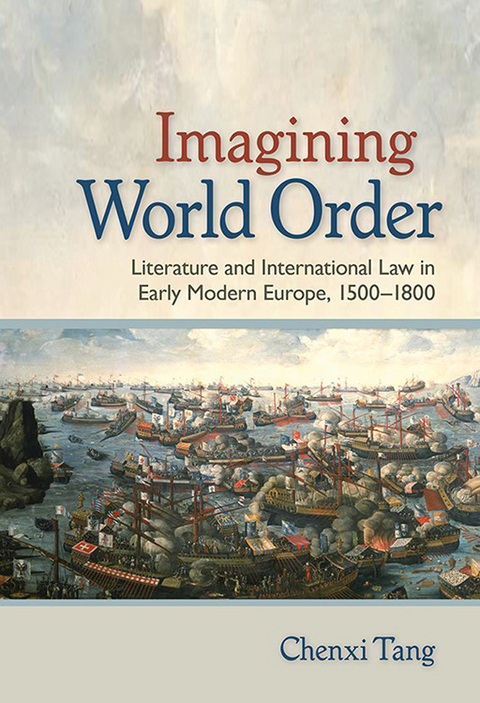
Imagining World Order (eBook)
360 Seiten
Cornell University Press (Verlag)
978-1-5017-1692-8 (ISBN)
In early modern Europe, international law emerged as a means of governing relations between rapidly consolidating sovereign states, purporting to establish a normative order for the perilous international world. However, it was intrinsically fragile and uncertain, for sovereign states had no acknowledged common authority that would create, change, apply, and enforce legal norms. In Imagining World Order, Chenxi Tang shows that international world order was as much a literary as a legal matter. To begin with, the poetic imagination contributed to the making of international law. As the discourse of international law coalesced, literary works from romances and tragedies to novels responded to its unfulfilled ambitions and inexorable failures, occasionally affirming it, often contesting it, always uncovering its problems and rehearsing imaginary solutions.
Tang highlights the various modes in which literary texts—some highly canonical (Camões, Shakespeare, Corneille, Lohenstein, and Defoe, among many others), some largely forgotten yet worth rediscovering—engaged with legal thinking in the period from the sixteenth to the eighteenth century. In tracing such engagements, he offers a dual history of international law and European literature. As legal history, the book approaches the development of international law in this period—its so-called classical age—in terms of literary imagination. As literary history, Tang recounts how literature confronted the question of international world order and how, in the process, a set of literary forms common to major European languages (epic, tragedy, romance, novel) evolved.
Chenxi Tang is Professor of German, University of California at Berkeley. He is the author of The Geographic Imagination of Modernity.
Acknowledgments
Introduction
International Law
Literary Approaches to International World Order
A Dual History of International Law and European Literature
1. The Old World Order Dissolving
Universal Laws in Flux: (Neoscholastic Jurisprudence)
Cosmic Order Disturbed: (Camões's Os Lusíadas, Reason of State)
The Beginnings of Public International Law: (Gentili, Suárez, Grotius)
2. The Poetics of International Legal Order
Treaty and Allegory in the Renaissance
The Founding Narratives of International Legal Personality: (Grotius, Hobbes, Leibniz)
The Founding Narratives of International Society: (Grotius, Leibniz)
Spectacles of International Order
The Drama of International Society
3. International Order as Tragedy
The Renaissance of Tragedy and the Problem of International Order
The Sovereign Will and the Tragic Form: (Marlowe's Tamburlaine, Shakespeare's King John)
A Tragicomic Intermezzo: The Shapes of World Order in Shakespeare's Romances
The Tragedy of Reason of State: (Lohenstein)
The Tragedy of Marriage Alliance: (Corneille)
International Order Through Tragic Experience
4. International Order as Romance
The Romance Form and World Order: (The Greek Romance, Barclay's Argenis)
The Crisis of Political Romance in the Mid-Seventeenth Century: (Herbert)
The Apotheosis and Extinction of Political Romance: (Anton Ulrich, Leibniz)
5. The Divergence Between International Law and Literature around 1700
The Depersonalization of the State: (Gryphius, Milton)
The Birth of the Private Individual: (Milton, Racine)
International Law as a Field of Expert Knowledge
Literature and the Private Individual
6. The Novel and International Order in the Eighteenth Century
The Fictional Construction of Society: Ius Naturae et Gentium
The Fictional Construction of Society: Poetics of the Novel
Transnational Commercial World Order: (Defoe)
Sentimental World Order: (Gellert, Sterne)
Cosmopolitan World Order: (Wieland, Goethe, Kant)
Epilogue
Notes
References
Index
| Erscheint lt. Verlag | 15.12.2018 |
|---|---|
| Zusatzinfo | 4 b&w halftones |
| Verlagsort | Ithaca |
| Sprache | englisch |
| Maße | 150 x 150 mm |
| Themenwelt | Literatur ► Essays / Feuilleton |
| Geisteswissenschaften ► Geschichte ► Regional- / Ländergeschichte | |
| Geschichte ► Teilgebiete der Geschichte ► Militärgeschichte | |
| Geisteswissenschaften ► Sprach- / Literaturwissenschaft ► Anglistik / Amerikanistik | |
| Geisteswissenschaften ► Sprach- / Literaturwissenschaft ► Literaturwissenschaft | |
| Recht / Steuern ► Rechtsgeschichte | |
| Schlagworte | Law and literature, international law, world order, early modern Europe, Shakespeare, Goethe, Marlowe, Barclay, Lohenstein, Anton Ulrich, Defoe, Sterne, Wieland, Camoes, comparative literature, sixteenth century, eighteenth century, seventeenth century, intellectual history |
| ISBN-10 | 1-5017-1692-1 / 1501716921 |
| ISBN-13 | 978-1-5017-1692-8 / 9781501716928 |
| Informationen gemäß Produktsicherheitsverordnung (GPSR) | |
| Haben Sie eine Frage zum Produkt? |
 EPUB (Adobe DRM)
Kopierschutz: Adobe-DRM
Adobe-DRM ist ein Kopierschutz, der das eBook vor Mißbrauch schützen soll. Dabei wird das eBook bereits beim Download auf Ihre persönliche Adobe-ID autorisiert. Lesen können Sie das eBook dann nur auf den Geräten, welche ebenfalls auf Ihre Adobe-ID registriert sind.
Details zum Adobe-DRM
Dateiformat: EPUB (Electronic Publication)
EPUB ist ein offener Standard für eBooks und eignet sich besonders zur Darstellung von Belletristik und Sachbüchern. Der Fließtext wird dynamisch an die Display- und Schriftgröße angepasst. Auch für mobile Lesegeräte ist EPUB daher gut geeignet.
Systemvoraussetzungen:
PC/Mac: Mit einem PC oder Mac können Sie dieses eBook lesen. Sie benötigen eine
eReader: Dieses eBook kann mit (fast) allen eBook-Readern gelesen werden. Mit dem amazon-Kindle ist es aber nicht kompatibel.
Smartphone/Tablet: Egal ob Apple oder Android, dieses eBook können Sie lesen. Sie benötigen eine
Geräteliste und zusätzliche Hinweise
Buying eBooks from abroad
For tax law reasons we can sell eBooks just within Germany and Switzerland. Regrettably we cannot fulfill eBook-orders from other countries.
aus dem Bereich