


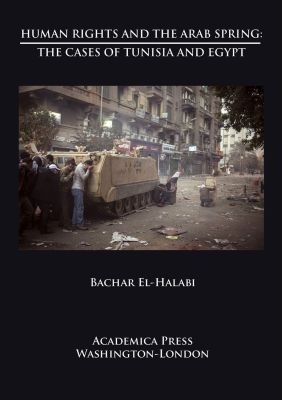
Human Rights and the Arab Spring
The Cases of Tunisia and Egypt
Seiten
2019
Academica Press (Verlag)
978-1-68053-470-2 (ISBN)
Academica Press (Verlag)
978-1-68053-470-2 (ISBN)
Highlights, analyses, and contrasts, from a "human rights law" perspective, the situation in Tunisia – the success model of the Arab Spring - before and after the "Jasmine Revolution," and in Egypt, the Arab Spring's most notable failure - before the 2011 revolution and after the subsequent "counter-revolution" led by the military establishment.
By 2015, four years after the dawn of the Arab Spring, the prospects of a unifying political reform narrative in the Arab World were noticeably dwindling. The unprecedented opportunity for a regional workshop of reform and state building had stalled, with Islamist movements more anxious about questions of identity and religious ethics, and with the old guards of the “deep state” establishments (mainly military or religious personnel) countering the revolutions, rather than being concerned with constitutionalism. Generally, both incoming governments and governments clinging to a single thread trying to fight the tides of change, have lapsed to reliance on police power to curtail protests, thus raising crucial questions, whether “orientalist” or otherwise intentionally regressive: Have post-revolution events proved that the Middle East is incompatible with democracy and international human rights standards? Would entrenching such concepts in the Middle East be doomed to fail?
The book will examine these questions as they unfolded during the Arab Spring, which sparked in January 2011, first in Tunisia, and then to six other Arab countries, including the most populous one, Egypt. Human Rights and the Arab Spring will highlight, analyse, and contrast, from a “human rights law” perspective, the situation in Tunisia – the success model of the Arab Spring – before and after the “Jasmine Revolution,” and in Egypt, the Arab Spring’s most notable failure – before the 2011 revolution and after the subsequent “counter-revolution,” which was led by the military establishment. The book’s ultimate goal is to make a case for a contemporary Arabian Magna Carta, a durable legal document that can be used to hold people in power (whether monarchs or dynastic “monarchical presidencies”) to account, in order to build a legal foundation for the democratisation, liberalisation, and possibly the secularisation of the region, or at least greater respect for international human rights laws and standards.
By 2015, four years after the dawn of the Arab Spring, the prospects of a unifying political reform narrative in the Arab World were noticeably dwindling. The unprecedented opportunity for a regional workshop of reform and state building had stalled, with Islamist movements more anxious about questions of identity and religious ethics, and with the old guards of the “deep state” establishments (mainly military or religious personnel) countering the revolutions, rather than being concerned with constitutionalism. Generally, both incoming governments and governments clinging to a single thread trying to fight the tides of change, have lapsed to reliance on police power to curtail protests, thus raising crucial questions, whether “orientalist” or otherwise intentionally regressive: Have post-revolution events proved that the Middle East is incompatible with democracy and international human rights standards? Would entrenching such concepts in the Middle East be doomed to fail?
The book will examine these questions as they unfolded during the Arab Spring, which sparked in January 2011, first in Tunisia, and then to six other Arab countries, including the most populous one, Egypt. Human Rights and the Arab Spring will highlight, analyse, and contrast, from a “human rights law” perspective, the situation in Tunisia – the success model of the Arab Spring – before and after the “Jasmine Revolution,” and in Egypt, the Arab Spring’s most notable failure – before the 2011 revolution and after the subsequent “counter-revolution,” which was led by the military establishment. The book’s ultimate goal is to make a case for a contemporary Arabian Magna Carta, a durable legal document that can be used to hold people in power (whether monarchs or dynastic “monarchical presidencies”) to account, in order to build a legal foundation for the democratisation, liberalisation, and possibly the secularisation of the region, or at least greater respect for international human rights laws and standards.
Bachar El-Halabi, National University of Ireland, Galway
| Erscheinungsdatum | 21.07.2019 |
|---|---|
| Reihe/Serie | St. James Studies in World Affairs |
| Verlagsort | Bethesda |
| Sprache | englisch |
| Maße | 157 x 231 mm |
| Gewicht | 325 g |
| Themenwelt | Recht / Steuern ► EU / Internationales Recht |
| Recht / Steuern ► Öffentliches Recht ► Völkerrecht | |
| Sozialwissenschaften ► Politik / Verwaltung | |
| ISBN-10 | 1-68053-470-X / 168053470X |
| ISBN-13 | 978-1-68053-470-2 / 9781680534702 |
| Zustand | Neuware |
| Informationen gemäß Produktsicherheitsverordnung (GPSR) | |
| Haben Sie eine Frage zum Produkt? |
Mehr entdecken
aus dem Bereich

aus dem Bereich
Die Rechtsprechung des Gerichtshofs der Europäischen Union, deutscher …
Buch | Softcover (2025)
Nomos (Verlag)
CHF 53,50


