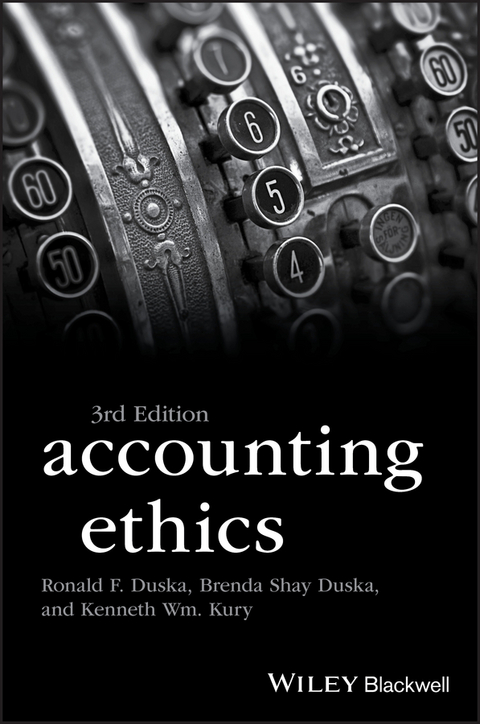
Accounting Ethics (eBook)
John Wiley & Sons (Verlag)
978-1-119-11880-0 (ISBN)
A trusted resource on the complex ethical questions that define the accounting profession
An accountant's practice depends on making difficult decisions. To achieve the best results, individual accountants and accounting firms need a clear understanding of the ethical duties and decision-making involved in the four major functions of modern accounting-auditing, management accounting, tax accounting, and consulting-as well as a strong sense of ethical conduct to guide the certification and validation of reliable financial records.
Now in its third edition, Accounting Ethics is a thorough and engaging exploration of the ethical issues that accountants encounter in their professional lives. Since the publication of the first edition in 2002, Accounting Ethics has become an indispensable resource for accounting courses and certification programs worldwide, known for its focus on real-world application, practical advice, reader-friendly guidance, and its insight into the effects of global change on the profession. Together with coverage of the contemporary regulatory environment-including the Sarbanes-Oxley Act, the Public Company Accounting Oversight Board, and the Dodd-Frank Wall Street Reform and Consumer Protection Act-this revised edition features expanded pedagogical resources such as new end-of-chapter case studies and discussion questions, and includes the updated AICPA Code of Conduct.
Concise and dependable, Accounting Ethics sustains its reputation as an authoritative resource for practicing accountants, new professionals, students of accounting, and those who are considering the profession.
Ronald F. Duska served as the Charles Lamont Post Chair of Ethics and the Professions at the American College of Financial Services and as the Director of the Center for Ethics in Financial Services until 2011. He is currently chief executive of Duska Business Ethics and Consulting and an adjunct professor of business ethics at Villanova University and St. Joseph's University.
Brenda Shay Duska, MT, CPA, is the owner of Shay Duska & Company LLC and specializes in taxation and financial management for small businesses. She is a member of the American Institute of Certified Public Accountants and the Pennsylvania Institute of Certified Public Accountants.
Kenneth Wm. Kury, PhD, CPA, is an assistant professor in the Family Business and Entrepreneurship program at Saint Joseph's University.
A trusted resource on the complex ethical questions that define the accounting professionAn accountant s practice depends on making difficult decisions. To achieve the best results, individual accountants and accounting firms need a clear understanding of the ethical duties and decision-making involved in the four major functions of modern accounting auditing, management accounting, tax accounting, and consulting as well as a strong sense of ethical conduct to guide the certification and validation of reliable financial records. Now in its third edition, Accounting Ethics is a thorough and engaging exploration of the ethical issues that accountants encounter in their professional lives. Since the publication of the first edition in 2002, Accounting Ethics has become an indispensable resource for accounting courses and certification programs worldwide, known for its focus on real-world application, practical advice, reader-friendly guidance, and its insight into the effects of global change on the profession. Together with coverage of the contemporary regulatory environment including the Sarbanes-Oxley Act, the Public Company Accounting Oversight Board, and the Dodd Frank Wall Street Reform and Consumer Protection Act this revised edition features expanded pedagogical resources such as new end-of-chapter case studies and discussion questions, and includes the updated AICPA Code of Conduct. Concise and dependable, Accounting Ethics sustains its reputation as an authoritative resource for practicing accountants, new professionals, students of accounting, and those who are considering the profession.
Ronald F. Duska served as the Charles Lamont Post Chair of Ethics and the Professions at the American College of Financial Services and as the Director of the Center for Ethics in Financial Services until 2011. He is currently chief executive of Duska Business Ethics and Consulting and an adjunct professor of business ethics at Villanova University and St. Joseph's University. Brenda Shay Duska, MT, CPA, is the owner of Shay Duska & Company LLC and specializes in taxation and financial management for small businesses. She is a member of the American Institute of Certified Public Accountants and the Pennsylvania Institute of Certified Public Accountants. Kenneth Wm. Kury, PhD, CPA, is an assistant professor in the Family Business and Entrepreneurship program at Saint Joseph's University.
Preface to the Third Edition vii
Introduction to Accounting Ethics 1
1 The Nature of Accounting and the Chief Ethical Difficulty:True Disclosure 9
2 Ethical Behavior in Accounting: What is Ethics? 35
3 Ethical Behavior in Accounting: Ethical Theory 57
4 Accounting as a Profession: Characteristics of a Profession 75
5 Accounting Codes of Conduct 83
6 The Rules of the Code of Conduct 103
7 The Auditing Function 129
8 The Ethics of Managerial Accounting 157
9 The Ethics of Tax Accounting 177
10 Ethics Applied to the Accounting Firm 197
Appendix A: Summary of Sarbanes-Oxley Act of 2002 219
Appendix B: IMA Statement of Ethical Professional Practice 231
Index 235
Introduction to Accounting Ethics
“To preserve the integrity of his reports, the accountant must insist upon absolute independence of judgment and action. The necessity of preserving this position of independence indicates certain standards of conduct. If the confidence of the public in the integrity of accountants’ reports is shaken, their value is gone.”
Arthur Andersen in a 1932 Lecture on Business Ethics
Rosemarie is the new controller for a small construction company, Acme builders. She is new on her job and grateful that the CEO, Peter, has allowed her to go on flex‐time to help her take care of her young daughter, who is in day care. Rosemarie is concerned about the collectability of receivables from Fergus Motel, for whom Acme has done extensive work. Rosemarie thinks that the allowance for these receivables must be adjusted. Upon expressing her concern to Peter, she is told that he thinks adjusting for them might put the approval of a much‐needed loan in jeopardy. Rosemarie thinks she should account for them, but it seems clear that when Peter said, “Well … do what you think is right”, he was really saying that he expected her to look out for the company and fudge the figures. Should she be a team player and go along with what Peter obviously wants, but didn’t specifically ask for?
John is a fairly young accountant working at a local CPA firm. John is wrestling with a problem. He is trying to decide whether to cover up a mistake made in not attaching an irrevocable election to a client’s recently submitted tax return. If he does not report the mistake he can relieve a significant portion of the tax burden of an important client. John thinks taxes are unfair anyway, and that his obligation to his client is to look out for the best interest of the client and save him from paying as much tax as possible. John also knows that keeping the client is important for the financial health of the company. Do you think most accountants would cover such a mistake? Would they be justified in covering such a mistake?
Leo is a senior accountant who has been assigned to the audit of a closely held corporation, CHC. Leo discovers that CHC’s income has been materially misstated, probably due to what appears to be a cutoff error, but possibly has been misstated deliberately. Leo takes the information to Adele, the audit manager. The work on the audit has already taken significantly longer than was projected in the budget, and investigating the misstatement would involve too much time. Besides, there are no tax implications due to the mistake, and the managing partner, who is also negotiating a consulting contract with CHC, is pressuring Leo to get the files to him as soon as possible. Adele tells Leo not to mention the adjustment in the working papers, because she sees no tax implications. No harm, no foul. Should Leo follow Adele’s “advice”, or does he have a responsibility beyond that to work for the benefit of the client?1
Situations such as those portrayed in these scenarios happen every day in the world of accountants. They raise ethical concerns that are typical of those that face accountants, whether they are management accountants, tax accountants, auditors, valuation specialists, or accountants performing any number of other accounting activities.
Such situations occurred long before the now infamous Enron bankruptcy case, in which the auditors and consultants from the accounting firm of Arthur Andersen came under criticism for not appropriately carrying out their responsibilities as accountants. In one instance Arthur Andersen, functioning in the role of outside auditor, failed to detect and/or disclose financial transactions wherein Enron shifted assets to a special purpose entity, which allowed the value of the company to look to be worth significantly more than it was. While defenders of Arthur Andersen declared such activity was within the law and generally accepted accounting principles, critics claimed that accountants are obliged to do more.
We have seen the outcome of the Enron/Andersen case with the demise of both Enron and Andersen and passage of Sarbanes–Oxley and the institution of the Public Company Accounting Oversight Board, but it is important to remember that the Enron/Andersen case did not present new ethical difficulties. It simply brought to light ethical questions that had been simmering for well over a quarter of a century, and unfortunately continue to simmer. Enron/Andersen, because it involved billions of dollars and affected so many people’s lives, brought to light in a dramatic fashion the ethical difficulties accountants face. The Enron/Andersen case, and each of the scenarios above raise the ethical questions: What is the appropriate behavior for accountants? What are accountants supposed to do? What are their responsibilities?
The scenarios, ironically, raise another important point. If you look at the citation, you will see that the scenarios were developed for a business ethics program sponsored by none other than the Arthur Andersen firm. It was a project that brought together leading thinkers of the business ethics community to develop teaching tools to be used in college courses on business ethics. The company was dedicated from its inception to doing the right thing. Arthur Andersen had the reputation from his earliest days in Chicago for being a person of impeccable integrity.
What went wrong with his company is a story written many times from many perspectives. From our perspective there are two main reasons. One is on the individual level. Accountants, at least the Houston offices of Andersen, did not do what they were supposed to do. They made the common mistake of many auditors who think their main obligation is to please the client who hires them. Rather, as we will try to show, accounting has a public purpose. It needs to serve the public good first. We will discuss this at length in the book. The second problem is that the company gave in to the systemic temptations that regularly beset the accounting firms, particularly the large firms. Firms, or the human beings who run them, are susceptible to incentives. We get what we reward. As an auditor, Arthur Andersen had a clear mission, to attest that the financial statements they were auditing reflected what was really going on in the company. However, that mission was shunted aside in the name of fees.
A venerable firm like Andersen, at one time, prided itself in its role as auditor. As an auditing firm it filled an important public function. However, as the large accounting firms grew, they forgot their main function and began to expand. What was the purpose of their expansion? To do consulting. Why? To bring in more profits. There was little reflection on how this consulting impacted on the primary function and responsibility of the auditing firm. There was little speculation about how reliance on consulting fees might impact auditing. It is clear what the responsibilities of an auditor are. However, if consulting brings more profit than auditing, human nature being what it is, the pressure will be there to do those things which enhance our income stream by doing more consulting. If we maintain our consulting work by pleasing our customer with soft auditing, so be it. Individuals and systems are much alike. They both give in to temptations. Hence any serious treatise on ethics needs to look at the pressures put on individual accountants and their firms by the systems in place, and the rewards of the system to determine whether they are aligned with the purposes of the system. These are the major concerns we will try to address in this book on accounting ethics.
Ethics is an overarching human concern that covers all areas of life. In this book we will examine how it is applicable and relevant to this one corner of human activity, accounting. Accounting as a human activity has an ethical dimension, for ethics is involved in all human activity. Human activity is precisely the kind of thing for which one is held responsible; it is activity which is done deliberately which one can control. It is also activity that helps or harms either oneself or others, or that is deemed to be either just or unjust, right or wrong. But to understand fully the ethical dimensions of accounting we will need to examine where and how the activity of accounting fits into the larger scheme of human activities.
We will examine in what way accounting is both an essential practice and a vital profession in the economically developed world of today. It is an essential practice because the current economic system could not exist without it. Business and the market, as we know it, would grind to a halt if there were no way to account for the existence and disposition of the wealth and goods of the world. For financial markets to function efficiently it is necessary to have transactions based on accurate portraits of the financial worth of any entity being traded. Those portraits are painted by accountants. Power relationships, property rights, ownership claims, valuations, receivables, and debts are all mental social constructs that define who owns what and owes what to whom. All of these constructs are identified and tracked by accountants and bookkeepers.
Because of this essential role in tracking the indeterminately large nexus of complicated financial relationships in the economic world of today accounting developed into a service profession. We will examine the nature of the accounting profession from the perspective of the general ethical responsibilities that accrue to professionals, as well...
| Erscheint lt. Verlag | 19.9.2018 |
|---|---|
| Reihe/Serie | Foundations of Business Ethics |
| Foundations of Business Ethics | Foundations of Business Ethics |
| Sprache | englisch |
| Themenwelt | Recht / Steuern ► Wirtschaftsrecht |
| Wirtschaft ► Betriebswirtschaft / Management ► Finanzierung | |
| Wirtschaft ► Betriebswirtschaft / Management ► Rechnungswesen / Bilanzen | |
| Wirtschaft ► Betriebswirtschaft / Management ► Unternehmensführung / Management | |
| Schlagworte | Accounting • accounting law and ethics • Accounting Special Topics • accounting standards of conduct • appropriate behavior of accountants • bankruptcy and ethics • Business & Management • Business Ethics • common mistakes made by auditors • ethical accounting reporting • ethical concerns and accounting • ethical difficulties and accounting • ethical obligations of accountants • ethical responsibilities of accountants • ethics and accountants performing other activities • ethics and accounting auditors • ethics and management accountants • ethics and tax accountants • ethics and valuation specialists • financial statements and ethics • Generally Accepted Accounting Principles • Guide to accounting ethics • principles of accounting ethics • public purpose of accounting • Rechnungswesen • responsibilities of accountants • Sarbanes Oxley • Spezialthemen Rechnungswesen • Tax Audit • the Public Company Accounting Oversight Board • understanding accounting ethics • Wirtschaftsethik • Wirtschaft u. Management |
| ISBN-10 | 1-119-11880-8 / 1119118808 |
| ISBN-13 | 978-1-119-11880-0 / 9781119118800 |
| Informationen gemäß Produktsicherheitsverordnung (GPSR) | |
| Haben Sie eine Frage zum Produkt? |
 EPUB (Adobe DRM)
Kopierschutz: Adobe-DRM
Adobe-DRM ist ein Kopierschutz, der das eBook vor Mißbrauch schützen soll. Dabei wird das eBook bereits beim Download auf Ihre persönliche Adobe-ID autorisiert. Lesen können Sie das eBook dann nur auf den Geräten, welche ebenfalls auf Ihre Adobe-ID registriert sind.
Details zum Adobe-DRM
Dateiformat: EPUB (Electronic Publication)
EPUB ist ein offener Standard für eBooks und eignet sich besonders zur Darstellung von Belletristik und Sachbüchern. Der Fließtext wird dynamisch an die Display- und Schriftgröße angepasst. Auch für mobile Lesegeräte ist EPUB daher gut geeignet.
Systemvoraussetzungen:
PC/Mac: Mit einem PC oder Mac können Sie dieses eBook lesen. Sie benötigen eine
eReader: Dieses eBook kann mit (fast) allen eBook-Readern gelesen werden. Mit dem amazon-Kindle ist es aber nicht kompatibel.
Smartphone/Tablet: Egal ob Apple oder Android, dieses eBook können Sie lesen. Sie benötigen eine
Geräteliste und zusätzliche Hinweise
Buying eBooks from abroad
For tax law reasons we can sell eBooks just within Germany and Switzerland. Regrettably we cannot fulfill eBook-orders from other countries.
aus dem Bereich