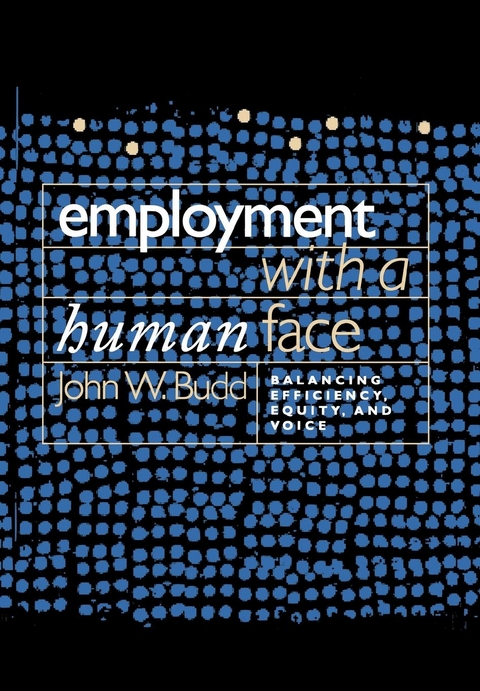
Employment with a Human Face (eBook)
288 Seiten
Cornell University Press (Verlag)
978-1-5017-2238-7 (ISBN)
John W. Budd contends that the turbulence of the current workplace and the importance of work for individuals and society make it vitally important that employment be given "a human face." Contradicting the traditional view of the employment...
John W. Budd contends that the turbulence of the current workplace and the importance of work for individuals and society make it vitally important that employment be given "a human face." Contradicting the traditional view of the employment relationship as a purely economic transaction, with business wanting efficiency and workers wanting income, Budd argues that equity and voice are equally important objectives. The traditional narrow focus on efficiency must be balanced with employees' entitlement to fair treatment (equity) and the opportunity to have meaningful input into decisions (voice), he says. Only through a greater respect for these human concerns can broadly shared prosperity, respect for human dignity, and equal appreciation for the competing human rights of property and labor be achieved.
Budd proposes a fresh set of objectives for modern democracies—efficiency, equity, and voice—and supports this new triad with an intellectual framework for analyzing employment institutions and practices. In the process, he draws on scholarship from industrial relations, law, political science, moral philosophy, theology, psychology, sociology, and economics, and advances debates over free markets, globalization, human rights, and ethics. He applies his framework to important employment-related topics, such as workplace governance, the New Deal industrial relations system, comparative industrial relations, labor union strategies, and globalization. These analyses create a foundation for reforming employment practices, social norms, and public policies. In the book's final chapter, Budd advocates the creation of the field of human resources and industrial relations and explores the wider implications of this renewed conceptualization of industrial relations.
John W. Budd contends that the turbulence of the current workplace and the importance of work for individuals and society make it vitally important that employment be given "a human face." Contradicting the traditional view of the employment relationship as a purely economic transaction, with business wanting efficiency and workers wanting income, Budd argues that equity and voice are equally important objectives. The traditional narrow focus on efficiency must be balanced with employees' entitlement to fair treatment (equity) and the opportunity to have meaningful input into decisions (voice), he says. Only through a greater respect for these human concerns can broadly shared prosperity, respect for human dignity, and equal appreciation for the competing human rights of property and labor be achieved.Budd proposes a fresh set of objectives for modern democracies—efficiency, equity, and voice—and supports this new triad with an intellectual framework for analyzing employment institutions and practices. In the process, he draws on scholarship from industrial relations, law, political science, moral philosophy, theology, psychology, sociology, and economics, and advances debates over free markets, globalization, human rights, and ethics. He applies his framework to important employment-related topics, such as workplace governance, the New Deal industrial relations system, comparative industrial relations, labor union strategies, and globalization. These analyses create a foundation for reforming employment practices, social norms, and public policies. In the book's final chapter, Budd advocates the creation of the field of human resources and industrial relations and explores the wider implications of this renewed conceptualization of industrial relations.
John W. Budd is Industrial Relations Landgrant Professor at the Carlson School of Management, University of Minnesota. He is the coeditor of The Ethics of Human Resources and Industrial Relations, also from Cornell, and Labor Relations: Striking a Balance.
| Erscheint lt. Verlag | 5.7.2018 |
|---|---|
| Verlagsort | Ithaca |
| Sprache | englisch |
| Maße | 160 x 160 mm |
| Themenwelt | Recht / Steuern ► Arbeits- / Sozialrecht ► Arbeitsrecht |
| Recht / Steuern ► EU / Internationales Recht | |
| Sozialwissenschaften ► Soziologie ► Mikrosoziologie | |
| Wirtschaft ► Volkswirtschaftslehre ► Makroökonomie | |
| ISBN-10 | 1-5017-2238-7 / 1501722387 |
| ISBN-13 | 978-1-5017-2238-7 / 9781501722387 |
| Informationen gemäß Produktsicherheitsverordnung (GPSR) | |
| Haben Sie eine Frage zum Produkt? |
 PDF (Adobe DRM)
Kopierschutz: Adobe-DRM
Adobe-DRM ist ein Kopierschutz, der das eBook vor Mißbrauch schützen soll. Dabei wird das eBook bereits beim Download auf Ihre persönliche Adobe-ID autorisiert. Lesen können Sie das eBook dann nur auf den Geräten, welche ebenfalls auf Ihre Adobe-ID registriert sind.
Details zum Adobe-DRM
Dateiformat: PDF (Portable Document Format)
Mit einem festen Seitenlayout eignet sich die PDF besonders für Fachbücher mit Spalten, Tabellen und Abbildungen. Eine PDF kann auf fast allen Geräten angezeigt werden, ist aber für kleine Displays (Smartphone, eReader) nur eingeschränkt geeignet.
Systemvoraussetzungen:
PC/Mac: Mit einem PC oder Mac können Sie dieses eBook lesen. Sie benötigen eine
eReader: Dieses eBook kann mit (fast) allen eBook-Readern gelesen werden. Mit dem amazon-Kindle ist es aber nicht kompatibel.
Smartphone/Tablet: Egal ob Apple oder Android, dieses eBook können Sie lesen. Sie benötigen eine
Geräteliste und zusätzliche Hinweise
Buying eBooks from abroad
For tax law reasons we can sell eBooks just within Germany and Switzerland. Regrettably we cannot fulfill eBook-orders from other countries.
aus dem Bereich