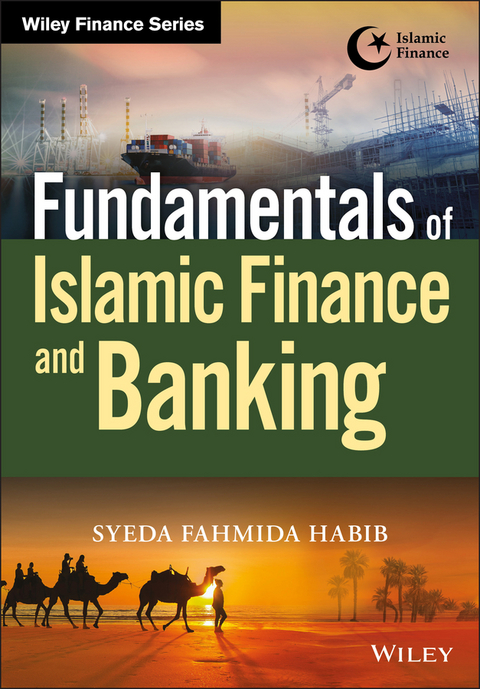
Fundamentals of Islamic Finance and Banking (eBook)
312 Seiten
Wiley (Verlag)
978-1-119-37103-8 (ISBN)
A comprehensive and fully up-to-date introductory textbook to Islamic finance and banking
Islamic finance and banking is being used increasingly globally - especially in the regions of Middle East and North Africa, South East and South Asia. To cater to the need of trained Islamic finance staff, a large number of Educational institutions are beginning to offer courses, majors and minors in Islamic finance and banking. The major challenge faced by these institutions are suitable textbooks for both undergrad and post-grad levels and especially with the relevant instructor resources (PPTs, test bank, practice activities and answer keys).
Luckily, Fundamentals of Islamic Finance and Banking is here to cover the most important topics related to Islamic finance and banking (IF&B) that are relevant for students of business, finance and banking.
- Offers an historical background of Islamic finance
- Covers the principles of Sharia Law as pertinent to finance and banking
- Provides in-depth discussion of the six key Islamic banking products: Murabaha, Mudaraba, Musharaka, Ijara, Salam and Istisna
- Discusses the Islamic insurance (Takaful)
- Gives an overview of Islamic investment, especially Sukuks
- Concludes with the global standing of the Islamic Finance and Banking industry
Would-be colleges and universities offering this subject as a course within their finance and/or banking program can't be without this invaluable guide.
SYEDA FAHMIDA HABIB, is currently an instructor at the School of Continuing Studies, York University, Toronto, Canada, specializing in finance, financial accounting and Strategic Management. Prior to this, she served as a senior lecturer at the Higher Colleges of Technology (HCT), UAE, for 19 years, specializing in various finance courses and especially involved in developing and team leading Islamic Finance and Banking. She holds an MBA, a Masters in Applied Finance and a DBA, is a member of CISI, and of the Institute of Islamic Banking and Insurance, London. She has written six books in the areas of finance, which were adopted as primary texts for HCT courses in the areas of Introduction to Finance, Financial Services Marketing in the Arab World and Personal Finance in the Arab World.
SYEDA FAHMIDA HABIB, is currently an instructor at the School of Continuing Studies, York University, Toronto, Canada, specializing in finance, financial accounting and Strategic Management. Prior to this, she served as a senior lecturer at the Higher Colleges of Technology (HCT), UAE, for 19 years, specializing in various finance courses and especially involved in developing and team leading Islamic Finance and Banking. She holds an MBA, a Masters in Applied Finance and a DBA, is a member of CISI, and of the Institute of Islamic Banking and Insurance, London. She has written six books in the areas of finance, which were adopted as primary texts for HCT courses in the areas of Introduction to Finance, Financial Services Marketing in the Arab World and Personal Finance in the Arab World.
CHAPTER 1
Introduction to Islamic Finance and Islamic Economics
Learning outcomes
Upon completion of this chapter, you should be able to:
- Define Islamic finance and explain the distinctive features of Islamic finance.
- Discuss the relationship between Islam and economics and the role of Islamic economics in social welfare.
- Describe the evolution of Islamic finance from the early days to the modern Islamic finance and banking industry.
- Identify the timeline of the development of contemporary Islamic finance and banking.
INTRODUCTION
The core concepts of Islamic finance are as old as Islam. Islam is not just a religion but a way of life. It provides guidance to its followers encompassing the social, religious, economic and political aspects of their lives. The Islamic law called Shariah law dictates specific dos and don'ts related to all aspects of a Muslim's life, including commercial and financial transactions. From the time of the Prophet Muhammad, peace be upon him (PBUH), specific financial instruments were used that were designed as per the requirements of the Shariah principles. Shariah law will be discussed in much more detail in Chapter 2 of this book.
The birth of modern Islamic finance and banking though happened in the second half of the twentieth century as an extension of Islamic economics, through the joint efforts of Shariah scholars and bankers. The global expansion of Islamic finance and banking was accelerated by the discovery of oil, rise in petrodollars and budget surpluses of the Gulf Cooperation Council (GCC) countries, with the concomitant increased demand among global Muslims to bank according to their religious beliefs (Natt, Al Habshi & Zainal, 2009). Initially Islamic banking experiments were private initiatives of individuals, but later governments in some Muslim countries significantly encouraged their growth, changing existing and developing new legislation and removing various handicaps in the predominantly interest-based environment (Ahmad, 1994).
For more than 200 years the finance and banking activities in the world have been operated on the conventional interest-based system. Individuals, businesses and governments have been completely adapted to conventional banks and an alternative to this system was unthinkable and seemed impossible. The concept of Islamic banking first emerged as an experimental Islamic bank was established in Mit Ghamr, Egypt in 1963, and the world's first commercial Islamic bank was set up in Dubai in 1975. Being new and different from the traditional conventional banking, there is a significant lack of awareness and knowledge about Islamic banking. Educational endeavours, trainings, seminars, conferences and the general spread of knowledge of the unique field of Islamic finance and banking are of utmost importance for its growth and acceptance in the global finance industry.
A major driving force that led to the revival of Islamic finance and banking in current times was the increasing awareness amongst the global Muslim population about the prohibition of interest in commercial transactions, mainly in banking and business operations, and their growing need to conduct their financial transactions as per their faith. This demand was predominant in the Muslim majority countries but began to grow amongst the Muslim population in non-Muslim countries also.
The operations of Islamic banks are quite similar to those of conventional banks, except that their transactions need to be free of interest and follow other Shariah law requirements. Although Islamic banking is still in its early days, starting from the feeble beginning of Mit Ghamr in 1963, it has been able to survive and grow at an unprecedented rate over the last five decades, something not seen in conventional finance, and is now viewed as an alternative form of finance and banking. It has attracted the attention of many investors and has the potential to attract new customers and grow further, earning market share.
CREATION OF MONEY AND CONVENTIONAL FINANCE AND BANKING
Before money was created, economic exchanges happened via the barter system. In the barter system one person exchanged a good or service with another person's good or service. This system had many inconveniences. Two people had to meet up where each owned something that the other wanted. The inconveniences of the barter system led to the emergence of money as a medium of exchange. Money separated buying and selling as two separate activities. Historically, many things have been used as mediums of exchange, like livestock (cows, camels, horses), grains (wheat, barley), precious metals (gold, silver) and finally coins and paper money.
The creation of money led to the development of financial institutions whose main purpose was to bring together those with surplus money and those with a shortage of money. Financial institutions have played important roles in the economies of all societies over time, collecting money from customers, providing them with safekeeping services and lending or investing these funds. This process is called financial intermediation and it is the core business of banks. Financial intermediation will be discussed in much greater detail in Chapter 3.
Western commercial banking started in around the 14th century in Florence and became more established in the 18th century with the advent of the Industrial Revolution. It was established by three groups of people and to this day conventional banking shows traces of its ancestors. These groups were:
- Rich and reputable merchants. Like a merchant the bank finances foreign trade, issues bills of exchange and provides capital to new business ventures.
- Money lenders. Like money lenders the bank pools the savings of the masses and lends it out to those with a shortage of finances and makes a profit by charging higher interest to the borrowers and paying lower interest to the savers.
- Goldsmiths. Like a goldsmith the bank serves as a trustee of customers' valuables.
DEFINITION OF ISLAMIC FINANCE AND BANKING
Islamic finance and banking is a faith-based financial system and its foundation is laid down in Shariah law and the principles of Islamic economics. Islamic economics will be discussed further later in this chapter. Since the original knowledge of the system is derived from the divine source of Quran – the holy book of the Muslim faith – it supersedes scientific methods or human decisions. The guiding principles of Islamic finance and banking emphasize fairness, justice, empathy, cooperation, entrepreneurship, ethics and the general good of the environment and society, not just profit maximization. This unique religion-based financial system can be better defined and understood by elaborating its distinctive features as below.
Distinctive Features of Islamic Finance
- Religious basis. Islamic finance is based on the rules and regulations derived from the Islamic faith and law, while conventional finance has no religious restrictions. All Islamic finance and banking contracts must be acceptable by Shariah law.
- Prohibition of interest. At the core of Islamic finance is the prohibition of Riba – which is interest or usury, and means an addition to the loan amount with the passage of time. Earning money from money is not allowed. It is the time value of money which is prohibited in Islam. Islam identifies money as a medium of exchange but not having intrinsic value that can earn more money. In contrast, interest payment and interest charging are at the core of conventional finance. Riba and other prohibitions in Islamic finance will be discussed further in Chapter 2 of this book.
- Link to real assets. To avoid money earning more money, all Islamic financial transactions are linked to a real asset and there is an exchange of goods and services, making them less risky.
- Bank as a partner. Conventional banks borrow funds from depositors and lend the funds to borrowers/entrepreneurs, while Islamic banks act as a partner to both the depositors and the borrowers. Islamic banks also operate as a seller in certain financial transactions.
- Profit and loss sharing. Conventional banks pay interest to the depositors and receive interest from the debtors to whom they lend funds. In contrast, predetermined payments on loans are prohibited in Islamic finance; instead, the system operates on a profit and loss-sharing basis. An Islamic bank shares in the profit of the client to whom it provides financing and is also required to share in any loss incurred by the business. On the deposit side, the Islamic bank shares its profit and loss with the depositors, pro rata to their deposit amounts.
- More prudent selection. Being a partner to the client, Islamic banks share in both the profit and loss of the borrower's enterprise and this encourages Islamic banks to be more prudent in selecting their clients and the projects they finance. Conventional banks charge fixed interest from their borrowers regardless of whether the client makes a profit or a loss, hence they are more concerned about the creditworthiness of the client and their ability to provide collateral rather than their business success. Islamic banks, on the other hand, give more emphasis to the feasibility of the project and the capabilities of the entrepreneur.
- Productive investment. Islam encourages Muslims to invest in productive enterprises rather than...
| Erscheint lt. Verlag | 19.7.2018 |
|---|---|
| Reihe/Serie | Wiley Finance |
| Wiley Finance Editions | Wiley Finance Editions |
| Sprache | englisch |
| Themenwelt | Recht / Steuern ► Wirtschaftsrecht |
| Wirtschaft ► Betriebswirtschaft / Management ► Finanzierung | |
| Betriebswirtschaft / Management ► Spezielle Betriebswirtschaftslehre ► Bankbetriebslehre | |
| Schlagworte | Finance & Investments • Finanz- u. Anlagewesen • Finanzwesen • Fundamentals of Islamic Finance and Banking</p> • ijara • Islamic Banking • Islamic finance and banking • Islamisches Finanzwesen • Istisna • <p>Islamic finance • Mudaraba • Murabaha • Musharaka • salam • Sukuk • Takaful • textbook to Islamic banking • textbook to Islamic finance • textbook to Islamic finance and banking |
| ISBN-10 | 1-119-37103-1 / 1119371031 |
| ISBN-13 | 978-1-119-37103-8 / 9781119371038 |
| Informationen gemäß Produktsicherheitsverordnung (GPSR) | |
| Haben Sie eine Frage zum Produkt? |
 EPUB (Adobe DRM)
Kopierschutz: Adobe-DRM
Adobe-DRM ist ein Kopierschutz, der das eBook vor Mißbrauch schützen soll. Dabei wird das eBook bereits beim Download auf Ihre persönliche Adobe-ID autorisiert. Lesen können Sie das eBook dann nur auf den Geräten, welche ebenfalls auf Ihre Adobe-ID registriert sind.
Details zum Adobe-DRM
Dateiformat: EPUB (Electronic Publication)
EPUB ist ein offener Standard für eBooks und eignet sich besonders zur Darstellung von Belletristik und Sachbüchern. Der Fließtext wird dynamisch an die Display- und Schriftgröße angepasst. Auch für mobile Lesegeräte ist EPUB daher gut geeignet.
Systemvoraussetzungen:
PC/Mac: Mit einem PC oder Mac können Sie dieses eBook lesen. Sie benötigen eine
eReader: Dieses eBook kann mit (fast) allen eBook-Readern gelesen werden. Mit dem amazon-Kindle ist es aber nicht kompatibel.
Smartphone/Tablet: Egal ob Apple oder Android, dieses eBook können Sie lesen. Sie benötigen eine
Geräteliste und zusätzliche Hinweise
Buying eBooks from abroad
For tax law reasons we can sell eBooks just within Germany and Switzerland. Regrettably we cannot fulfill eBook-orders from other countries.
aus dem Bereich