


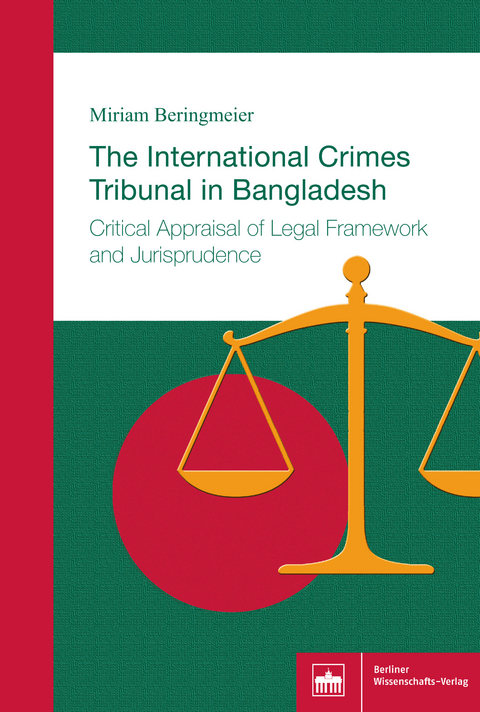
The International Crimes Tribunal in Bangladesh (eBook)
326 Seiten
BWV Berliner Wissenschafts-Verlag
978-3-8305-4030-4 (ISBN)
Acknowledgments 7
Table of contents 9
List of abbreviations 15
Part I: Introduction and outline of the investigation 19
1 Introduction and statement of the problem 19
2 Objectives of the study and considered jurisprudence 21
3 Outline of the investigation 22
Part II: Towards an International Crimes Tribunal 23
1 Historical background 23
1.1 The province of Bengal 23
1.2 The Partition of British India 24
1.3 The Liberation War 25
2 First attempts to deal with the war crimes 41
2.1 The Bangladesh Collaborators (Special Tribunal) Order, 1972 42
2.2 The Bangladesh National Liberation Struggle (Indemnity) Order, 1973 46
2.3 The International Crimes (Tribunals) Act, 1973 46
2.4 Constitutional amendments 47
2.5 International agreements 49
2.6 Political environment in post-war Bangladesh 50
3 Ending impunity 51
3.1 Politics after 1991 51
3.2 Emerging call for trials of war criminals 52
3.3 Establishment of the ICT 54
3.4 Controversies surrounding the ICT 55
Part III: The ICT in comparison to other accountability mechanisms 61
1 The different accountability mechanisms and their applicability in the context of Bangladesh 61
1.1 The International Criminal Court 61
1.2 Ad hoc international criminal tribunals 66
1.3 Mixed tribunals 67
1.4 Domestic trials 67
1.5 Truth and reconciliation commissions 68
1.6 Trials in third states 69
1.7 Decision-making process in Bangladesh 70
2 The domestic character of the International Crimes Tribunal in Bangladesh 71
2.1 Structure of the ICT 72
2.2 Jurisdiction of the ICT 73
2.3 Applicable law and jurisprudence 76
2.4 Amnesties 103
2.5 Ne bis in idem 109
2.6 Funding 111
2.7 Interim ndings 112
Part IV: Compliance of the ICT Act, the Rules of Procedure and the ICT’s jurisprudence with international standards 113
1 Criteria of investigation 113
1.1 International treaties 115
1.2 Customary international law 118
1.3 Jurisprudence of international criminal law 118
2 The crimes within the ICT’s jurisdiction 119
2.1 Genocide 119
2.2 Crimes against humanity 134
2.3 War crimes 168
2.4 Crimes against peace 171
2.5 Violation of any humanitarian rules applicable in armed conflicts laid down in the Geneva Conventions of 1949 171
2.6 Any other crimes under international law 172
2.7 Inchoate crimes 180
2.8 Interim ndings 186
3 The modes of liability of the ICT Act 186
3.1 The modes of liability of the ICT Act and customary international law 187
3.2 The modes of liability in the jurisprudence of the ICT 190
3.3 Interim ndings 221
4 Procedural rights 221
4.1 Right to legal assistance and to an interpreter 223
4.2 Right not to be subjected to arbitrary arrest or detention and to be informed of the reasons for arrest 224
4.3 Right not to be compelled to incriminate oneself or to confess guilt and to remain silent 230
4.4 Presumption of innocence 233
4.5 Right to be tried by an independent and impartial tribunal 239
4.6 Right to be tried without undue delay 244
4.7 Right to a fair and public hearing 246
4.8 Right to adequate time and facilities for preparation 248
4.9 The right to be present and trials in absentia 250
4.10 Legal remedies 254
4.11 Penalties 257
4.12 Witnesses and victims 260
4.13 Interim ndings 265
Part V: The ICT in the context of transitional justice in Bangladesh 267
1 The role of criminal trials in the process of transitional justice 267
1.1 Measures and aims of transitional justice 267
1.2 Objectives and limitations of criminal trials in transitional justice processes 269
2 The ICT’s contribution to the process of transitional justice 271
2.1 Factors that determine and limit transitional justice in Bangladesh 272
2.2 The ICT as a transitional justice mechanism 274
2.3 Interim findings 279
Part VI: Conclusion and outlook 281
References 285
Appendix 303
The International Crimes Tribunals Act 303
The Rules of Procedure of Tribunal 2 315
| Erscheint lt. Verlag | 16.7.2018 |
|---|---|
| Sprache | englisch |
| Themenwelt | Recht / Steuern |
| ISBN-10 | 3-8305-4030-2 / 3830540302 |
| ISBN-13 | 978-3-8305-4030-4 / 9783830540304 |
| Informationen gemäß Produktsicherheitsverordnung (GPSR) | |
| Haben Sie eine Frage zum Produkt? |
 PDF (Wasserzeichen)
Größe: 4,2 MB
DRM: Digitales Wasserzeichen
Dieses eBook enthält ein digitales Wasserzeichen und ist damit für Sie personalisiert. Bei einer missbräuchlichen Weitergabe des eBooks an Dritte ist eine Rückverfolgung an die Quelle möglich.
Dateiformat: PDF (Portable Document Format)
Mit einem festen Seitenlayout eignet sich die PDF besonders für Fachbücher mit Spalten, Tabellen und Abbildungen. Eine PDF kann auf fast allen Geräten angezeigt werden, ist aber für kleine Displays (Smartphone, eReader) nur eingeschränkt geeignet.
Systemvoraussetzungen:
PC/Mac: Mit einem PC oder Mac können Sie dieses eBook lesen. Sie benötigen dafür einen PDF-Viewer - z.B. den Adobe Reader oder Adobe Digital Editions.
eReader: Dieses eBook kann mit (fast) allen eBook-Readern gelesen werden. Mit dem amazon-Kindle ist es aber nicht kompatibel.
Smartphone/Tablet: Egal ob Apple oder Android, dieses eBook können Sie lesen. Sie benötigen dafür einen PDF-Viewer - z.B. die kostenlose Adobe Digital Editions-App.
Buying eBooks from abroad
For tax law reasons we can sell eBooks just within Germany and Switzerland. Regrettably we cannot fulfill eBook-orders from other countries.
aus dem Bereich


