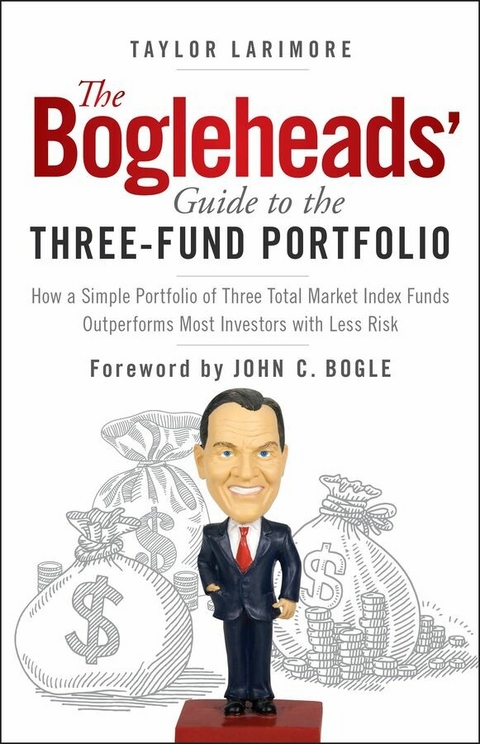
The Bogleheads' Guide to the Three-Fund Portfolio (eBook)
John Wiley & Sons (Verlag)
978-1-119-48735-7 (ISBN)
Twenty benefits from the three-fund total market index portfolio.
The Bogleheads' Guide to The Three-Fund Portfolio describes the most popular portfolio on the Bogleheads forum. This all-indexed portfolio contains over 15,000 worldwide securities, in just three easily-managed funds, that has outperformed the vast majority of both professional and amateur investors.
If you are a new investor, or an experienced investor who wants to simplify and improve your portfolio, The Bogleheads' Guide to The Three-Fund Portfolio is a short, easy-to-read guide to show you how.
TAYLOR LARIMORE is a sage on the Boglehead forums for everyone who wants to discover 'the Boglehead way.' Crowned the 'King of the Bogleheads' by Jack Bogle, he has spent more than seven decades in finance and investing, in such positions as revenue officer for the IRS, chief of the Financial Division for the Small Business Administration in South Florida, and a director of the Dade County Housing Finance Authority. He is co-author of The Bogleheads' Guide to Investing and The Bogleheads' Guide to Retirement Planning.
Twenty benefits from the three-fund total market index portfolio. The Bogleheads Guide to The Three-Fund Portfolio describes the most popular portfolio on the Bogleheads forum. This all-indexed portfolio contains over 15,000 worldwide securities, in just three easily-managed funds, that has outperformed the vast majority of both professional and amateur investors. If you are a new investor, or an experienced investor who wants to simplify and improve your portfolio, The Bogleheads Guide to The Three-Fund Portfolio is a short, easy-to-read guide to show you how.
TAYLOR LARIMORE is a sage on the Boglehead forums for everyone who wants to discover "the Boglehead way." Crowned the "King of the Bogleheads" by Jack Bogle, he has spent more than seven decades in finance and investing, in such positions as revenue officer for the IRS, chief of the Financial Division for the Small Business Administration in South Florida, and a director of the Dade County Housing Finance Authority. He is co-author of The Bogleheads' Guide to Investing and The Bogleheads' Guide to Retirement Planning.
FOREWORD BY JOHN C. BOGLE xi
PREFACE: THE HISTORY OF THE BOGLEHEADS'
THREE-FUND PORTFOLIO xvii
ACKNOWLEDGMENTS xxv
CHAPTER 1: THE INVESTMENT INDUSTRY 1
CHAPTER 2: JOHN C. BOGLE--THE INVESTOR'S BEST FRIEND 5
CHAPTER 3: JOHN BOGLE INTRODUCES THREE TOTAL MARKET INDEX FUNDS 9
CHAPTER 4: TWENTY BENEFITS OF TOTAL MARKET INDEX FUNDS (IN NO PARTICULAR ORDER) 13
Benefit1: No Advisor Risk 14
Benefit2: No Asset Bloat 17
Benefit3: No Index Front Running 19
Benefit4: No Fund Manager Risk 20
Benefit5: No Individual Stock Risk 22
Benefit6: No Overlap 24
Benefit7: No Sector Risk 25
Benefit8: No Style Drift 26
Benefit9: Low Tracking Error 27
Benefit10: Above-Average Return 28
Benefit11: Simplifi ed Contributions and Withdrawals 32
Benefit12: The Benefitof Consistency 33
Benefit13: Low Turnover 34
Benefit14: Low Costs 35
Benefit15: Maximum Diversifi cation (lower risk) 38
Benefit16: Portfolio Effi ciency (best risk/return ratio) 39
Benefit17: Low Maintenance 40
Benefit18: Easy to Rebalance 41
Benefit19: Tax Effi ciency 42
Benefit20: Simplicity (for investors, caregivers, and heirs) 44
CHAPTER 5: GETTING STARTED 49
CHAPTER 6: STAY THE COURSE 59
APPENDIX I: WHAT EXPERTS SAY 63
APPENDIX II: MEET THE BOGLEHEADS 69
GLOSSARY OF FINANCIAL TERMS 75
INDEX 79
Foreword
There is something truly remarkable about the intersection of something old and something new. First, a World War II veteran of the Battle of the Bulge has an idea for building a better world for investors. A decade later, modern technology begins to create unprecedented opportunities for the development of social networks, opening a whole new world for interpersonal communication. That combination of man and technology led to the creation of an investor-driven website for individual investors.
The Army combat veteran, born in 1924, is Taylor Larimore, distinguished citizen of Miami, Florida, and a truly wonderful human being. The new technology is the Internet. The idea: to allow investors in the Vanguard mutual funds to share their ideas, their investment experiences, and their financial strategies with one another, as it is said, “without fear or favor.”
Founded by Taylor in 1998 as the “Vanguard Diehards,” the name of the new website was changed to the “Bogleheads” in 2007. Their first meeting—Diehards I—took place in March 2000, when I joined some 20 Vanguard investors in Taylor’s Miami condominium for dinner, friendship, and lively conversation about investment strategy and policy.
Then to Vanguard’s home in Valley Forge, Pennsylvania, on June 8, 2001, with 40 Bogleheads in attendance. Then to Chicago, where Morningstar hosted the three-day gathering for 50 dedicated investors. Next, to Denver and the Chartered Financial Analysts Conference in 2004, with 90 Bogleheads in attendance.
On to San Diego 2008, and to Fort Worth in 2009, before settling down to roost each year thereafter at a mid-size hotel near Vanguard’s headquarters in the Philadelphia region. The hotel’s capacity limits the attendance to some 225 Bogleheads and the openings are quickly filled—a full house every year since then.
I’ve talked to the Bogleheads at all of these meetings. Each October, for ten years now, I’m asked to summarize the major events at Vanguard, in the mutual fund industry, and in the financial markets, and to place them in historical perspective. (The format has barely changed.)
Taylor Larimore is known unofficially as “the King of the Bogleheads”; his friend Mel Lindauer is known as “the Prince.” Mel runs these annual gatherings, at which a range of experts speak, including authors (and investment advisors), Bill Bernstein and Rick Ferri. In recent years, Gus Sauter, former Chief Investment Officer at Vanguard, now retired, has become a regular speaker.
But the limited size and scope of these gatherings merely scratches the surface of the vast network the Bogleheads have developed. To date, the Bogleheads.org forum has been receiving up to 4.5 million hits per day, and in a single day the site has been visited by as many as 90,000 unique individuals. I believe the forum is the most popular financial website in America.
And why not? The members want to help one another. There are no financial incentives for doing so, nor are there any costs for participating. “Selfless” is the modus operandi.
THE THREE-FUND PORTFOLIO
Taylor Larimore has participated in the writing and publication of two earlier books, both reaching large numbers of investors: The Bogleheads’ Guide to Investing (2006) and The Bogleheads’ Guide to Retirement Planning (2009). In The Bogleheads’ Guide to the Three-Fund Portfolio, Taylor goes on his own to explore one of the subjects dearest to his heart—using three all-market index funds: Vanguard Total Stock Market Index Fund (U.S. stock market), Vanguard Total International Stock Index Fund (non-U.S. stock market), and Vanguard Total Bond Market Index Fund (U.S. bonds).
Taylor’s idea combines the nth degree of diversification, a sensible investment balance between stocks and bonds, efficiency, and economy. “Simplicity” is the watchword. Yes, as he notes, investors’ allocation among these three asset classes depends on their particular investment goals, risk tolerance, age, and wealth. Even investors’ temperament comes into play, for financial markets are volatile. Sometimes the financial markets giveth, and sometimes (with far less frequency) they taketh away.
I’d estimate that thousands of Vanguard investors have subscribed to the idea of “The Three-Fund Portfolio.” As originally conceived by Taylor, the initial allocation into each of the three index funds would be based on the investor’s goals, time frame, risk tolerance and personal financial situation.
A WORD ABOUT NON-U.S. STOCKS
In my first book, Bogle on Mutual Funds, published in 1994, I wrote that a long-term investor need not allocate any of his or her assets to non-U.S. stocks. But if they disagreed, I argued, they should limit their holdings to 20% of their stock portion, given the significant extra risks involved (such as currency risk and sovereign risk).
My opinion was based on my expectation that the American economy would continue to grow over the long term, and that the market values of U.S. corporations would grow faster than the values of non-U.S. corporations. Since 1994, as it was to happen, the U.S. S&P 500 Index was to rise by 743%, while the EAFE (Europe, Australasia, and Far East) Index of non-U.S. stocks rose by 237%.
That I was right is beside the point. It may have been luck. But now that U.S. stocks have dominated for nearly 25 years, it may well be time for reversion to the mean, with non-U.S. stocks leading the way rather than following. Who really knows? No one knows what tomorrow may bring. But I’m inclined to stick by my earlier conclusion that holdings of non-U.S. stocks should be limited to no more than 20% of equities.
For U.S. investors, Taylor suggests that 20% of the equity allocation should be placed in a Total International Stock Index Fund. That suggested 20% is essentially a compromise between my suggested maximum of 20% and the minimum 20% recommended by a Vanguard study.
A GOOD BOOK BY A WISE AUTHOR
Please note that the fine points of asset allocation in The Three-Fund Portfolio constitute only a small part of this fine book. It is replete with sound advice and will effectively serve both experienced and novice investors. Taylor describes the investment lessons he learned the hard way—by risking his own hard-earned money and falling short of the market’s return. He tried to beat the market by picking individual stocks, both through an investment club and on his own; he chased the returns of hot mutual funds, only to suffer the inevitable fate of reversion to the mean; he followed investment newsletters that claimed to be able to beat the market, but, of course, did not; he invested with a stock broker who was good at collecting fees, but had no ability to beat the market.
Finally, Taylor read my first book, Bogle on Mutual Funds, and was persuaded by my unassailable Cost Matters Hypothesis: The gross return of the market, minus the costs of investing, equals net return to investors. If active investors in aggregate own the market, which they do, as a group they receive the market’s return minus the high costs of active investing. Index investors also own the market, but at rock-bottom cost. So the average actively-managed portfolio will, of necessity, underperform the average indexed portfolio. Investing in index funds is the only way to guarantee that you’ll receive your fair share of the market’s return.
Taylor goes on to list many of the other benefits of broad-market indexing, including the elimination of manager risk, individual stock risk, sector risk, and tracking error, just to name a few. He cites numerous experts who support index investing, such as David Swensen, Warren Buffett, and Paul Samuelson. Nobel laureate William Sharpe concluded his influential paper, “The Arithmetic of Active Management,” with these words: “Properly measured, the average actively-managed dollar must underperform the average passively-managed dollar, net of costs. Empirical analyses that appear to refute this principle are guilty of improper measurement.”
The Three-Fund Portfolio will help you to develop a sound asset allocation strategy, make smart investment selections, and guide the implementation of your plan. Taylor offers one final piece of advice, and it’s a mantra I’ve repeated countless times throughout my long career in finance: Stay the course. As I said in my book Common Sense on Mutual Funds, “No matter what happens, stick to your program. I’ve said, ‘Stay the course’ a thousand times, and I meant it every time. It’s the most important single piece of investment wisdom I can give to you.”
“A POWER SEEN FROM AFAR”
In writing the Foreword to The Bogleheads’ Guide to Investing in 2005, I cited this expression from Democracy in America, written by Alexis de Tocqueville in 1835, nearly two centuries ago.
As soon as several of the inhabitants of the United States have taken up an opinion or a feeling they wish to promote, they look out for mutual assistance, and as soon as they have found one another out, they combine. From that moment they are no longer isolated men, but a...
| Erscheint lt. Verlag | 1.6.2018 |
|---|---|
| Vorwort | John C. Bogle |
| Sprache | englisch |
| Themenwelt | Recht / Steuern ► Wirtschaftsrecht |
| Wirtschaft ► Betriebswirtschaft / Management ► Finanzierung | |
| Schlagworte | Boglehead • Boglehead investing • Boglehead portfolio • Bogleheads • Boglehead three fund • Finance & Investments • Finanz- u. Anlagewesen • Finanzwesen • Investing • investing book • investing portfolio • market index funds • Taylor Larimore • The Bogleheads' Guide to the Three-Fund Portfolio • Three fund • three fund Boglehead • three fund investing • three fund portfolio • what is Boglehead • what is Boglehead investing |
| ISBN-10 | 1-119-48735-8 / 1119487358 |
| ISBN-13 | 978-1-119-48735-7 / 9781119487357 |
| Informationen gemäß Produktsicherheitsverordnung (GPSR) | |
| Haben Sie eine Frage zum Produkt? |
 EPUB (Adobe DRM)
Kopierschutz: Adobe-DRM
Adobe-DRM ist ein Kopierschutz, der das eBook vor Mißbrauch schützen soll. Dabei wird das eBook bereits beim Download auf Ihre persönliche Adobe-ID autorisiert. Lesen können Sie das eBook dann nur auf den Geräten, welche ebenfalls auf Ihre Adobe-ID registriert sind.
Details zum Adobe-DRM
Dateiformat: EPUB (Electronic Publication)
EPUB ist ein offener Standard für eBooks und eignet sich besonders zur Darstellung von Belletristik und Sachbüchern. Der Fließtext wird dynamisch an die Display- und Schriftgröße angepasst. Auch für mobile Lesegeräte ist EPUB daher gut geeignet.
Systemvoraussetzungen:
PC/Mac: Mit einem PC oder Mac können Sie dieses eBook lesen. Sie benötigen eine
eReader: Dieses eBook kann mit (fast) allen eBook-Readern gelesen werden. Mit dem amazon-Kindle ist es aber nicht kompatibel.
Smartphone/Tablet: Egal ob Apple oder Android, dieses eBook können Sie lesen. Sie benötigen eine
Geräteliste und zusätzliche Hinweise
Buying eBooks from abroad
For tax law reasons we can sell eBooks just within Germany and Switzerland. Regrettably we cannot fulfill eBook-orders from other countries.
aus dem Bereich