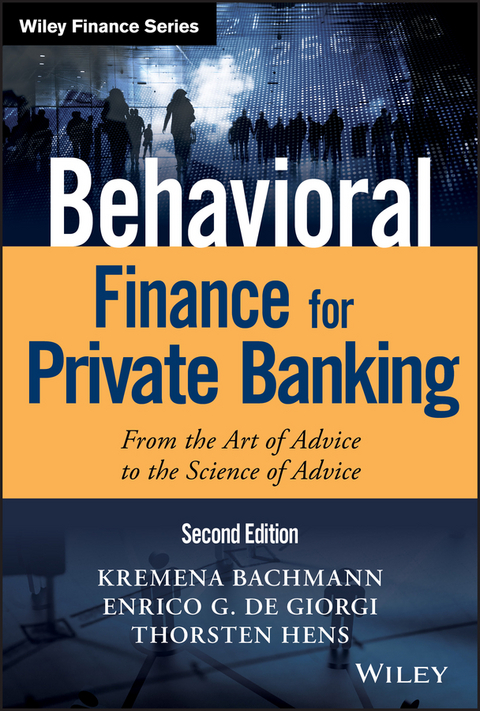
Behavioral Finance for Private Banking (eBook)
John Wiley & Sons (Verlag)
978-1-119-45371-0 (ISBN)
An essential framework for wealth management using behavioral finance
Behavioral Finance for Private Banking provides a complete framework for wealth management tailored to the unique needs of each client. Merging behavioral finance with private banking, this framework helps you gain a greater understanding of your client's wants, needs, and perspectives to streamline the decision making process. Beginning with the theoretical foundations of investment decision making and behavioral biases, the discussion delves into cultural differences in global business and asset allocation over the life cycle of the investment to help you construct a wealth management strategy catered to each individual's needs. This new second edition has been updated to include coverage of fintech and neurofinance, an extension of behavioral finance that is beginning to gain traction in the private banking space.
Working closely with clients entails deep interpersonal give and take. To be successful, private banking professionals must be as well-versed in behavioral psychology as they are in finance; this intersection is the heart of behavioral finance, and this book provides essential knowledge that can help you better serve your clients' needs.
- Understand the internal dialogue at work when investment decisions are made
- Overcome the most common behavioral biases-and watch for your own
- Learn how fintech and neurofinance impact all aspects of private banking
- Set up a structured wealth management process that places the client's needs front and center
KREMENA BACHMANN is senior research associate at the University of Zurich, senior lecturer at the Zurich University of Applied Sciences (ZHAW) and academic advisor at Moor & Bachmann AG, a Swiss multi-family office. As a behavioral finance researcher publishing in peer-reviewed journals she is also actively engaged in the development of practical solutions that help to improve financial decision making.
ENRICO DE GIORGI is professor of mathematics and director of the institute of mathematics and statistics at University of St. Gallen. He is also associate editor of Mathematics and Financial Economics and Decisions in Economics and Finance and founding partner of BhFS Behavioral Finance Solutions. His research has been published in the top peer-reviewed journals in Finance and Management.
THORSTEN HENS is a professor of financial economics and a member of the directorate of the department of banking and finance at the University of Zurich. He is a founding partner of BhFS Behavioral Finance Solutions, Swiss Fintech Innovations and the University of Zurich Research Priority Program on financial regulation, Finreg. He is a coauthor of 60 peer-reviewed scientific publications and seven books.
An essential framework for wealth management using behavioral finance Behavioral Finance for Private Banking provides a complete framework for wealth management tailored to the unique needs of each client. Merging behavioral finance with private banking, this framework helps you gain a greater understanding of your client s wants, needs, and perspectives to streamline the decision making process. Beginning with the theoretical foundations of investment decision making and behavioral biases, the discussion delves into cultural differences in global business and asset allocation over the life cycle of the investment to help you construct a wealth management strategy catered to each individual s needs. This new second edition has been updated to include coverage of fintech and neurofinance, an extension of behavioral finance that is beginning to gain traction in the private banking space. Working closely with clients entails deep interpersonal give and take. To be successful, private banking professionals must be as well-versed in behavioral psychology as they are in finance; this intersection is the heart of behavioral finance, and this book provides essential knowledge that can help you better serve your clients needs. Understand the internal dialogue at work when investment decisions are made Overcome the most common behavioral biases and watch for your own Learn how fintech and neurofinance impact all aspects of private banking Set up a structured wealth management process that places the client s needs front and center Private banking clients demand more than just financial expertise. They want an advisor who truly understands their needs, and can develop and execute the kind of strategy that will help them achieve their goals. Behavioral Finance for Private Banking provides a complete framework alongside insightful discussion to help you become the solution your clients seek.
KREMENA BACHMANN is senior research associate at the University of Zurich, senior lecturer at the Zurich University of Applied Sciences (ZHAW) and academic advisor at Moor & Bachmann AG, a Swiss multi-family office. As a behavioral finance researcher publishing in peer-reviewed journals she is also actively engaged in the development of practical solutions that help to improve financial decision making. ENRICO DE GIORGI is professor of mathematics and director of the institute of mathematics and statistics at University of St. Gallen. He is also associate editor of Mathematics and Financial Economics and Decisions in Economics and Finance and founding partner of BhFS Behavioral Finance Solutions. His research has been published in the top peer-reviewed journals in Finance and Management. THORSTEN HENS is a professor of financial economics and a member of the directorate of the department of banking and finance at the University of Zurich. He is a founding partner of BhFS Behavioral Finance Solutions, Swiss Fintech Innovations and the University of Zurich Research Priority Program on financial regulation, Finreg. He is a coauthor of 60 peer-reviewed scientific publications and seven books.
Chapter 1 Introduction 1
Chapter 2 Behavioral Biases 5
2.1 Information Selection Biases 6
2.2 Information Processing Biases 11
2.3 Biases after Receiving Feedback 31
2.4 Are More Heads Smarter Than One? 33
2.5 Summary of Biases 35
2.6 Conclusion 39
Chapter 3 Cultural Differences in Investors' Behavior 41
3.1 What Is Financial Culture? 41
3.2 The INTRA Study 43
3.3 Conclusion 46
Chapter 4 Neurological Foundations and Biases' Moderation 47
4.1 The Human Brain 47
4.2 Insights for Behavioral Finance 48
4.3 Moderation of Biases 49
4.4 Conclusion 50
Chapter 5 Diagnostic Tests for Investment Personality 51
5.1 A Case Study 51
5.2 Design of Diagnostic Questionnaires 52
5.3 Knowledge and Investment Experience 53
5.4 Psychology and Emotions 59
5.5 Client's Diagnostic Profile 65
Chapter 6 Decision Theory 69
6.1 Introduction 69
6.2 A (Very) Short History of Decision Theory 70
6.3 Expected Utility 73
6.4 Mean-Variance Analysis 76
6.5 Prospect Theory 78
6.6 Rationality of Mean-Variance and Prospect Theory 87
6.7 The Optimal Asset Allocation 91
6.8 Comparing the Decision Theories 102
6.9 Conclusion 103
Chapter 7 Product Design 105
7.1 Introduction 105
7.2 Case Study 107
7.3 Theory of Product Design 114
7.4 Structured Products Designed by Customers 120
7.5 Conclusion 123
Chapter 8 Dynamic Asset Allocation 125
8.1 Time Diversification 126
8.2 Rebalancing 129
8.3 Conclusion 134
Chapter 9 Life-Cycle Planning 137
9.1 Case Study 137
9.2 Case Study Werner Bruni 139
9.3 Consumption Smoothing 140
9.4 The Life-Cycle Hypothesis 141
9.5 The Behavioral Life-Cycle Hypothesis 143
9.6 Conclusion 146
Chapter 10 Risk Profiling 147
10.1 Risk-Profiling Methodologies 148
10.2 Comparing Risk-Profiling Methodologies 151
10.3 A Case Study 152
10.4 The Risk Dimensions 153
10.5 Behavioral Risk Profiler 155
10.6 Risk Profiling and Its Regulation 166
10.7 Conclusion 167
Chapter 11 Structured Wealth Management Process 169
11.1 Benefits 172
11.2 Implementation 173
11.3 Regulatory Requirements 174
11.4 Structuring the Wealth Management Process 177
11.5 Relevance of Different Theories 196
11.6 Complying with the Regulatory Requirements 197
11.7 Information Technology in Client Advisory Services 197
Chapter 12 Fintech 201
12.1 History of Fintech 201
12.2 Current State of Fintech 201
12.3 Assessment of Fintech Solutions 202
Chapter 13 Case Studies 203
13.1 Case Study 1: Structured Wealth Management 204
13.2 Case Study 2: Experience Sampling 209
13.3 Case Study 3: Goal-based Approach 210
Chapter 14 Conclusions 219
Chapter 15 Appendix: Mathematical Arguments 221
15.1 Proof that Expected Utility Satisfies the Axioms of Rational Choice 221
15.2 Derivation of the Fourfold Pattern of Risk Taking 222
15.3 Mean-Variance as a Special Case of Prospect Theory 222
15.4 Prospect Theory Optimal Asset Allocation 224
15.5 No Time Diversification Theorem 225
References 227
Index 235
CHAPTER 2
Behavioral Biases
Behavioral finance research is driven by observations suggesting that individuals' decisions can be irrational and different from what previous theories assume. In this chapter, we will see that individuals' decisions can be systematically wrong because people's decisions are driven by emotions or misunderstandings or because people use inappropriate rules of thumb, also called heuristics, to handle information and make decisions. Certainly, financial markets are very complex so that optimization can lead to fragile results and good heuristics are preferable.1 But what is typically observed is that people apply successful heuristics from other domains without properly assessing their effect in the investment domain. One example for the latter is adaptive learning, which is very successful in many day‐to‐day situations like choosing food: One tries out a new wine. If one likes it, one buys it again. However, in finance it leads to buying assets when they are expensive and selling them when they are cheap, as the roller coaster in Figure 2.01 illustrates.
FIGURE 2.01 Market dynamics and decision behavior of a typical investor
To more deeply understand why we may observe such behavior, we consider a typical decision‐making process and discuss how each stage of the process can be biased. First, decision makers select the information that appears to be relevant for their decisions. Then, they process the selected information to form beliefs and to compare alternatives. After deciding, individuals receive new information as a feedback. This feedback influences, in return, the way the decision makers search for more data, that is, the loop is closed.
The chapter provides evidence that certain mistakes can occur in each of these steps. It discusses the relevance of these mistakes for investors and suggests strategies to avoid the mistakes.
2.1 INFORMATION SELECTION BIASES
When confronted with information, individuals need to judge how relevant it is for the task they need to handle. Thereby individuals seem to consider only particular information while disregarding other that might be relevant as well. For investment decisions, such information filtering can be dangerous since there is uncertainty about the relative importance of economic factors for the future—investment rules that have worked in the past do not always work in the future. So, are there any patterns in the way people select relevant information, and why should we expect that their impact is systematic?
2.1.1 Attention Bias
The first observation on individuals' selection of information is that it can be biased due to a specific task. People gather information that they think is relevant for dealing with the problem and disregard others, which they would otherwise notice. This is demonstrated in an experiment, where participants have been asked to watch a video with two basketball teams: one team wearing black shirts and another one wearing white shirts (Simons & Chabris, 1999). The task was to count the passes of the white team. Afterward, participants have been asked whether they have observed something unusual. Some participants spotted that there was a second ball. But only a few noticed a big black gorilla walking slowly through the picture, stopping in the middle, winking, and passing slowly away. The reason for not seeing the gorilla is the attention bias. Due to the limited attention that people have, they can get only the information they consider important for solving a specific task. All other information remains disregarded, independent of how extreme it is. Hence, when people focus too much on one task, something unexpected can happen that they might not notice. Moreover, related experiments show that even when people know that something unexpected might happen (e.g., that a gorilla would appear), this doesn't help them notice otherunexpected things.
Relevance for Investors and Moderation The attention bias is relevant for investors because all investors use media to inform themselves. But the media process follows certain patterns. Some media set the agenda, other media follow, and for some time all media report the same story. In these times, other investment relevant information is not seen—like the gorilla in the experiment just mentioned. For example, in summer 2011 we observed a global stock market downturn: From the end of July to the end of August, the DJIA fell from 12,700 to 10,700, the Euro Stoxxs 50 fell from 2,800 to 2,200, and the Nikkei from 10,000 to 8,750 (i.e., stock markets plunged by 16%, 21% and 12.5%, respectively). Looking at the words Internet users searched in Google2 during summer 2011, we see that the public attention mainly focused on the US debt ceiling debate that was positively resolved by August 1st. So why did stocks decline after the showdown in the US Congress was resolved? One explanation is that the gorilla “US recession” was not seen in July, so the attention for a possible recession in the United States was hidden behind the budget ceiling debate while after that debate was over the recession attracted the attention of the public. Indeed, the search for the words “US debt” peaked in July 2011 while the words “US recession” peaked in August 2011. And indeed, the US business cycle slowed down considerably during the summer of 2011.
The best moderation of the attention bias is to agree on certain key information (e.g., macroeconomics, politics, valuation levels, sentiment of the market) that one always discusses with the investors irrespectively of whether it is topical or not.
2.1.2 Selective Perception Based on Experience
Perception of information is, by its nature, always selective. But in many situations people might not be able to see things just because they do not expect them to occur given their experience. This has been demonstrated in an experiment with playing cards (Bruner & Postman, 1949). Participants were shown five playing cards and asked what they have seen. What researchers were testing is whether the participants would recognize doctored cards (e.g., a black three of a heart). They found out that, on average, participants needed four times longer to recognize a doctored card than a normal card. Most of the people were very sure that the doctored card was a normal card. Even when participants recognized that something was wrong, they sometimes misperceived the incongruity (e.g., people who were shown a black four of hearts declared that the spades were “turned the wrong way”). This experiment shows that experience can influence the way people look at new evidence. When people have enough experience with a specific situation, they often see what they expect to see based on their experience. Hence, in some cases, experience may lower performance.
Relevance for Investors and Moderation To give an example of how selective perception can affect investments, recall the stock market crash in the years 2007–2008. From the summer of 2007 to the beginning of 2009, the DJIA fell from 14,100 to 6,525, the Euro Stoxxs 50 from 4,500 to 1,800 and the Nikkei from 18,250 to 7,125—that is, stock markets plunged between 50% and 60% around the world. Unfortunately, none of the standard indicators could predict this decline. The P/E ratios and the Fed measure that could predict for example the crash of the dot‐com bubble signaled no risk during the summer of 2007. Investors who used those risk measures because of the positive experience with them were caught by surprise during the stock market crash of 2007–2008. Indeed, that stock market crash did not come from overvaluation of stocks but from a bubble in the housing market in the United States, the United Kingdom, and Spain. This housing bubble resulted in a financial crisis, which then slowed down the global economy. Thus, experience with some indicators might seduce investors to stop thinking transversally.
The best way to deal with the selective perception bias is to ask yourself: What is my motivation to see things in a certain way? What expectations did I bring into the situation? Why do others not share my view?
2.1.3 Confirmation Bias
Previous experience influences the way we perceive information that we face, but it also affects the way we search for information. People tend to search for information that confirms one's beliefs or hypotheses, while they give disproportionately less consideration to alternative possibilities. This bias in information selection is known as the confirmation bias. It has been first discovered by Wason (1960). In his experiment, participants were asked to identify a rule applied to triples of numbers (e.g., 2, 4, and 6). To discover the rule, participants could decide on their own triples and receive a feedback on whether their numbers conform to the rule or not. While the true rule was “three numbers of increasing order of magnitude,” most participants tested a specific hypothesis as for example “increasing by 2.” However, those who test their rule can never discover that their rule is wrong because all examples that fit their rule fit also the true rule. Thus, to test the rule “increasing by 2,” it is critical to try, for example, 2, 4, and 7.
Although there are circumstances where searching for confirmatory evidence can be useful...
| Erscheint lt. Verlag | 10.5.2018 |
|---|---|
| Reihe/Serie | Wiley Finance |
| Wiley Finance Editions | Wiley Finance Editions |
| Sprache | englisch |
| Themenwelt | Recht / Steuern ► Wirtschaftsrecht |
| Wirtschaft ► Betriebswirtschaft / Management ► Finanzierung | |
| Schlagworte | Applied Psychology • Asset Allocation • behavioral finance framework • behavioral finance introduction • behavioral finance textbook • client management • client needs • client relationships • Finance & Investments • finance psychology • Finanz- u. Anlagewesen • Finanzwesen • FinTech • investment decision making</p> • <p>behavioral finance • Neurofinance • neurofinance framework • practical psychology • Private Banking • private banking framework • private banking methods • private banking techniques • private banking training • Private Wealth Management • Wealth Management • wealth management framework |
| ISBN-10 | 1-119-45371-2 / 1119453712 |
| ISBN-13 | 978-1-119-45371-0 / 9781119453710 |
| Informationen gemäß Produktsicherheitsverordnung (GPSR) | |
| Haben Sie eine Frage zum Produkt? |
 EPUB (Adobe DRM)
Kopierschutz: Adobe-DRM
Adobe-DRM ist ein Kopierschutz, der das eBook vor Mißbrauch schützen soll. Dabei wird das eBook bereits beim Download auf Ihre persönliche Adobe-ID autorisiert. Lesen können Sie das eBook dann nur auf den Geräten, welche ebenfalls auf Ihre Adobe-ID registriert sind.
Details zum Adobe-DRM
Dateiformat: EPUB (Electronic Publication)
EPUB ist ein offener Standard für eBooks und eignet sich besonders zur Darstellung von Belletristik und Sachbüchern. Der Fließtext wird dynamisch an die Display- und Schriftgröße angepasst. Auch für mobile Lesegeräte ist EPUB daher gut geeignet.
Systemvoraussetzungen:
PC/Mac: Mit einem PC oder Mac können Sie dieses eBook lesen. Sie benötigen eine
eReader: Dieses eBook kann mit (fast) allen eBook-Readern gelesen werden. Mit dem amazon-Kindle ist es aber nicht kompatibel.
Smartphone/Tablet: Egal ob Apple oder Android, dieses eBook können Sie lesen. Sie benötigen eine
Geräteliste und zusätzliche Hinweise
Buying eBooks from abroad
For tax law reasons we can sell eBooks just within Germany and Switzerland. Regrettably we cannot fulfill eBook-orders from other countries.
aus dem Bereich