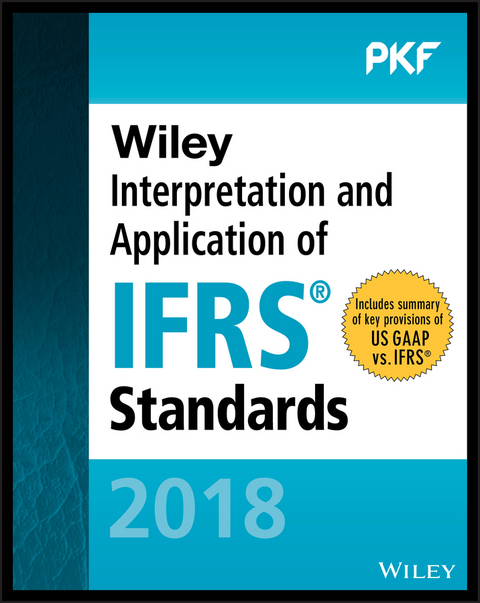
Wiley Interpretation and Application of IFRS Standards 2018 (eBook)
1016 Seiten
Wiley (Verlag)
978-1-119-46151-7 (ISBN)
Wiley IFRS 2018 offers a complete resource for the interpretation and application of the latest International Financial Reporting Standards (IFRS) as outlined by the International Accounting Standards Board (IASB). With up-to-date coverage and a host of practical tools, this book provides invaluable guidance on the expanding framework for unified financial reporting. Organised for easy navigation, each chapter includes general statement information followed by topic-specific discussion to facilitate both quick-reference and in-depth study. The expert team at PKF International provides authoritative insight from a practitioner's perspective: IFRIC interpretations and practical real-world guidance ensure full understanding of the newest standards, and the Disclosure Checklist helps verify compliance.
The IASB's efforts are paying off as more and more countries around the globe either adopt IFRS as their national standards, or adjust local standards in alignment. A working understanding of IFRS application is becoming essential, even as the rules continue to evolve. This book provides full coverage of the latest standards and thorough guidance for implementation.
- Review the latest IFRS rules and standards
- Apply guidelines and best practices appropriately
- Gain expert insight on IFRS interpretation and implementation
- Ensure compliance and verify completeness
Uniform financial reporting reduces the costs of financial statement preparation for multinational companies, and streamlines the assessment of business results. As the standards themselves evolve, so must practitioners' understanding of how to apply them correctly in real-world cases. Wiley IFRS 2018 offers a complete, up-to-date reference to help you apply and comply with the latest international standards.
With offices in 440 cities, PKF operates in 150 countries across 5 continents and specialises in providing high quality audit, accounting, tax, and business advisory services to international and domestic organisations in all of their markets.
PKF International member firms have an aggregate fee income of $2.52 billion, and the network is a member of the Forum of Firms - an organisation dedicated to consistent and high quality standards of financial reporting and auditing practices worldwide.
The one-stop resource for IFRS interpretation and application, updated for 2018 Wiley IFRS 2018 offers a complete resource for the interpretation and application of the latest International Financial Reporting Standards (IFRS) as outlined by the International Accounting Standards Board (IASB). With up-to-date coverage and a host of practical tools, this book provides invaluable guidance on the expanding framework for unified financial reporting. Organised for easy navigation, each chapter includes general statement information followed by topic-specific discussion to facilitate both quick-reference and in-depth study. The expert team at PKF International provides authoritative insight from a practitioner's perspective: IFRIC interpretations and practical real-world guidance ensure full understanding of the newest standards, and the Disclosure Checklist helps verify compliance. The IASB's efforts are paying off as more and more countries around the globe either adopt IFRS as their national standards, or adjust local standards in alignment. A working understanding of IFRS application is becoming essential, even as the rules continue to evolve. This book provides full coverage of the latest standards and thorough guidance for implementation. Review the latest IFRS rules and standards Apply guidelines and best practices appropriately Gain expert insight on IFRS interpretation and implementation Ensure compliance and verify completeness Uniform financial reporting reduces the costs of financial statement preparation for multinational companies, and streamlines the assessment of business results. As the standards themselves evolve, so must practitioners' understanding of how to apply them correctly in real-world cases. Wiley IFRS 2018 offers a complete, up-to-date reference to help you apply and comply with the latest international standards.
PKF International is a global network of legally independent firms bound together by a shared commitment to quality, integrity and the creation of clarity in a complex regulatory environment. With offices in 440 cities, PKF operates in 150 countries across 5 continents and specialises in providing high quality audit, accounting, tax, and business advisory services to international and domestic organisations in all of their markets. PKF International member firms have an aggregate fee income of $2.52 billion, and the network is a member of the Forum of Firms - an organisation dedicated to consistent and high quality standards of financial reporting and auditing practices worldwide.
About the Authors vii
1 Introduction to International Financial Reporting Standards 1
2 Conceptual Framework 27
3 Presentation of Financial Statements 45
4 Statement of Financial Position 65
5 Statements of Profit or Loss and Other Comprehensive Income, and Changes in Equity 81
6 Statement of Cash Flows 101
7 Accounting Policies, Changes in Accounting Estimates, and Errors 119
8 Inventories 139
9 Property, Plant and Equipment 157
10 Borrowing Costs 185
11 Intangible Assets 193
12 Investment Property 221
13 Impairment of Assets and Non-Current Assets Held for Sale 235
14 Consolidations, Joint Arrangements, Associates and Separate Financial Statements 257
15 Business Combinations 309
16 Shareholders' Equity 361
17 Share-Based Payment 383
18 Current Liabilities, Provisions, Contingencies and Events After the Reporting Period 417
19 Employee Benefits 449
20 Revenue from Contracts with Customer 475
21 Government Grants 515
22 Leases 527
23 Foreign Currency 583
24 Financial Instruments 615
25 Fair Value 737
26 Income Taxes 767
27 Earnings per Share 803
28 Operating Segments 821
29 Related Party Disclosures 839
30 Accounting and Reporting by Retirement Benefit Plans 853
31 Agriculture 861
32 Extractive Industries 877
33 Accounting for Insurance Contracts 887
34 Interim Financial Reporting 905
35 Hyperinflation 925
36 First-Time Adoption of International Financial Reporting Standards 935
Index 967
1
Introduction to International Financial Reporting Standards
- Introduction
- Origins and Early History of the IASB
- The Current Structure
- Process of IFRS Standard Setting
- Convergence: The IASB and Financial Reporting in the US
- The IASB and Europe
- Appendix A: Current International Financial Reporting Standards (IAS/IFRS) and Interpretations (SIC/IFRIC)
- Appendix B: Projects Completed Since Previous Issue (July 2016 to June 2017)
- Appendix C: IFRS for SMEs
- Definition of SMEs
- IFRS for SMEs is a Complete, Self-Contained Set of Requirements
- Modifications of Full IFRS made in IFRS for SMEs
- Disclosure Requirements under IFRS for SMEs
- Maintenance of the IFRS for SMEs
- SME Implementation Group
- Implications of the IFRS for SMEs
- Application of the IFRS for SMEs
Introduction
The mission of the IFRS Foundation and the International Accounting Standards Board (IASB) is to develop International Financial Reporting Standards (IFRS) that bring transparency, accountability and efficiency to financial markets around the world. They seek to serve the public interest by fostering trust, growth and long-term stability in the global economy.
The motivation for the convergence of historically dissimilar financial reporting standards has been, in the main, to facilitate the free flow of capital so that, for example, investors in the US would become more willing to finance business in, say, China or the Czech Republic. Access to financial statements which are written in the same “language” would help to eliminate a major impediment to induce investor confidence, sometimes referred to as “accounting risk,” which adds to the more tangible risks of making such cross-border investments. Additionally, permission to list a company's equity or debt securities on an exchange has generally been conditional on making filings with national regulatory authorities. These regulators tend to insist either on conformity with local Generally Accepted Accounting Practice (GAAP) or on a formal reconciliation to local GAAP. These procedures are tedious and time-consuming, and the human resources and technical knowledge to carry them out are not always widely available, leading many would-be registrants to forgo the opportunity of broadening their investor bases and potentially lowering their costs of capital.
There were once scores of unique sets of financial reporting standards among the more developed nations (“national GAAP”). The year 2005 saw the beginning of a new era in the global conduct of business, and the fulfilment of a 30-year effort to create the financial reporting rules for a worldwide capital market. During that year's financial reporting cycle, the 27 European Union (EU) member states plus many other countries, such as Australia, New Zealand and South Africa, adopted IFRS.
Since then, many countries, such as Argentina, Brazil, Korea, Canada, Mexico and Russia, have adopted IFRS. Indeed, at the time of writing, more than 130 countries now require or permit the use of IFRS. China has moved its national standards significantly towards IFRS. All other major economies, such as Japan and the United States, have either moved towards IFRS in recent years or established time lines for convergence or adoption in the near future.
2007 and 2008 proved to be watershed years for the growing acceptability of IFRS. In 2007, one of the most important developments was that the US Securities and Exchange Commission (SEC) dropped the reconciliation (to US GAAP) requirement, which had formerly applied to foreign private registrants. Since then, those reporting in a manner fully compliant with IFRS (i.e., without any exceptions to the complete set of standards imposed by IASB) have no longer been required to reconcile net income and shareholders' equity to the amounts which would have been presented under US GAAP. In effect, the SEC was acknowledging that IFRS was fully acceptable as a basis for accurate, transparent, meaningful financial reporting.
This easing of US registration requirements for foreign companies seeking to enjoy the benefits of listing their equity or debt securities in the US led understandably to a call by domestic companies to permit them also to choose freely between financial reporting under US GAAP and IFRS. By late 2008 the SEC appeared to have begun the process of acceptance, first for the largest companies in those industries having (worldwide) the preponderance of IFRS adopters, and later for all publicly held companies. However, a new SEC chair took office in 2009, expressing a concern that the move to IFRS, if it were to occur, should perhaps take place more slowly than had previously been indicated.
It had been highly probable that non-publicly held US entities would have remained restricted to US GAAP for the foreseeable future, both from habit and because no other set of standards would be viewed as being acceptable. However, the American Institute of Certified Public Accountants (AICPA), which oversees the private-sector auditing profession's standards in the US, amended its rules in 2008 to fully recognise IASB as an accounting standard-setting body (giving it equal status with the Financial Accounting Standards Board (FASB)), meaning that auditors and other service providers in the US could now issue opinions (or provide other levels of assurance, as specified under pertinent guidelines) which affirmed that IFRS-based financial statements conformed with “generally accepted accounting principles.” This change, coupled with the promulgation by IASB of a long-sought standard providing simplified financial reporting rules for privately held entities (described later in this chapter), might be seen as increasing the likelihood that a more broadly-based move to IFRS will occur in the US over the coming years.
The historic 2002 Norwalk Agreement—embodied in a Memorandum of Understanding (MoU) between the US standard setter, FASB, and the IASB—called for “convergence” of the respective sets of standards, and indeed a number of revisions of either US GAAP or IFRS have already taken place to implement this commitment. The aim of the Boards was to complete the milestone projects of the MoU by the end of June 2011.
Despite this commitment by the Boards, certain projects such as financial instruments (impairment and hedge accounting), revenue recognition, leases and insurance contracts were deferred due to their complexity and the difficulty in reaching consensus views. The converged standard on revenue recognition, IFRS 15, was finally published in May 2014, although both Boards have subsequently deferred its effective date to annual periods beginning on or after 1 January 2018. The standard on leasing, IFRS 16, was published in January 2016, bringing to completion the work of the Boards on the MoU projects. Details of these and other projects of the standard setters are included in a separate section in each relevant chapter of this book.
Despite the progress towards convergence described above, the SEC dealt a blow to hopes of future alignment in its strategic plan published in February 2014. The document states that the SEC “will consider, among other things, whether a single set of high-quality global accounting standards is achievable,” which is a significant reduction in its previously expressed commitment to a single set of global standards. This leaves IFRS and US GAAP as the two comprehensive financial reporting frameworks in the world, with IFRS gaining more and more momentum.
The completed MoU with FASB (and with other international organisations and jurisdictional authorities) has been replaced by a MoU with the Accounting Standards Advisory Forum (ASAF). The ASAF is an advisory group to the IASB, which was set up in 2013. It consists of national standard setters and regional bodies with an interest in financial reporting. Its objective is to provide an advisory forum where members can constructively contribute towards the achievement of the IASB's goal of developing globally accepted high-quality accounting standards. FASB's involvement with the IASB is now through ASAF.
Origins and Early History of the IASB
Financial reporting in the developed world evolved from two broad models, whose objectives were somewhat different. The earliest systematised form of accounting regulation developed in continental Europe in 1673. Here a requirement for an annual fair value statement of financial position was introduced by the government as a means of protecting the economy from bankruptcies. This form of accounting at the initiative of the state to control economic participants was copied by other states and later incorporated into the 1807 Napoleonic Commercial Code. This method of regulating the economy expanded rapidly throughout continental Europe, partly through Napoleon's efforts and partly through a willingness on the part of European regulators to borrow ideas from each other. This “code law” family of reporting practices was much developed by Germany after its 1870 unification, with the emphasis moving away from market values to historical cost and systematic depreciation. It was used later by governments as the basis of tax assessment when taxes on business profits started to be introduced, mainly in the early...
| Erscheint lt. Verlag | 9.4.2018 |
|---|---|
| Reihe/Serie | Wiley Regulatory Reporting |
| Sprache | englisch |
| Themenwelt | Recht / Steuern ► Wirtschaftsrecht |
| Wirtschaft ► Betriebswirtschaft / Management ► Rechnungswesen / Bilanzen | |
| Wirtschaft ► Betriebswirtschaft / Management ► Unternehmensführung / Management | |
| Schlagworte | Accounting • IFRS • International Accounting • Internationales Rechnungswesen • Rechnungswesen |
| ISBN-10 | 1-119-46151-0 / 1119461510 |
| ISBN-13 | 978-1-119-46151-7 / 9781119461517 |
| Informationen gemäß Produktsicherheitsverordnung (GPSR) | |
| Haben Sie eine Frage zum Produkt? |
 EPUB (Adobe DRM)
Größe: 1,9 MB
Kopierschutz: Adobe-DRM
Adobe-DRM ist ein Kopierschutz, der das eBook vor Mißbrauch schützen soll. Dabei wird das eBook bereits beim Download auf Ihre persönliche Adobe-ID autorisiert. Lesen können Sie das eBook dann nur auf den Geräten, welche ebenfalls auf Ihre Adobe-ID registriert sind.
Details zum Adobe-DRM
Dateiformat: EPUB (Electronic Publication)
EPUB ist ein offener Standard für eBooks und eignet sich besonders zur Darstellung von Belletristik und Sachbüchern. Der Fließtext wird dynamisch an die Display- und Schriftgröße angepasst. Auch für mobile Lesegeräte ist EPUB daher gut geeignet.
Systemvoraussetzungen:
PC/Mac: Mit einem PC oder Mac können Sie dieses eBook lesen. Sie benötigen eine
eReader: Dieses eBook kann mit (fast) allen eBook-Readern gelesen werden. Mit dem amazon-Kindle ist es aber nicht kompatibel.
Smartphone/Tablet: Egal ob Apple oder Android, dieses eBook können Sie lesen. Sie benötigen eine
Geräteliste und zusätzliche Hinweise
Buying eBooks from abroad
For tax law reasons we can sell eBooks just within Germany and Switzerland. Regrettably we cannot fulfill eBook-orders from other countries.
aus dem Bereich