


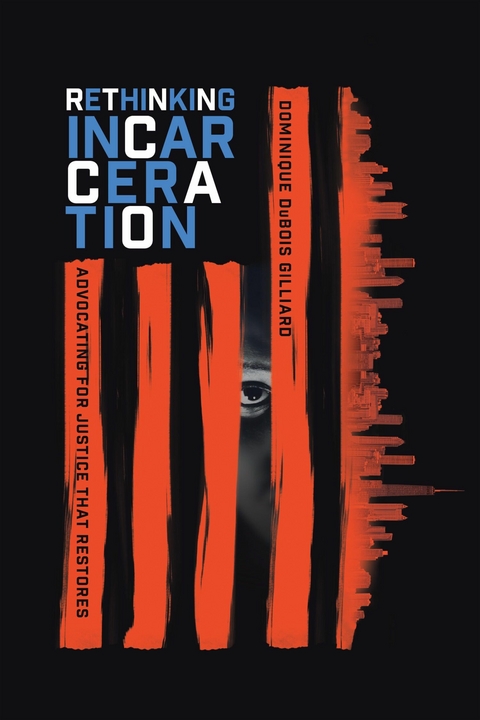
Rethinking Incarceration (eBook)
240 Seiten
IVP (Verlag)
978-0-8308-8773-6 (ISBN)
Dominique DuBois Gilliard is the director of racial righteousness and reconciliation for the Love Mercy Do Justice (LMDJ) initiative of the Evangelical Covenant Church (ECC). He serves on the boards of directors for the Christian Community Development Association and Evangelicals for Justice. In 2015, he was selected as one of the ECC's '40 Under 40' leaders to watch, and the Huffington Post named him one of the 'Black Christian Leaders Changing the World.' An ordained minister, Gilliard has served in pastoral ministry in Atlanta, Chicago, and Oakland. He was executive pastor of New Hope Covenant Church in Oakland, California and also served in Oakland as the associate pastor of Convergence Covenant Church. He was also the campus minister at North Park University and the racial righteousness director for ECC's ministry initiatives in the Pacific Southwest Conference. With articles published in the CCDA Theology Journal, The Covenant Quarterly, and Sojourners, Gilliard has also blogged for Christianity Today, Faith & Leadership, Red Letter Christians, Do Justice, and The Junia Project. He earned a bachelor's degree in African American Studies from Georgia State University and a master's degree in history from East Tennessee State University, with an emphasis on race, gender, and class in the United States. He also earned an MDiv from North Park Seminary, where he served as an adjunct professor teaching Christian ethics, theology, and reconciliation.
Dominique DuBois Gilliard is the director of racial righteousness and reconciliation for the Love Mercy Do Justice (LMDJ) initiative of the Evangelical Covenant Church (ECC). He serves on the boards of directors for the Christian Community Development Association and Evangelicals for Justice. In 2015, he was selected as one of the ECC's "40 Under 40" leaders to watch, and the Huffington Post named him one of the "Black Christian Leaders Changing the World." An ordained minister, Gilliard has served in pastoral ministry in Atlanta, Chicago, and Oakland. He was executive pastor of New Hope Covenant Church in Oakland, California and also served in Oakland as the associate pastor of Convergence Covenant Church. He was also the campus minister at North Park University and the racial righteousness director for ECC's ministry initiatives in the Pacific Southwest Conference. With articles published in the CCDA Theology Journal, The Covenant Quarterly, and Sojourners, Gilliard has also blogged for Christianity Today, Faith & Leadership, Red Letter Christians, Do Justice, and The Junia Project. He earned a bachelor's degree in African American Studies from Georgia State University and a master's degree in history from East Tennessee State University, with an emphasis on race, gender, and class in the United States. He also earned an MDiv from North Park Seminary, where he served as an adjunct professor teaching Christian ethics, theology, and reconciliation.
INTRODUCTION
I MUST CONFESS THAT I STRUGGLED writing this book. Throughout the process I experienced a deep, lingering dissonance. My unrest emanated from knowing that mass incarceration is decimating communities, and yet I felt—at times—as if it is not the most urgent issue facing us today. Amid a racial nadir, it has been arduous investing my time, emotions, and heart in a project that does not explicitly name the elephant in the room. To write a book that does not explicitly address police brutality; the copious number of unarmed black, brown, and native lives lost to it; and the xenophobia spreading throughout our nation like a cancer felt disingenuous and unfaithful.
These are perilous times! I, along with much of the African American community, am living in a perpetual state of trauma resonant of this haunting line from Hamilton: “I imagine death so much it feels more like a memory / When is it gonna get me?”1 I lose sleep contemplating this question. I feel paralyzed by its gravity, particularly as I pray for family members with cognitive impairments. The stress, strain, and anxiety of feeling as if there is a target on your back is debilitating. While composing this book, I repeatedly found myself paralyzed by trauma, unable to muster meaningful words. In those moments, even the most mundane tasks proved to be unbearable.
Between the World and Me is an evocative letter written by Ta-Nehisi Coates to his son about the dystopian reality of growing up black in the United States. Coates, paralleling his own experience to his son’s, writes,
The law did not protect us. And now, in your time, the law has become an excuse for stopping and frisking you, which is to say, for furthering the assault on your body. But a society that protects some people through a safety net of schools, government-backed home loans, and ancestral wealth but can only protect you with a club of criminal justice has either failed at enforcing its good intentions or has succeeded at something much darker. However you call it, the result was our infirmity before the criminal forces of the world. It does not matter if the agent of those forces is white or black—what matters is our condition, what matters is the system that makes your body breakable.2
As Coates explains, black bodies have historically evoked a peculiar surveillance and a distinctive enforcement of the law. From the beginnings of vocational policing, where some officers functioned as slave catchers, to the Jim Crow era, where cops rigidly enforced racial purity boundaries, police have frequently functioned as a colonial presence within black communities. Princeton professor Mark Lewis Taylor writes, “The police are often the frontline for surveillance, control, and dissemination of terror in poor communities.”3
Within many impoverished communities of color, police are perceived and experienced as an alien, occupying force. This intensifies with each unsubstantiated stop-and-frisk, racist officer-involved text scandal, and unarmed citizen killed—prompting a new hashtag. Whether one affirms this perception of police or not, Scripture calls the church to seek to understand why entire communities feel this way. By meekly considering what has created this perception within many stigmatized communities, the church begins to seek the interest of others first, as Philippians 2 commissions the body to do. When the church takes this humble approach, we begin to take on the mindset of Christ.
Let me be crystal clear: police have a difficult job, one that most of us will never know the pressures of. I admire and respect the work of officers who uphold their sworn duty to protect and serve, those who patrol communities with dignity, integrity, and honor. I appreciate their daily sacrifice and deeply grieve the loss of their lives in the line of duty. These virtuous officers deserve our utmost respect, gratitude, and support.
Nevertheless, my admiration for upstanding officers cannot obscure the truth. We have systemic policing problems. While body camera, dash cams, and cell phone videos have recently exposed unethical policing practices and behavior to a broader segment of society, many of us know that these are not new realities. Furthermore, our policing problems are far more expansive than officers killing unarmed and mentally impaired citizens of color. Our policing problems—implicit bias, racial profiling, and the ethical abuse of power—are pervasive, and they cannot be reduced to a few rogue officers. Yes, bad apples must be expelled from law enforcement, but our challenges are institutional, and they are exacerbated by a lack of judicial accountability.
Policing failures are merely symptoms of problems inherent in our broader criminal justice system. Police bear a disproportionate share of the criticism for an inept system. In many ways, they have become the scapegoats of a morally bankrupt system. They are the whipping boys of a system marred by racial and class biases, breeding racial profiling and partial sentencing that has crescendoed into mass incarceration. This does not exonerate police—corrupt cops must be held accountable—but we must acknowledge that officers frequently carry more than their fair share of the blame within a system proven to be ethically and morally deficient.
Our nation’s overcrowded jails, prisons, and detention centers are an indictment of our criminal justice system. It is impossible to visit these institutions and not be struck by the inhumane treatment of the people serving time and the disproportionate number of black and brown bodies confined in cages like animals. These men and women are America’s latest crop of strange fruit.
THE REVELATION THAT BRED A REVOLUTION
In the groundbreaking book The New Jim Crow (2010), Michelle Alexander defines our prison system as a method of racially charged social control that creates “a lower caste of individuals who are permanently barred by law and custom from mainstream society.”4 While many knew our criminal justice system was flawed, virtually no one dared to ponder something this dire was transpiring in 2010. In fact, Alexander herself was initially skeptical of activists who connected mass incarceration to Jim Crow. She initially called their claims hyperbole and detrimental to the cause. However, as she formed relationships with people disenfranchised by the system, she was compelled to do more investigative research on their claims and started to see the system anew. Alexander, who was working as the director of the Racial Justice Project at the American Civil Liberties Union (ACLU) of Northern California, set the spark that has ignited a revolution.
Alexander begins her book by sharing the story of Jarvious Cotton, a disenfranchised black man. Alexander says, “Like his father, grandfather, great-grandfather, and great-great grandfather, he has been denied the right to participate in our electoral democracy.”5 Expanding the scope of her inquiry, she reveals that “today there are more African-American adults under correctional control, in prison or jail, on probation or parole, than were enslaved in 1850, a decade before the Civil War.”6 Honing in on how the War on Drugs has depleted the black community, Alexander notes that “in at least fifteen states, blacks are admitted to prison on drug charges at a rate from twenty to fifty-seven times greater than that of white men.”7 However, in spite of needed policy reforms, Alexander ultimately concludes that “all of the needed reforms have less to do with failed policies than a deeply flawed public consensus, one that is indifferent, at best, to the experience of poor people of color.”8
As a pastor, this haunted me. It lingered, and I kept thinking, If anyone should be leading the charge, demonstrating what a morally and ethically rooted public consensus consists of, it should be—it must be—the church! But as someone who has ministered in some of the cities most ravaged by mass incarceration (Atlanta, Chicago, and Oakland), I lamentably confess that we have failed to do this. Furthermore, I can attest that the church—broadly speaking—is still eerily silent, seven years later.
Bryan Stevenson’s Just Mercy picked up where The New Jim Crow left off, keeping mass incarceration on our national conscience. Just Mercy explores how mercy should inform our understanding of justice, causing us to see how our brokenness distorts what we understand and pursue as justice. Stevenson writes, “The power of just mercy is that it belongs to the undeserving. It’s when mercy is least expected that it’s most potent—strong enough to break the cycle of victimization and victimhood, retribution and suffering. It has the power to heal the psychic harm and injuries that lead to aggression and violence, abuse of power, mass incarceration.”9
Rethinking Incarceration picks up on Just Mercy’s ethos, illuminating restorative justice as a philosophical practice that enables Christians to practically embrace mercy as we pursue justice that reflects God’s heart. While it builds on both Alexander’s and Stevenson’s works, it is profoundly different. This book will frame mass incarceration theologically, examining the church’s role in its evolution and sustainment while advocating for an alternative, christocentric way to engage our criminal justice system.
This book provides a historical analysis of mass incarceration and a biblical basis for reframing how we think, teach, and preach about justice. It offers a new lens for interpreting how God’s justice is...
| Erscheint lt. Verlag | 2.3.2018 |
|---|---|
| Verlagsort | Lisle |
| Sprache | englisch |
| Themenwelt | Religion / Theologie ► Christentum ► Moraltheologie / Sozialethik |
| Recht / Steuern ► Strafrecht ► Kriminologie | |
| Sozialwissenschaften ► Politik / Verwaltung | |
| Wirtschaft | |
| Schlagworte | Behind bars • biblical justice • Call • call to justice • Christian justice • Church • Civil Rights • criminal • criminal justice system • detention • Discrimination • discuss • felon • felony • I'm Still Here • incarcerated • incarceration system • jail • Justice • Law • locked up • Mass Incarceration • meritocratic • New Jim Crow • Prison • Prison system • racial bias • racial inequality • respond • Restorative Justice • Social Justice • Social Policy • Systemic injustice • Theological • Theology • the sun does shine |
| ISBN-10 | 0-8308-8773-3 / 0830887733 |
| ISBN-13 | 978-0-8308-8773-6 / 9780830887736 |
| Informationen gemäß Produktsicherheitsverordnung (GPSR) | |
| Haben Sie eine Frage zum Produkt? |
 EPUB (Wasserzeichen)
DRM: Digitales Wasserzeichen
Dieses eBook enthält ein digitales Wasserzeichen und ist damit für Sie personalisiert. Bei einer missbräuchlichen Weitergabe des eBooks an Dritte ist eine Rückverfolgung an die Quelle möglich.
Dateiformat: EPUB (Electronic Publication)
EPUB ist ein offener Standard für eBooks und eignet sich besonders zur Darstellung von Belletristik und Sachbüchern. Der Fließtext wird dynamisch an die Display- und Schriftgröße angepasst. Auch für mobile Lesegeräte ist EPUB daher gut geeignet.
Systemvoraussetzungen:
PC/Mac: Mit einem PC oder Mac können Sie dieses eBook lesen. Sie benötigen dafür die kostenlose Software Adobe Digital Editions.
eReader: Dieses eBook kann mit (fast) allen eBook-Readern gelesen werden. Mit dem amazon-Kindle ist es aber nicht kompatibel.
Smartphone/Tablet: Egal ob Apple oder Android, dieses eBook können Sie lesen. Sie benötigen dafür eine kostenlose App.
Geräteliste und zusätzliche Hinweise
Buying eBooks from abroad
For tax law reasons we can sell eBooks just within Germany and Switzerland. Regrettably we cannot fulfill eBook-orders from other countries.
aus dem Bereich


