Zum Hauptinhalt springen
Nicht aus der Schweiz? Besuchen Sie lehmanns.de
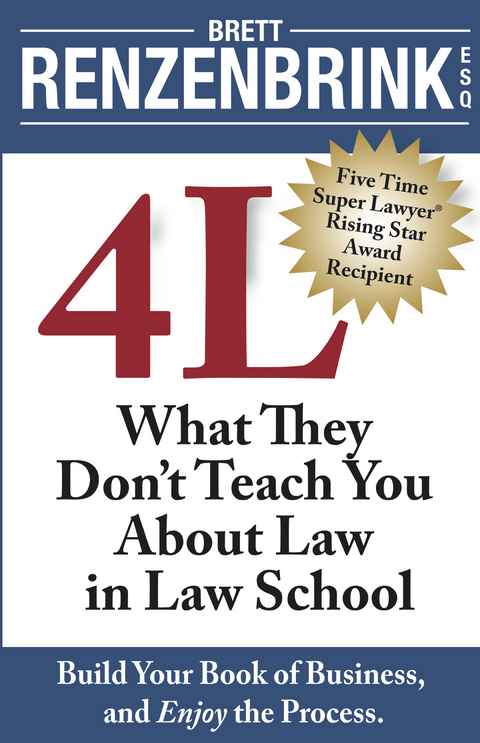
4 L -  Brett Renzenbrink

4 L (eBook)

What They Don't Teach You About Law in Law School
eBook Download: EPUB
2018 | 1. Auflage
187 Seiten
Cincinnati Book Publishing (Verlag)
978-0-9995747-8-2 (ISBN)
Systemvoraussetzungen
11,89 inkl. MwSt
(CHF 11,60)
Der eBook-Verkauf erfolgt durch die Lehmanns Media GmbH (Berlin) zum Preis in Euro inkl. MwSt.
  • Download sofort lieferbar
  • Zahlungsarten anzeigen
Brett Renzenbrink introduces his proven and revolutionary methods, which are designed to teach professionals how to amass, retain, and leverage a book of business. His techniques will enable you to become bulletproof at your firm, but more importantly, give you permission to do so in a manner that does not require any sacrifice of your core beliefs or quest for personal fulfillment. 4L fearlessly disrupts the conventional lessons taught to young lawyers about attracting prospective clients and offers new strategies that will make you re-think everything you know about what it takes to demand higher income, more success, and happiness from the Law. Brett will teach you how to become a rainmaker in the New Law landscape, a more volatile and inhospitable marketplace than it was even 10 years ago. Can it be learned? The answer is an unequivocal 'yes.' 4L is a must-read for current law students, recent graduates, and seasoned lawyers looking to evolve their approach to the law practice and to fast-track their journey toward more leverage, money, and happiness in their professional lives.
Brett Renzenbrink introduces his proven and revolutionary methods, which are designed to teach professionals how to amass, retain, and leverage a book of business. His techniques will enable you to become bulletproof at your firm, but more importantly, give you permission to do so in a manner that does not require any sacrifice of your core beliefs or quest for personal fulfillment. 4L fearlessly disrupts the conventional lessons taught to young lawyers about attracting prospective clients and offers new strategies that will make you re-think everything you know about what it takes to demand higher income, more success, and happiness from the Law. Brett will teach you how to become a rainmaker in the New Law landscape, a more volatile and inhospitable marketplace than it was even 10 years ago. Can it be learned? The answer is an unequivocal "e;yes."e; 4L is a must-read for current law students, recent graduates, and seasoned lawyers looking to evolve their approach to the law practice and to fast-track their journey toward more leverage, money, and happiness in their professional lives. "e;4L is a market reaction. Plain and simple."e; said Renzenbrink. "e;The practice of law has changed dramatically in the last 10 years, and so must we."e; The book originated as a blog, "e;The Legonomist"e;, that focused on analyzing non-legal factors that impact not how Law is practiced, but deployed as a business. As Renzenbrink recalls, the mission change literally overnight early in 2017. "e;On May 1, 2017, my life changed forever. I went to bed the night before fine, and woke up with permanent facial paralysis on the right side of my face."e; Renzenbrink found out later after visiting multiple doctors that he had what was called "e;Bell's Palsy"e;, a mysterious type of facial paralysis that occurs suddenly without warning, and about which there is very little understanding in the medical community. If this all sounds familiar, it is because Bell's Palsy is the same affliction that movie star, Angelina Jolie, described having in a recent press conference. Renzenbrink has a different take on the permanent effects of the disease, and accepted what he considered the challenge from God. "e;I was depressed. I couldn't work, or eat, or sleep, or smile, or have any use of my right eye. Then, it hit me. This disease was God slapping me in the face and teaching me that I've spent too much time and effort suppressing my self-expression as a lawyer. It's time to build this thing, and do it in a way where I'm not compromising myself."e;In legal educational, most law students (at least in the United States) track their development as a lawyer by numerical year (or 1L, 2L, 3L denoting what year of law school they are in). "e;4L"e; is Renzenbrink's version of education that extends passed the 3rd year of law school into the real-world practice of law. In this first installment, 4L focuses on "e;client development"e; (or recruitment and retention of clients) but Renzenbrink's plan is to create a series with multiple installments. If you speak to Brett, it almost hard to discern that he's an actual attorney. As Renzenbrink says, "e;I'm an advocate. I don't practice law, I deploy it. There are multiple other factors, non-legal factors,that go into valuable guidance to clients. I call the bigger subject "e;Legonomics"e;, which is the study of how non-legal factors can impact or control the 'correct' legal advice"e;. He also has an overt mission of empowering people to build a successful practice, doing it their way, and in a manner where they have the ability to enjoy the process. Renzenbrink made his mission clear, announcing recently that 10% of all book profits will be donated to the "e;Lawyer Assistance Program"e; in each state where the book is sold.

AUTHOR’S PREFACE
Abraham Lincoln is dead. There, I said it. And so is the practice of law as Abe knew it.
Lawyers no longer must step foot in a library, Juris Doctorate is no longer a distinction held aloft by chosen few, and apprenticeship is a premise that only exists on reality television. (Or at least it did before Donald Trump “got fired” and became President.)
It only took the market a half-century to catch up, but it’s over. So, get over it.
Lawyers today don’t even know how to describe what it is that they do. Have you ever stopped to think that there really isn’t a term for The Practice of Law other than The Practice of Law?
Our profession has been around for hundreds of years, and has anyone in the history of law ever stopped to think that there isn’t a nice, neat term for what we do on a day-to-day basis? We say that we practice law, but is that really true? The reality is what we actually do is something far from what we say.
Law is a subject. It’s a body of knowledge. Law, in its purest form, is the achievement of results arising from an understanding or interpretation of precedents and statutes, and the generation of the principled result.
But In the real world, (and certainly in the real world of the twenty- first century) principle and principal often come in conflict. It is not the pursuit of law, but the deployment of it that we actually do.
If I asked a lawyer what questions could be asked that would be answered, it depends, the lawyer would likely answer, “Well, it depends.”
It’s become cliché that lawyers give this two-word, $200 an hour answer to virtually every question that a client could ever ask. It drives people insane because they believe that lawyers should be able to provide them with an up-or-down, right-or-wrong response to any legal question.
That would make sense, but for the fact that most lawyers don’t practice law.
They don’t view things strictly through a lens of legal rightness or wrongness. There are 500 shades of gray in every legal question and most factors being considered have very little to do with the law itself.
So, in some ways, it depends is typically the right answer.
There have been thousands of studies that attempt to identify common denominators of truly successful businesses, in a Fortune 500 sense. I’ve only seen one that I believe: Openness to change.
Staying stagnant is impossible in an ever-changing world. Either change with it, or allow it to change without you. As one of my mentors would say, “You are either green and growing, Brett, or ripe and rotting.” You can never permit yourself to fully arrive, because every time you take five minutes to congratulate yourself, you are six minutes further behind.
I can hear Big Law partners now: “I provide legal services. The only people who buy it are people that need it. It’s the same product that we’ve sold for hundreds of years. If it ain’t broke, don’t fix it.”
News flash: The VHS wasn’t broken when they invented the DVD. DVDs weren’t broken when Netflix came out. It’s borderline creepy to be in a car with someone who pulls out a CD book rather than popping on Spotify or Sirius—but the CD still works just fine.
The point is that today’s titans of industry evolve even when evolution isn’t necessary.
I remember when the iPad first came out. My first thought seriously was, “Who is going to pay money for a giant cell phone that can’t make calls?” As of the date that I write this, the iPad has sold nearly a half billion dollars’ worth of product. Sure, people didn’t need it— but they sure bought the ever-loving hell out of it.
Other professional service industries innovate regularly. Doctors come up with new procedures for treating and preventing common ailments every day. CPAs and financial service providers will each sell you on a new product that is both unique to their particular firm and revolutionary as an investment or tax strategy.
We lawyers, however, continue to sell the exact same thing that we have for centuries without even an attempt to innovate. Sure, people now have different modes of communicating their services (such as slick websites and social media), but that—at best—was a reaction to marketing efficiencies and deals more with the recruitment of prospective clients than the deliverables transmitted.
Think about it. Lawyers are the only people that have not professionally innovated at all in the last 250 years. Maybe history teachers haven’t changed much, either—but that’s their job: To tell people about history, and then—after that—tell a new group of people about history.
Whether you practice in domestic relations, personal injury, tax, corporate, estate planning, probate, it doesn’t matter. In fact, lawyers actually devolve more than we evolve. The more that we practice in a similar fashion and receive the same result, we become more deeply entrenched in precedent and boilerplate—and never think for a second that just because something has been done the same way for hundreds of years, does not necessarily mean that it has to be done that way.
What we fail to recognize is that this is a set up, and we all will be the victims of our own design. By being so blindly consistent and predictable, we are boiling ourselves down to our common denominators. We are automating ourselves. That not only makes us easy to knock off, but also makes us individually miserable and unfulfilled in the process.
Our arrogance and insistence that we don’t need to operate as a business—but only as a profession—has created the monster that we all must now confront and overcome.
That’s the what of this book. So, what’s the why? Why have the audacity to publish a book that attacks the foundations of a profession that provided my livelihood and platform for success? What’s the point?
On May 1, 2017, my life changed forever. I went to bed that night and woke up without the ability to move half of my face. Literally.
I learned later that I have what’s called Bell’s Palsy, which means that my facial nerve doesn’t communicate properly with my face and prevents me from moving anything on the right side. My mouth, my nose, my eye—all without the ability to move.
I couldn’t sleep. Couldn’t eat. Couldn’t speak. Nothing.
It took me months to realize it, but that night, I believe that a divine force slapped me in the face and woke me from a decade-long professional slumber.
The symptoms, causes, recovery timetables, everything about Bell’s Palsy is a mystery to the medical community. There is one consequence, though, that I can absolutely say without question will occur if you have it: Suppressed expression.
Bell’s Palsy was a physical manifestation of what I was already experiencing in my professional career. A divine force was telling me, “This disorder is you—the choices you’ve made to further your career by compromising your free expression in the process.”
I have gotten far in my career in a short period of time, but I have not always been true to myself in the process. I’ve stifled parts of myself that I felt were not productive. I let the external pressures applied by my profession and peers dictate how I am now permitted to express who I am.
It hit me. I had professional Bell’s Palsy long before I was ever diagnosed.
I am required, then—if for no other reason than that I don’t want to get slapped by God again—to reach out to those individuals who feel similarly constricted in our profession, to call out those traditional forces that perpetuate the problem, and to explore how regaining our sense of self in the process can make us both more successful and more actualized in that success.
Disrupting the practice of law is not part of that why. Disruption, though, can be a useful tool, especially when this book’s primary objective—amassing a book of business, and enjoying every minute of it—is being disrupted by pressure to adhere to antiquated legal traditions and ideals.
In other words, the law disrupted our capacity to be successful and happy first. All we are doing is disrupting back.
We have an opportunity (and have earned that opportunity with grit, fire, and, of course, hundreds of thousands of dollars in student loans) to become the master of professional destiny, make a dramatic, positive impact on the world in which we live, create a legacy for ourselves that lives long beyond our years. Oh yeah, and we make pretty good money doing it.
But these spoils are increasingly coming with the prospect of a rewired thought processes, resulting in compromised moral caliber and de-prioritization of self, family, and happiness.
Enter, 4L.
The 4L structure requires that we look at Number One Second and start by analyzing others first. What is the DNA profile of our prospective clients? What makes them tick? Where do they come from in the first place?
In Section One, the analysis is inward. Our...

Erscheint lt. Verlag 20.3.2018
Sprache englisch
Themenwelt Recht / Steuern
ISBN-10 0-9995747-8-7 / 0999574787
ISBN-13 978-0-9995747-8-2 / 9780999574782
Informationen gemäß Produktsicherheitsverordnung (GPSR)
Haben Sie eine Frage zum Produkt?
EPUBEPUB (Ohne DRM)
Größe: 274 KB

Digital Rights Management: ohne DRM
Dieses eBook enthält kein DRM oder Kopier­schutz. Eine Weiter­gabe an Dritte ist jedoch rechtlich nicht zulässig, weil Sie beim Kauf nur die Rechte an der persön­lichen Nutzung erwerben.

Dateiformat: EPUB (Electronic Publication)
EPUB ist ein offener Standard für eBooks und eignet sich besonders zur Darstellung von Belle­tristik und Sach­büchern. Der Fließ­text wird dynamisch an die Display- und Schrift­größe ange­passt. Auch für mobile Lese­geräte ist EPUB daher gut geeignet.

Systemvoraussetzungen:
PC/Mac: Mit einem PC oder Mac können Sie dieses eBook lesen. Sie benötigen dafür die kostenlose Software Adobe Digital Editions.
eReader: Dieses eBook kann mit (fast) allen eBook-Readern gelesen werden. Mit dem amazon-Kindle ist es aber nicht kompatibel.
Smartphone/Tablet: Egal ob Apple oder Android, dieses eBook können Sie lesen. Sie benötigen dafür eine kostenlose App.
Geräteliste und zusätzliche Hinweise

Buying eBooks from abroad
For tax law reasons we can sell eBooks just within Germany and Switzerland. Regrettably we cannot fulfill eBook-orders from other countries.

Mehr entdecken
aus dem Bereich
Ratgeber mit Mustern, Beispielen und Rechtsprechungshinweisen

von Eugen Ehmann

eBook Download (2025)
Richard Boorberg Verlag
CHF 37,95

von Sascha Bleschick; Ingo Oellerich

eBook Download (2025)
Richard Boorberg Verlag GmbH & Co KG
CHF 28,30